



Just imagine entering a world where there is an integration of digital and reality. From interactive product demonstrations to industrial training simulations, immersive technology is changing the way users perceive digital systems.
In the case of startups that are developing a minimum viable product, it is not a technical decision but a strategic one of whether to use virtual reality or augmented reality. Development cost, user adoption, hardware requirements, and long-term ROI are influenced by this choice.
Here we are going to deconstruct the difference between AR and VR, present real-life examples, and give some practical advice to make the right decision when it comes to selecting the immersive technology to include in your MVP.
Understanding the Core Technologies
To make a decision about AR vs VR, you need to learn how each of the technologies operates technically.
What Is Virtual Reality
Virtual reality develops a completely sentient virtual space that substitutes the real physical environment of the user. Using head-mounted devices like the Meta Quest or HTC Vive, users are transported into a 3D world created in a computer with real-time graphics processing engines like Unity or Unreal Engine.
VR simulations are done with spatial tracking, motion controllers, stereoscopic displays, and 6DoF tracking to provide a simulated presence. The user is completely insulated from the real world.
This is the basis point in case somebody poses a question as to what the difference between AR and VR is. VR replaces reality.
What Is Augmented Reality
AR superimposes digital content over the physical environment with the help of such gadgets as smartphones, tablets, or AR goggles. Augmented reality does not augment the environment but improves it by means of computer vision, object recognition, and spatial mapping.
AR involves such technologies as SLAM, LiDAR scanning, and markerless tracking to position virtual objects in real space.
This is one of the main distinctions that should be remembered when we compare augmented reality and virtual reality. AR can be used to strengthen reality, whereas VR substitutes it.
The Difference Between Virtual Reality and Augmented Reality
In order to make an informed decision about MVP, you should have a clear understanding of what virtual reality versus augmented reality is, not just simple definitions.
The difference has an effect on user experience, infrastructure needs, scalability, and, in the long run, the success of your product in the market.
Dimension |
Virtual Reality |
Augmented Reality |
|
Core Experience |
Creates a fully simulated 3D environment that replaces physical surroundings |
Enhances the real world by layering contextual digital elements |
|
Level of Immersion |
High immersion with complete sensory engagement |
Moderate immersion that blends digital with physical context |
|
Hardware Dependency |
Requires dedicated VR headsets and motion controllers |
Runs on smartphones, tablets, or AR smart glasses |
| User Environment |
Requires controlled physical space for movement |
Works within the user’s existing real-world setting |
|
Interaction Model |
Gesture tracking, hand controllers, spatial locomotion |
Touch input, camera scanning, spatial anchoring |
|
Technical Stack |
Game engines, real-time rendering pipelines, physics simulation |
Computer vision, SLAM algorithms, object recognition |
|
Deployment Scalability |
Limited by headset adoption rates |
Scalable through existing mobile device penetration |
|
Primary Use Cases |
Training simulations, immersive gaming, virtual walkthroughs |
Retail previews, navigation overlays, and interactive education |
| Development Cost |
Higher initial production due to 3D asset creation |
Moderate cost depending on tracking and device compatibility |
|
Learning Curve |
Users must adapt to immersive navigation |
Minimal learning curve due to familiar mobile interface |
AR can speed up adoption and validation out of frictionless access when your audience is mobile-first. Nevertheless, VR allows a level of depth and interaction that cannot be achieved with other products unless your product depends on immersive simulations, sophisticated spatial interaction, or experiential storytelling.
Read More: 40 Best Technology Stacks for Mobile App Development
Market Growth and Industry Trends
Market data and adoption trends should also be a factor in choosing VR vs AR.
Statista forecasts the world AR and VR market to be more than 96 billion USD in 2029.
A different report by Statista indicates that by the year 2024, the global AR user base would have reached over 1.7 billion users.
Comparatively, the penetration of VR users is still low because it is hardware-dependent, but its usage is gradually increasing in enterprises.
These figures bring out a significant point. AR is at present enjoying the advantages of being able to scale to smartphones, whereas VR performs well in business and expert settings.
Virtual Reality vs Augmented Reality for MVP Development
The considerations you should make when considering virtual reality and augmented reality in your MVP revolve around the speed of validation and usability.
MVP is created to test hypotheses. Therefore, ask yourself:
- Do users need full immersion?
- Are they easily able to access the necessary hardware?
- Does your core value have any ties to real-world context?
We may divide this into smaller parts.
When VR Makes Sense for Your MVP
The VR app development would be optimal when:
- You are creating healthcare, aviation, or manufacturing simulation-based training.
- Your product relies on the notion of spatial immersion and realistic 3D settings.
- The user experience needs to be undistracted.
To illustrate, a client of our enterprise had the need to have a VR training solution to minimize the onboarding mistakes in the case of machine handling. The retention of the traditional video training was low.
We created a VR simulator with interactiveness, real-time error reporting, and performance analysis. Consequently, the time spent on training was decreased by fifty percent, and the error in operations declined drastically.
This is an illustration of the ability of immersive learning to address quantifiable business issues.
When AR Is Better for Your MVP
AR app development should be developed when:
- Your users are dependent on mobile gadgets.
- The product complements real-life interactions.
- You demand accelerated implementation without hardware restrictions.
The retail brands leverage the AR concepts, such as virtual try-on sessions. AR is used to superimpose interior designs onto physical space by real estate companies. AR in startups in healthcare is used to visualize anatomy in real time.
Should you still be in doubt as to which between AR and VR is superior, it will still be up to your audience to find out.
Read More: Best Scalable Ecommerce Technology Stack for Enterprise
AR vs VR in Cost and Development Complexity
MVPs are highly concerned with costs.
The VR app development usually includes:
- High-fidelity 3D modeling
- Physics engines
- Optimization of real-time rendering
- Dedicated headset testing
This is capable of escalating production costs and development cycles.
AR app development involves:
- Computer vision implementation
- Camera calibration
- Cross-device compatibility
- Online content management
Though AR may be less expensive in the short run, more complicated object tracking or enterprise-level AR could also prove to be expensive.
Regarding validation, AR can enable faster go-to-market implementation because of mobile accessibility.
Augmented Reality vs Virtual Reality Examples
The knowledge of augmented reality vs virtual reality examples may help to understand where to go.
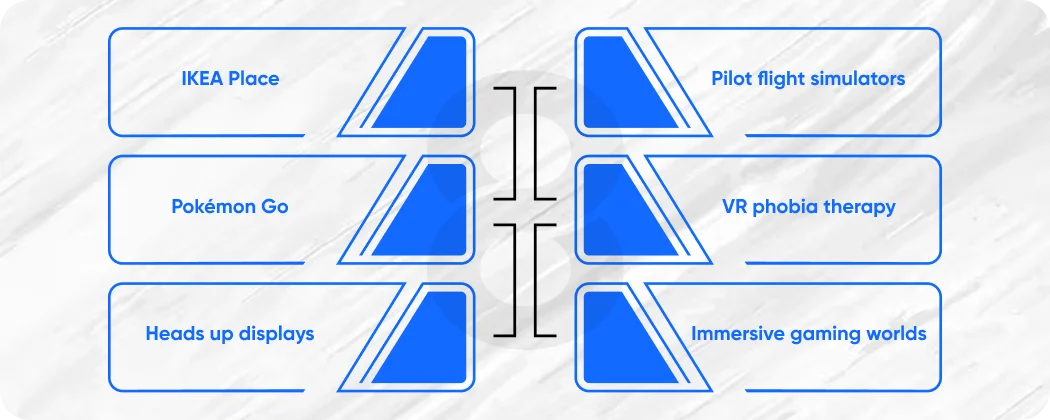
Augmented Reality Examples:
- The IKEA Place app will enable the customer to see furniture in their homes
- Pokémon Go superimposes virtual animals in the physical world
- AR is applied in automotive firms in the case of heads-up displays
Virtual Reality Examples:
- Pilot training flight simulators
- Phobia treatment VR therapy sessions
- Simulative gaming spaces
These have varied behavioral needs. This is why, in the comparison between augmented reality and virtual reality, you should adjust your goal of the MVP to the behavior of the user.
Conversion Focused Product Thinking
Technology should be able to produce quantifiable results as far as business is concerned.
Ask:
- Does the immersive layer improve the retention of users?
- Is it reducing the sales process?
- Does it lower the cost of operation?
To an individual retail customer, we have experimented with both AR and non-AR product previews. The AR edition boosted the conversion rates by a margin of 22 percent since customers were able to see the size of products in their homes. This enhanced buying confidence.
That is what makes you incorporate immersive technology into a conversion-motivated strategy instead of constructing it as a novelty.
Augmented Reality Ideas for MVPs
Some examples of realistic augmented reality ideas are:
- Online fashion product trial
- Engaging package experiences
- Textbook overlays of AR
- Real estate imaging software
These concepts will be especially effective when mobile interaction is the main channel.
Read More: How Much Does Augmented Reality App Development Cost?
Virtual Reality Ideas for MVPs
Now, assume the following ideas of virtual reality:
- Training simulations in the field of industrial safety
- Virtual onboarding programs
- On-site property tours
- Exposure to therapy and mental health
VR generates intense concentration and emotional involvement. That is potent for certain verticals.
What Is the Difference Between AR and VR in User Experience
In case a person inquires, what is the distinction between AR and VR from a UX perspective? The following is a better clarifying explanation.
AR enriches the physical environment of the user with an overlay of digital contextual data that is interacted with in an environment familiar to the user, without interfering with normal work processes, movement, and awareness of the real environment.
Virtual reality necessitates the user to immerse themselves in a fully simulated world using specific hardware, with the necessity of a high level of concentration, restricted physical space, and total isolation of the environment.
In the case of MVPs that aim at mass adoption, user-friendliness, low hardware, and frictionless onboarding usually have an important impact on user adoption and retention in the long run.
Read More: MVP Development Cost 2026 – The Executive’s Budgeting Guide
Technical Infrastructure Considerations
Comparing VR and AR, consider the infrastructure needs.
VR requires:
- GPU-intensive rendering
- Motion tracking systems
- Latency optimization
- High-resolution texture mapping
AR requires:
- Optimization of camera processing
- Real-time object detection
- Environmental mapping
- Multi-device compatibility
The two need a scalable backend architecture in case your product deals with user-generated information or analytics.
Which Is Better AR or VR for Your MVP
The decision of which one to use between AR and VR in your MVP should not be made based on hype or tendency. It relates immersive technology to your product vision, target audience behavior, and quantifiable business results.
Whether AR or VR is superior or not has no universal solution.
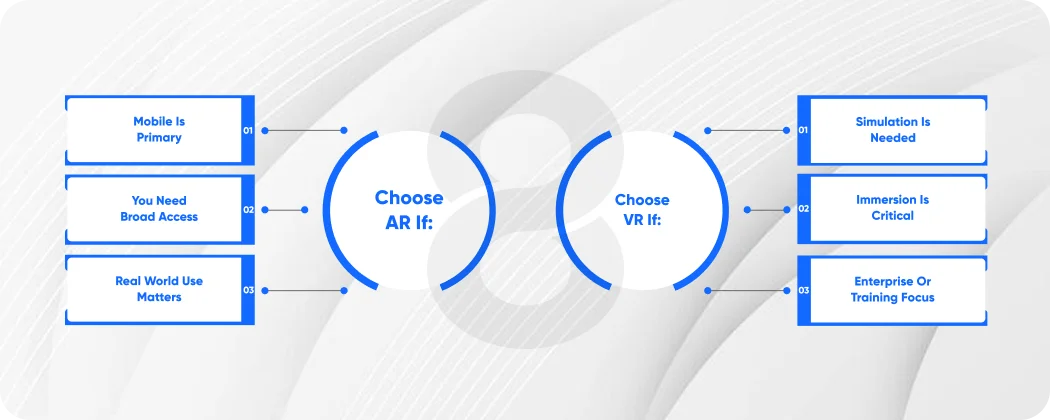
Choose AR if:
- You want mass accessibility
- Mobile is the first trend for your audience
- Your product increases real-life interaction
Choose VR if:
- You need deep immersion
- Simulation is required in your industry
- You are aiming at the business or the training industries
Finally, the virtual reality vs. augmented reality discussion should be based on your business purpose, users, scale, development objectives, and future expansion strategy rather than the technology consideration.
Your Strategic Partner for AR and VR MVP Development
Virtual reality vs augmented reality is a decision that cannot be made with more than a comparison between these two concepts, which are technical in nature. It requires a partner that is knowledgeable in product strategy, user behavior, and scalable architecture.
Our team is aimed at matching immersive technology and quantifiable business results. Regardless of whether you need mobile access with the assistance of the AR app development or simulation-based experiences with the help of VR app development, we are more concerned with performance, usability, and validation.
The goal is simple: to turn your MVP into a high-impact, revenue-generating digital product.
Final Thoughts: Making the Strategic Choice
The virtual reality vs. augmented reality debate is not based on trends but on strategic alignment. Both technologies will push the engagement, and only one of them will align with your MVP goals.
AR will usually be the smarter tool should you require a quick adoption and real-world integration. VR is more impactful in case immersion and the level of simulation are critical. Look at your main issue, authenticate the user requirements, and select the technology that will help to bring quantifiable business results.