


Ask five agencies to quote the same VR project and you will get different numbers that look like they belong to five different projects. One says $30K. Another says $300K. Nobody explains the gap, and you are left wondering whether you are being lowballed on quality or overcharged for a logo on a slide deck.
This guide exists to close that gap. It breaks down VR app development costs complexity tier, individual feature, platform, team structure, and industry, along with realistic timelines for each phase of a build. The estimates here come from how we scope VR projects at 8ration. Treat the numbers as a frame of reference for your own quotes.
What is VR App Development
VR app development is the process of building software for head-mounted displays and spatial computing environments, where the user is placed inside a rendered 3D world instead of looking at one through a flat screen. A VR app tracks head and hand movement, renders two slightly different images for each eye, and has to do all of it fast enough that the user’s inner ear does not file a complaint.
It sits next to two related disciplines that get confused with it constantly. AR app development overlays digital content on the real world through a phone camera or glasses. Mixed reality blends the two… anchoring virtual objects to physical space so they interact with real surfaces. VR is the fully immersive end of that spectrum and the major platforms right now are Meta Quest, Apple Vision Pro, PlayStation VR2, SteamVR, and WebXR.
The money says this stopped being an experiment a while ago. Grand View Research put the global VR market at $59.96 billion in 2022 and expects $435.36 billion by 2030, which works out to 27.5 percent growth a year, the kind of curve that gets a line item approved without much of a fight.
Headsets are moving too. IDC counted roughly 14.5 million XR devices shipped in 2025, up 41.6 percent on the year before. None of which answers the only question that matters to someone holding a budget, so let’s get to the numbers.
Types of VR Apps and How They Affect Cost
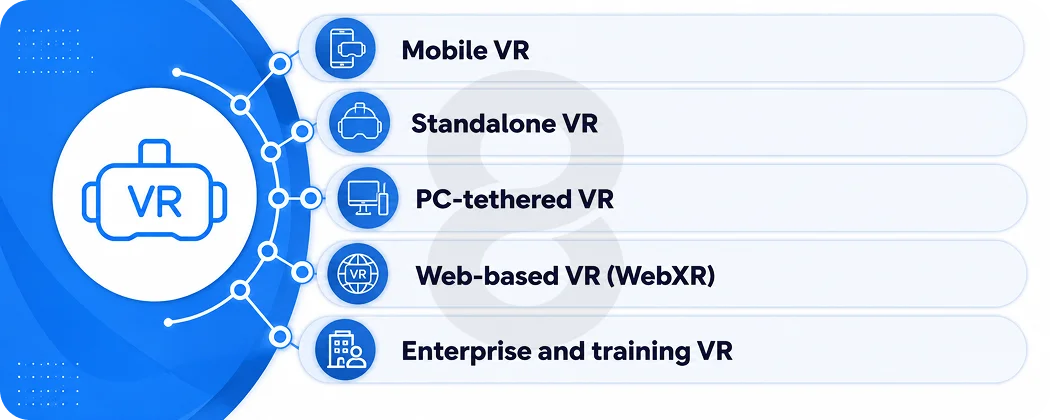
Cost conversations go sideways when both parties are picturing a different kind of VR app. These are the five categories that actually matter for budgeting.
Mobile VR
The phone-in-a-plastic-viewer setup that Google Cardboard made famous. Cheap to build and distribute… and honestly a bit of a dead end. Rendering demands are light, so the price sits at the bottom of the market, but so does the immersion and the category keeps shrinking as standalone headsets drift under the $300 mark.
Standalone VR
Meta Quest 2, Quest 3, Pico 4. Self-contained headsets, no PC, no cable. When a client shows up with a commercial VR idea and no strong platform opinion, this is where the project ends up, because the install base is the biggest and the developer tooling has had years to shake its bugs out. Cost-wise it’s the middle of the road, and the middle of the road is exactly where most business projects belong.
PC-tethered VR
Valve Index, HTC Vive Pro, anything that needs a gaming PC humming next to it. All that horsepower buys high-fidelity simulation and serious enterprise visualization, and you pay for it twice, once in steeper performance targets and again in the highest development bills of any category on this page.
Web-based VR (WebXR)
VR that runs in a browser, built on Three.js, A-Frame, or Babylon.js. Nobody downloads anything. The same build works on a headset, a phone, and a laptop, which is a genuinely underrated distribution story. You give up some visual fidelity, and the price tag gives a chunk of that back.
Enterprise and training VR
Custom-built simulations for onboarding, safety drills, and skills training, often with LMS integration, compliance reporting, and fleet device management attached. Per-project complexity is the highest here. The payoff is real, though: PwC’s VR soft skills training study found that learners completed VR training four times faster than classroom training and were 275 percent more confident applying what they learned.
| VR App Type | Typical Cost Range | Primary Use Case |
|---|---|---|
| Mobile VR | $10,000–$30,000 | Marketing Experiences & Simple 360° Tours |
| Standalone VR | $25,000–$150,000 | Commercial Apps, Training & Games |
| PC-Tethered VR | $60,000–$300,000+ | High-End Simulation & Enterprise Visualization |
| WebXR | $15,000–$70,000 | Product Showcases, Virtual Tours & Events |
| Enterprise / Training VR | $80,000–$500,000+ | Workforce Training, Safety & Compliance |
How Much Does VR App Development Cost
VR app development costs anywhere from $20K to $500K and up. On its own that range is useless, so here is how it actually splits. A basic single-platform app lands between $20K and $60K.
Custom environments and richer interaction move you into $60K to $150K territory and enterprise builds with multi-user support and backend integrations start around $150K.
The tiers aren’t arbitrary. Each one maps to specific decisions and the rest of this section walks through what bumps a project from one bracket into the next.
Basic VR app
Expect $20K to $60K and a two to four months build. What that money buys is deliberately narrow: one platform, a handful of scenes, gaze or simple controller input, and 3D assets pulled mostly from existing libraries. Plenty of useful products live happily inside those limits. A virtual showroom does. So does a 360° property walkthrough, or a single well-made training scenario.
Mid-tier VR app
Expect $60K to $150K over four to seven months. Multi-scene experiences, full controller and hand interaction, custom 3D environments, user accounts, and some personalization. Most serious commercial VR products, from branded experiences to multi-module training programs, land in this tier.
Enterprise VR app
Expect $150K to $500K or more, over seven months to a year and sometimes longer. This is the point where the project stops being an app and starts being a program. Here’s the part that catches buyers off guard. The integration and compliance work can cost as much as the immersive content itself, and almost nobody budgets for that on the first pass.
| Tier | What’s Included | Estimated Cost | Typical Timeline |
|---|---|---|---|
| Basic | Single platform, limited scenes, stock assets, simple interaction | $20,000 – $60,000 | 2 – 4 months |
| Mid-tier | Custom environments, full interaction, accounts, personalization | $60,000 – $150,000 | 4 – 7 months |
| Enterprise | Multi-user, analytics, LMS/CRM integration, device management | $150,000 – $500,000+ | 7 – 12+ months |
VR App Development Cost by Feature
Tiers are useful for orientation, but budgets are actually built feature by feature. Here is where the money goes.
3D environment and world-building
The single biggest variable in most VR budgets. Licensed asset libraries can furnish a scene for a few thousand dollars. Meanwhile, fully custom environments modeled and optimized from scratch can consume $10K to $60K on their own. Optimization matters as much as artistry, since every asset has to hold a stable frame rate on mobile-class chips.
User interaction and controller mapping
Ray-casting for menus, physics-based object grabbing, hand tracking, and haptic feedback each add their own development and testing load. Basic controller support is table stakes. Natural hand interaction that feels right takes iteration, and iteration is billable hours.
Multiplayer and social features
Real-time position synchronization and avatar systems make multiplayer the most expensive standalone feature category, commonly adding $30K to $100K or more. Networked physics in VR is unforgiving, because latency that a flat-screen game tolerates reads as broken in a headset.
AI-driven experiences
Adaptive difficulty, conversational NPCs, and personalization engines are moving from novelty to expectation, especially in training products where scenarios should respond to the learner. This layer typically draws on dedicated AI development work alongside the VR build, adding roughly $20,000 to $80,000 depending on how much intelligence the experience needs.
VR streaming and video integration
360° video playback, live event streaming, and spatial audio pipelines sit in the middle of the cost range. The engineering is well understood, but bandwidth handling and video quality tuning for stereoscopic playback still take real work.
Analytics and performance dashboards
Telemetry, gaze and interaction heatmaps, completion tracking, hooks into whatever LMS the client already runs. If you’re an enterprise buyer, skip the “optional” framing entirely. Come renewal season, a training program with no numbers behind it is the first thing finance cuts, and they won’t feel bad about it.
Cross-platform compatibility
OpenXR makes it possible to serve Quest, Vision Pro, and SteamVR from one codebase, and “possible” is doing some quiet work in that sentence. Every extra target still wants its own optimization pass, its own input mapping, its own store submission.
Budget a 20 to 40 percent premium over a single-platform build. It’s the same math as conventional cross-platform app development, really. One codebase saves you from building twice, and the abstraction sends you a bill anyway.
| Feature | Development Complexity | Estimated Cost Add-on |
|---|---|---|
| Custom 3D environments | High | $10,000 – $60,000 |
| Controller & interaction mapping | Medium | $5,000 – $20,000 |
| Hand tracking & haptics | Medium | $8,000 – $25,000 |
| Multiplayer & social | Very high | $30,000 – $100,000+ |
| AI-driven behavior | High | $20,000 – $80,000 |
| 360° video & streaming | Medium | $10,000 – $40,000 |
| Analytics & dashboards | Medium | $8,000 – $30,000 |
| Cross-platform support | Medium-high | +20% – 40% of build |
VR App Development Cost by Platform
Pick a platform and you’ve picked a tech stack, a certification process, and a decent chunk of your budget, all before anyone writes a line of code.
Meta Quest development cost
Quest has the install base, and in this market the install base settles most arguments. It’s the commercial default, and it’s the baseline every other platform in this section gets priced against. Builds run through Unity or Unreal Engine with the Meta XR SDK, and after this many hardware generations the tooling has been sanded smooth enough that genuine engineering surprises are rare.
Apple Vision Pro
visionOS builds use SwiftUI, RealityKit, and Apple’s spatial computing conventions, and developers who know that stack well charge accordingly. Expect a 30 to 50 percent premium over an equivalent Quest build. The install base is smaller, but the audience skews toward enterprise and premium consumers, and dedicated Vision Pro app development is increasingly a line item in serious immersive roadmaps.
PlayStation VR2
PSVR2 is a gaming-first platform with Sony’s certification process standing between you and launch. Certification adds calendar time and QA cost. So budget a 20 to 40 percent premium and a longer runway. For non-gaming business apps, it is rarely the right first target.
SteamVR and HTC Vive
The PC-tethered route, built on OpenXR standards, serving enthusiast gaming and high-end enterprise simulation. Hardware capability is the highest available, and so are the performance expectations that come with it. Premiums typically run 15 to 30 percent over the Quest baseline.
WebXR
This is the browser route: Three.js, A-Frame, or Babylon.js, with no app store standing between you and the user. It runs on whatever device someone already owns and typically comes in 20 to 40 percent under a native headset build.
The catch is fidelity, plus a few device features you simply can’t reach from a browser. For a virtual tour, a product configurator, or an event experience with a two-week shelf life, that trade is usually easy to take.
| Platform | SDK / Tech Stack | Cost vs. Quest Baseline | Best Suited For |
|---|---|---|---|
| Meta Quest | Unity, Unreal, Meta XR SDK | Baseline | Commercial apps, training, games |
| Apple Vision Pro | visionOS, SwiftUI, RealityKit | +30% – 50% | Premium enterprise, productivity |
| PlayStation VR2 | Unity/Unreal + Sony cert | +20% – 40% | Console gaming |
| SteamVR / Vive | OpenXR, PC-tethered | +15% – 30% | High-end sim, enthusiast gaming |
| WebXR | Three.js, A-Frame, Babylon.js | −20% – 40% | Tours, showcases, events |
VR App Development Timeline
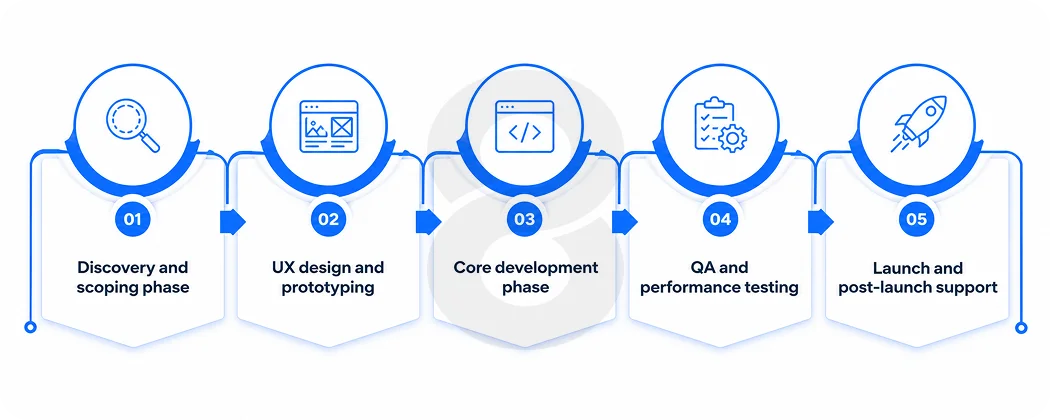
A typical VR app takes three to nine months from kickoff to launch, with enterprise projects running 12 months or longer. Here is how that time actually gets spent.
Discovery and scoping phase
Requirements gathering, competitor analysis, platform selection, and the technical feasibility questions that save six figures later. Skipping this phase is the most reliable way to blow the budget in month five.
Duration: 2 to 4 weeks.
UX design and prototyping
Wireframing for three dimensional space works differently from flat design. User flows have to be tested inside a headset rather than approved in Figma. Comfort, locomotion, and interaction models get locked here.
Duration: 3 to 6 weeks.
Core development phase
Environment construction, interaction mechanics, backend integration, and content production. This is the longest phase by a wide margin, running several months depending on the complexity tier, and it is where feature-level cost decisions from earlier in this article turn into engineering hours.
Duration: 8 to 20 weeks.
QA and performance testing
Frame rate stability, latency, and motion comfort testing across target devices, plus platform certification where it applies. Vision Pro review and Sony’s PSVR2 process both add calendar time that teams forget to schedule.
Duration: 3 to 6 weeks
Launch and post-launch support
Store submission on Meta, Apple, or Steam, then the patch cycle, analytics review, and content updates that keep the app alive. The launch itself takes 2 to 4 weeks. The support commitment continues for the life of the product.
Duration: 2 to 4 weeks.
| Phase | Key Tasks | Estimated Duration |
|---|---|---|
| Discovery & Scoping | Requirements, feasibility, platform choice | 2 – 4 weeks |
| UX Design & Prototyping | Spatial wireframes, in-headset flow testing | 3 – 6 weeks |
| Core Development | Environments, interactions, backend, content | 8 – 20 weeks |
| QA & Performance Testing | Frame rate, comfort, certification | 3 – 6 weeks |
| Launch & Post-Launch | Store submission, patches, analytics | 2 – 4 weeks + ongoing |
What Factors Affect VR App Development Cost
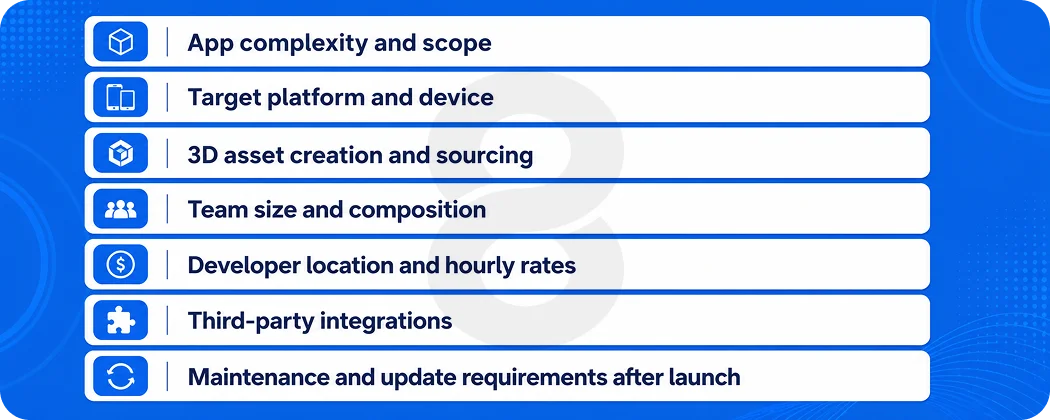
Seven variables explain nearly every gap between two quotes for the same project.
App complexity and scope
Scene count, interaction depth, and content volume set the floor for everything else. A single-scenario training module and a ten-module program with branching outcomes are different projects wearing the same name, and their budgets differ accordingly.
Target platform and device
Each platform brings its own SDK, performance envelope, and certification process. Quest is the cost baseline, Vision Pro carries the steepest premium, and WebXR usually comes in under both. Adding platforms multiplies testing and submission work.
3D asset creation and sourcing
Custom-modeled environments cost several times more than licensed library assets. Most sensible budgets mix the two, spending custom-art money only on the objects and spaces users will scrutinize up close.
Team size and composition
A minimal VR team is three or four people. An enterprise build can need eight or more across development, 3D art, design, QA, and backend. Every added specialist raises the monthly burn rate, whatever the hourly rates involved.
Developer location and hourly rates
Regional rate differences of five times or more are normal in this market. A team in United States and a team in Pakistan can deliver comparable work at very different price points, which is covered in detail in the next section.
Third-party integrations
Every LMS or CRM service you connect brings its own API quirks, testing burden, and creative ways of breaking two years from now. On enterprise projects, integrations are the quiet line item that walks a mid-tier budget into enterprise pricing while everyone is busy looking at the 3D art.
Maintenance and update requirements after launch
Headset makers push OS and SDK updates at a pace mobile developers would find rude. Leave a VR app untouched for a year and it ages worse than a neglected phone app ever does. The planning number that holds up in practice is 15 to 25 percent of the original build cost, every year.
Read More: Virtual Reality vs Augmented Reality: Choosing the Right Tech for Your MVP
VR App Development Team Structure and Hiring Costs
The core roster: a project manager, one or two VR developers, a 3D artist, a UX designer, and a QA engineer. Add a backend developer if the app talks to servers. On smaller builds, several of those can be part-time seats rather than full hires. If that list sounds like a mobile game development team, that’s because it basically is one. The engines and production pipelines overlap almost completely.
As for who employs those people: go in-house when VR is going to be a permanent product line, hire freelancers for small contained builds, and use an agency for the wide middle case, where you need a full team for six months and zero VR headcount on payroll afterward. Each of the three works for somebody. The tell is when a vendor insists their model is the only sane one, at which point you know exactly what they sell.
| Region | Hourly Rate Range | Notes on Tradeoffs |
|---|---|---|
| North America | $100 – $250 | Highest rates, easiest timezone overlap for US buyers |
| Western Europe | $80 – $150 | Strong enterprise experience, high rates |
| Eastern Europe | $40 – $80 | Deep game-engine talent pool, solid value |
| South Asia | $25 – $50 | Best rates, strong Unity/Unreal talent, vet communication |
| Southeast Asia | $25 – $60 | Growing VR ecosystem, quality varies by studio |
Industries Using VR App Development
Industry context changes what ‘VR app’ even means, and it changes the budget conversation with it. A training simulator and a virtual showroom share an engine and almost nothing else. Here’s where the technology is actually earning its keep right now.
Healthcare and medical training
VR gives clinicians somewhere to rehearse high-stakes procedures where the worst possible outcome is hitting restart. Surgical simulation, anatomy teaching, exposure therapy, all repeatable on demand. Hospitals that wire these modules into their existing healthcare software stack stop scheduling training around cadaver supply and whichever week the instructor happens to be free.
Corporate learning and development
Soft skills practice, onboarding, and compliance training are the highest-volume enterprise VR use case. PwC’s enterprise study found VR training reached cost parity with classroom delivery at 375 learners, and became 52 percent cheaper than classrooms at 3,000 learners. Past that scale, the finance case largely writes itself.
Real estate and virtual property tours
Buyers walk through unbuilt developments and remote listings without a flight. Developers selling pre-construction units use VR walkthroughs to close on floor plans that exist only in Unreal Engine, an approach that extends naturally from conventional real estate app development.
Retail and virtual try-on
Furniture at real scale, a car interior you can sit in before you order it, showrooms that never pay rent. In practice most retail VR lives on WebXR, for the plain reason that customers will click a browser link years before they buy a headset to go shopping.
Gaming and entertainment
Gaming is still where most of the consumer money is, and it doubles as the industry’s R&D lab. Nearly every interaction pattern that shows up in enterprise VR was proven in a game first. Studios shipping to Quest and PSVR2 use the same Unity and Unreal pipelines as the rest of game development, plus a layer of comfort and locomotion design that flat-screen games never had to think about.
Manufacturing, safety, and simulation
Assembly training, hazard drills, and digital twin walkthroughs let workers rehearse dangerous procedures without stopping a production line. Manufacturers already investing in manufacturing software increasingly treat VR simulation as the training layer on top of that stack, and the same logic applies in education, where institutions run virtual labs that would be unaffordable as physical facilities.
How to Reduce VR App Development Costs Without Cutting Quality
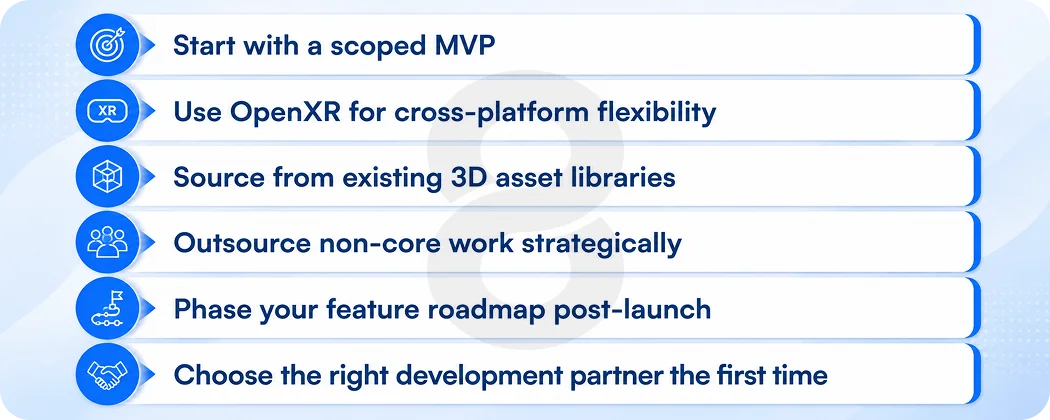
Cutting VR costs the wrong way shows up instantly, usually as a frame rate problem someone can feel in their stomach. The savings that actually hold come from scoping decisions, made early. Six of them, in rough order of how much money they tend to save.
Start with a scoped MVP
Build the one scenario that proves the whole idea, put it in front of real users, and let what they actually do decide the roadmap. It’s humbling how reliably this works. In our experience about half the features in a first-draft VR spec quietly disappear once real usage data shows up, and nobody ever asks where they went.
Use OpenXR for cross-platform flexibility
Building against the OpenXR standard keeps future platform ports cheap even if you launch on Quest alone. It costs a little discipline now and saves a rewrite later.
Source from existing 3D asset libraries
Reserve custom art for hero objects and brand-critical spaces. Licensed environments, props, and character rigs cover the rest at a tenth of the cost, and users genuinely cannot tell for background content.
Outsource non-core work strategically
Keep product decisions and domain knowledge close, and hand execution-heavy work like asset production, QA passes, and porting to lower-cost regions. The rate table earlier in this article is the whole argument.
Phase your feature roadmap post-launch
Multiplayer, analytics dashboards, and additional platforms can all arrive in version two. Launching lean gets revenue and learning flowing months earlier, and both of those fund the roadmap better than optimism does.
Choose the right development partner the first time
Rescue projects, where a second agency rebuilds a failed first attempt, routinely cost more than doing it properly once. Check shipped VR titles, ask to try them in a headset, and talk to past clients before signing anything.
Read More: Hire VR Developers: Complete Guide to Hiring Skilled Virtual Reality Developers
How 8ration Can Help With VR App Development
8ration builds immersive products end to end, from VR app development and metaverse experiences to the Unity and Unreal engineering underneath them. Our team takes projects from discovery through spatial UX design, 3D asset production, development, QA on physical headsets, and the store submission grind across Meta Quest, Apple Vision Pro, and WebXR.
The features that sink VR-only studios, conversational NPCs, LMS integrations, companion mobile apps, are things we already build every week in our AI, game, and mobile practices, so none of it gets farmed out to a subcontractor you’ll never meet. And we quote against the same cost logic this article lays out. If a feature isn’t earning its budget line, we’ll tell you before you pay for it.
The Bottom Line
VR pricing stops being mysterious once you see the levers: complexity tier sets the bracket, features and platform choice move you within it, and team location scales the whole number up or down. With Statista projecting the AR and VR market to reach $50.9 billion in 2026, the buyers getting the best deals are the ones who walk into quote conversations already knowing what their scope should cost.
If a proposal lands far outside the ranges in this guide, in either direction, ask why. A good partner can defend every line item. A bad one changes the subject.