



Many professionals ask what agentic AI is today. The concept describes systems acting independently toward defined goals. These systems plan actions without constant human instructions. They observe environments and adapt decisions using feedback loops. Their autonomy separates them from traditional passive software tools. Understanding this shift matters for builders and technology decision makers.
Modern enterprises increasingly deploy such systems across operational environments. Interest rises because autonomy reduces supervision costs significantly. Curiosity grows since capabilities now approach practical business reliability. This article explains the foundations and shows agentic AI examples clearly.
Defining Agentic Intelligence
Researchers define agency as goal-directed behavior with environmental awareness. Software qualifies when it selects actions without explicit step commands. The definition answers what agentic AI is in technical language. An agent perceives context and then selects optimal operations automatically. Classical programs follow scripts while agents choose strategies dynamically. This concept powers AI workflow automation across modern enterprises.
This distinction forms the conceptual backbone of autonomous system design. Engineers measure agency through adaptability and decision independence metrics. Higher scores indicate stronger autonomy and reasoning flexibility. Lower scores indicate rule dependence and limited situational awareness. Industry frameworks classify systems along graduated autonomy spectrums. Such principles influence blockchain development services architectures globally.
Core Architectural Components
Agent systems share structural modules enabling independent operational reasoning.
- Perception modules gather structured and unstructured environmental signals
- Planning modules generate action sequences satisfying objective constraints
- Memory modules store state history supporting contextual continuity
- Tool modules interact with external software services or hardware
- Evaluation modules measure results against defined success criteria
Each module communicates through internal state representations continuously. Coordination logic maintains coherence between perception, planning, and execution. Failures occur when modules desynchronize under unpredictable input conditions.
Behavioral Characteristics
True agents exhibit recognizable operational traits during runtime. They pursue goals even when conditions shift unexpectedly. They recover from partial failure without manual resets and request information when uncertainty exceeds confidence thresholds. This terminate tasks once the success criteria are satisfied. These traits distinguish prototypes from production-capable deployments.
Why Agentic Systems Matter Now
Computational costs declined while model capabilities increased dramatically. This convergence enables practical autonomy outside research laboratories. Businesses deploy assistants handling workflows previously requiring human operators. Analysts highlight agentic AI examples across logistics, finance, and healthcare sectors. Competitive pressure forces organizations to automate decision-heavy processes.
Early adopters report measurable productivity and accuracy improvements. Investment accelerates because return metrics already show positive trends. Vendors now package autonomy as configurable enterprise platforms. Standardization efforts aim to ensure interoperability between different agent frameworks.
Comparison With Traditional Automation
# |
Feature |
Traditional Automation |
Agent Systems |
| 1 | Control Logic | Fixed rules | Adaptive reasoning |
| 2 | Flexibility | Low | High |
| 3 | Learning | Rare | Continuous |
| 4 | Intervention | Frequent | Occasional |
| 5 | Context Awareness | Minimal | Extensive |
Technical Layers Inside Agentic Platforms
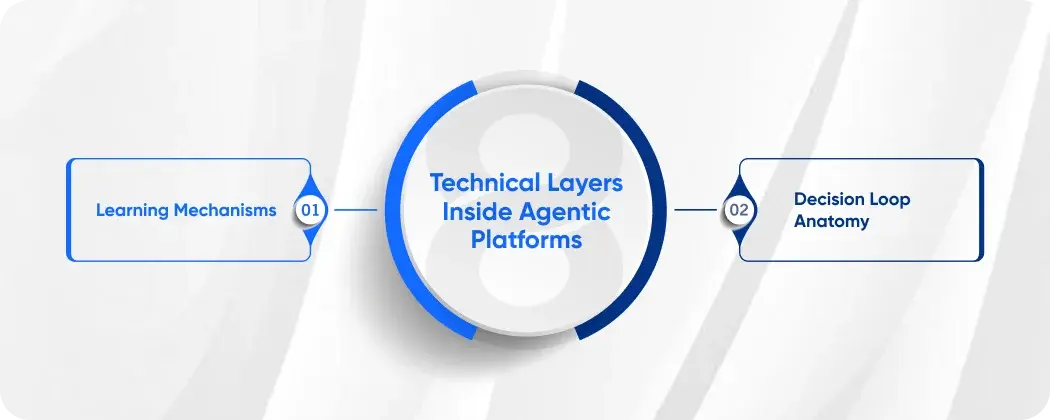
Infrastructure for autonomous systems spans multiple abstraction tiers. Hardware acceleration enables real-time reasoning under heavy workloads. Operating layers manage memory scheduling and task prioritization. Middleware handles communication between internal modules and external services.
Application layers define domain-specific objectives and constraints. Observability layers track performance metrics and anomaly signals. Security layers enforce permissions and prevent unauthorized capability escalation. Each layer must integrate seamlessly to maintain stable autonomy. Weak integration often causes cascading system-level failures in mobile app development services.
Learning Mechanisms
Agents improve through iterative feedback-driven optimization cycles. Reinforcement learning remains common for sequential decision environments. Supervised fine-tuning helps align behavior with policy constraints. Self-reflection loops allow internal critique before executing actions. Hybrid training pipelines combine several methods for reliability.
Designers choose methods based on domain risk tolerance. Safety-critical domains demand rigorous validation before deployment. Less critical domains permit exploratory learning behaviors.
Decision Loop Anatomy
Every autonomous cycle follows a structured reasoning progression. First perception gathers signals from sensors or datasets. Next interpretation converts signals into symbolic representations. Then, planning selects candidate actions maximizing expected utility. Execution performs chosen actions through available interfaces.
Evaluation measures results against defined objective metrics. Memory updates its internal state with new contextual knowledge. This loop repeats continuously until termination conditions are triggered.
Read More: Artificial Intelligence in Automotive Industry – Trends & Use Cases
Practical Implementation Domains
Real adoption demonstrates maturity beyond theoretical prototypes. Observers track agentic AI examples within customer support automation platforms. Financial institutions deploy them for fraud pattern detection. Hospitals experiment with triage assistants supporting clinical staff.
Manufacturers test them for predictive maintenance scheduling tasks. Retailers use them for inventory optimization decisions. These agentic AI examples show cross-industry applicability. Adoption barriers now relate mostly to governance, not capability.
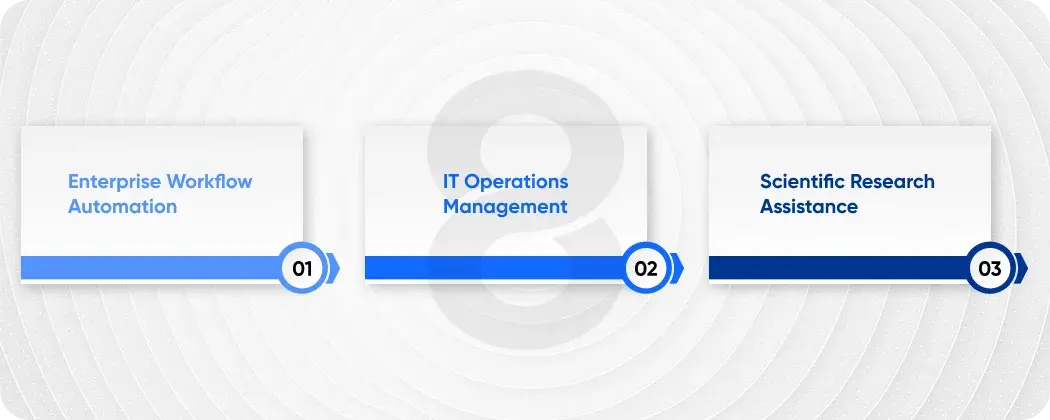
Enterprise Workflow Automation
Large organizations run complex processes spanning multiple software systems. Agents coordinate tasks across applications without manual orchestration scripts. They interpret business objectives and then translate them into execution steps. Analysts often cite agentic AI examples managing procurement cycles autonomously. These systems read contracts, evaluate vendors, and submit orders. Staff intervene only when exceptions exceed confidence thresholds.
IT Operations Management
Infrastructure teams handle alerts, logs, metrics, and incident tickets daily. Autonomous agents triage alerts and then prioritize responses intelligently. They correlate signals across monitoring tools before escalation. Many case studies document agentic AI examples resolving outages automatically. The mean time to resolution decreases when agents act immediately. Human engineers then focus on architectural improvements.
Scientific Research Assistance
Laboratories generate massive datasets requiring interpretation and hypothesis testing. Agents analyze results and then propose experimental adjustments systematically. They review literature databases to support reasoning decisions. Published reports mention agentic AI examples accelerating drug discovery pipelines. Researchers validate suggestions before executing costly physical experiments. Collaboration between human intuition and machine persistence proves powerful.
Safety And Governance Considerations

Autonomy introduces responsibility requiring rigorous oversight frameworks. Designers must specify boundaries restricting permissible system actions. Auditing tools should log reasoning steps for later inspection. Regulators demand transparency when decisions affect human welfare. Ethical review boards evaluate deployments involving sensitive data usage. Risk models estimate potential harm from erroneous decisions. Mitigation strategies include fallback modes and manual override channels. Continuous monitoring detects drift from intended behavioral patterns.
Failure Modes
Understanding failure scenarios improves resilience engineering practices. Agents may misinterpret context due to ambiguous inputs. They might optimize the wrong objectives if specifications contain errors. Tool integrations sometimes return corrupted or outdated information. Memory components can accumulate misleading historical patterns. Adversarial inputs might manipulate reasoning pathways maliciously. Testing frameworks simulate such scenarios before production release.
Alignment Techniques
Alignment ensures systems pursue intended goals consistently. Policy constraints restrict actions violating organizational guidelines. Reward shaping guides learning toward acceptable behavioral regions. Constitutional prompting embeds normative rules into reasoning processes. Human feedback loops correct undesirable emerging strategies. These techniques reduce risk while preserving operational autonomy.
Development Lifecycle
Building autonomous systems requires disciplined engineering methodology. Teams begin by defining measurable objectives and constraints clearly. Next, they design modular architectures supporting iterative improvements. Prototype agents undergo simulation testing before real environment exposure.
Validation stages evaluate reliability, robustness, and ethical compliance. Deployment phases include monitoring dashboards and rollback procedures. Maintenance phases retrain models using fresh operational data. Mature lifecycles treat agents as evolving software organisms.
Tooling Ecosystem
An expanding ecosystem supports rapid agent development today. Frameworks provide templates for perception planning and execution modules. Simulation environments enable safe experimentation with decision strategies. Evaluation suites benchmark performance across standardized task sets.
Observability platforms visualize reasoning traces for debugging purposes. Security toolkits test vulnerabilities against adversarial manipulation attempts. Integration libraries connect agents with enterprise software systems.
Skill Requirements
Organizations adopting autonomy need multidisciplinary technical expertise. Machine learning specialists design reasoning and learning components. Software engineers implement infrastructure and integration layers. Domain experts define objectives, constraints, and evaluation metrics.
Security analysts assess risks and harden system boundaries. Product managers align capabilities with user value outcomes. Collaboration among these roles determines the project’s probability of success.
Read More: AI in Self-Driving Cars – The Future of Autonomous Delivery Stacks
Economic Impact Analysis
Autonomous systems reshape cost structures across industries globally. Labor allocation shifts toward supervision and strategy activities. Routine cognitive tasks gradually transfer to machine agents. Productivity increases when decisions occur instantly without delays. Competitive landscapes change as automation lowers operational barriers.
Market leaders invest heavily to secure early advantages. Smaller firms adopt platforms, reducing infrastructure entry costs. Economists monitor long-term workforce transformation implications.
Cost-Benefit Comparison
# |
Dimension |
Manual Processes |
Agent-Driven Processes |
| 1 | Speed | Limited by staff | Near real-time |
| 2 | Scalability | Hiring required | Software scaling |
| 3 | Consistency | Variable | Predictable |
| 4 | Cost Trend | Rising | Declining |
| 5 | Error Rate | Human dependent | Model dependent |
Human Collaboration Model
Autonomy works best when paired with human judgment oversight. Hybrid workflows combine machine speed with human contextual reasoning. Supervisors review outputs rather than performing entire processes manually. This structure increases throughput without sacrificing accountability standards. Case analyses show agentic
AI examples assisting legal document review. Lawyers validate results instead of searching documents themselves. Another set shows agentic AI examples supporting supply chain forecasting. Planners adjust recommendations using strategic business knowledge.
Trust Building Factors
User trust determines adoption success more than raw capability metrics. Transparent reasoning traces help users understand decision logic. Consistent performance builds confidence over repeated interactions. Clear escalation channels reassure operators during uncertain situations. Training programs teach staff how to collaborate effectively. Documentation explains system limits, preventing unrealistic expectations.
Read More: How To Build Artificial Intelligence Like ChatGPT
Design Principles For Practitioners
Engineers designing agents should follow proven architectural guidelines. Start with narrow objectives before expanding the capability scope. Use a modular design enabling component replacement without system collapse. Implement logging from the earliest prototype stages onward.
Validate using adversarial scenarios, not only ideal conditions. Prioritize interpretability when decisions affect critical outcomes. Maintain version control for models and configuration states. Document assumptions underlying reward functions and policies.
Evaluation Metrics
Performance measurement requires multidimensional assessment strategies. Accuracy measures the correctness of selected actions. Latency measures decision speed under realistic workloads. Robustness measures stability against noisy or adversarial inputs. Generalization measures performance across unseen environments.
Efficiency measures resource consumption during operation cycles. Safety measures frequency of harmful or policy-violating outputs. Teams should track all metrics simultaneously for balanced evaluation.
Read More: 10 Types of Machine Learning Models for Smarter Decision Making
Future Trajectory
Technological progress suggests rapid capability expansion in the coming years. Models grow more context-aware and reasoning-capable. Hardware advances reduce latency, enabling real-time autonomy. Standards bodies work toward interoperability protocols across platforms.
Educational institutions introduce curricula focused on autonomous system engineering. Investment capital continues flowing into startups building agent platforms. Analysts predict widespread integration across consumer applications soon. Many forecasts reference agentic AI examples becoming everyday infrastructure.
Research Frontiers
Open problems still challenge researchers pursuing reliable autonomy. Long-horizon planning remains difficult under uncertain environments. Memory compression without information loss requires novel architectures. Formal verification methods must scale to learning systems. Social alignment across cultures demands interdisciplinary collaboration.
Energy efficiency becomes critical as deployments scale globally. Progress in these areas will determine future adoption speed.
Read More: Artificial Intelligence for Banking to Drive Smarter Decisions
Conceptual Recap
Readers often revisit the question of what is agentic AI after examples. The answer involves autonomy reasoning, adaptability, and goal orientation. Systems exhibiting these traits qualify within most definitions. Observing agentic AI examples clarifies theory through tangible implementations. Exposure reduces confusion surrounding terminology and marketing claims. Technical literacy helps stakeholders evaluate vendor promises realistically.
Extended Real World Illustration Set
Below appears a consolidated list highlighting diverse implementations.
- Autonomous cybersecurity monitors detect anomalies and then isolate threats
- Personal productivity assistants schedule tasks across calendars intelligently
- Agricultural monitoring agents adjust irrigation based on sensor data
- Energy grid balancers redistribute loads during demand fluctuations
- Educational tutors adapt lesson difficulty dynamically for learners
- Urban traffic coordinators are optimizing signals using live congestion feeds
- Disaster response planners are allocating resources across affected regions
- Space mission controllers manage satellite diagnostics remotely
- Media recommendation agents curate content aligned with preferences
- Environmental monitoring systems predicting wildfire spread patterns
These scenarios collectively represent agentic AI examples across domains. Studying them reveals recurring architectural and behavioral patterns. Designers can reuse patterns to accelerate new system development.
Read More: AI Chatbot Cost & ROI – Budgeting for Custom Enterprise Solutions
Strategic Adoption Guidance
Organizations considering deployment should follow structured evaluation phases. First, identify processes involving repetitive decision-heavy workflows. Next, estimate potential gains from partial or full automation. Then run pilot programs measuring real performance metrics. Compare results against baseline human-operated processes carefully. Successful pilots justify scaling across additional operational units. Governance teams should review ethical and compliance implications. Continuous feedback loops ensure deployments remain aligned with objectives.
Risk Mitigation Checklist
- Define explicit operational boundaries before activation
- Implement monitoring dashboards tracking behavioral anomalies
- Establish emergency shutdown mechanisms accessible instantly
- Conduct regular audits of decision logs
- Update training data to prevent performance drift
- Simulate adversarial conditions during testing cycles
Following these steps reduces the probability of harmful system behavior.
Ready to Build Your Own Autonomous AI System
At 8ration, innovation meets practical execution to help businesses deploy intelligent technologies confidently. The team builds advanced AI systems, scalable applications, and modern digital platforms tailored to operational goals. With deep technical expertise and strategic insight, 8ration transforms complex ideas into reliable solutions. Organizations gain efficiency, automation, and competitive strength while launching future-ready products designed for performance, adaptability, and long-term growth.
Closing Perspective
Understanding what is agentic AI equips professionals for technological shifts. Autonomous systems already influence workflows across many sectors. Observing agentic AI examples demonstrates practical value beyond theoretical promise. Continued research and responsible design will shape their societal impact. Stakeholders who study principles today gain a strategic advantage tomorrow.