


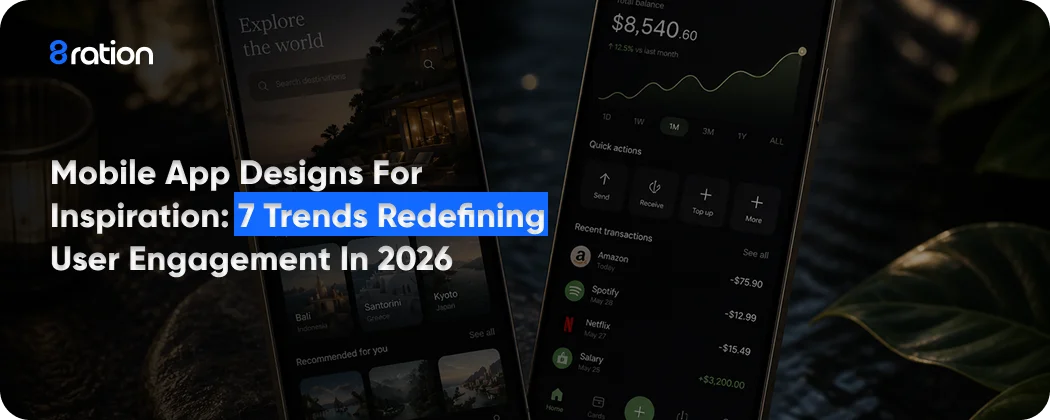
Digital space is changing more than ever, and mobile app design is at the core of the change. No longer a question of choice but a survival skill: whether you are hiring an app design firm, searching the web to find app designers near you, or looking to design your own app, knowing what makes users remain, interact, and become converts is no longer a question of choice but a question of survival.
The expectations of the users have changed entirely in 2026. Individuals are no longer satisfied with apps that work. They desire apps that are living, intelligent, and conscious of their time. Some of the major changes leading to this are:
- Increased interest in customized, situational experiences.
- Users who want near-zero friction in all interactions.
- Increasing attention to the privacy of data and ethical construction.
- Normalization of foldable devices and multimodal inputs.
In case you are already developing a mobile app, calculating the cost of developing an app, or even trying to find the best mobile app development company to help you to make your idea come true, this in-depth exploration of seven revolutionary trends will act as a motivation and a business strategy guide.
1. AI-Powered Hyper-Personalization

Gone are the days of uniformly fitting app designs. Artificial intelligence serves mobile application designers in 2026 because they use it to create interface changes, which the system makes, based on its two main functions of offering system suggestions. The application will show you its initial version on Day 1, but will make minor updates by Week 4 after it has observed your usage patterns and preferences. The practical implementation of personalization with AI:
- A fitness app that conceals functions you never access and reveals the type of workout you prefer
- A shopping application that customizes its homepage according to your shopping habits
- A news application that can rearrange (by the time you spend reading a category)
- A banking application that displays pertinent offers depending on your spending habits
This trend is a huge competitive opportunity to businesses that consider developing an app to my business. When your app knows your customers better than the apps of your competitors, you automatically win their loyalty. What is great personalized design:
- The content and context can be flexed dynamically, and navigation remains consistent.
- Color schemes and core capabilities are still recognizable despite changing layouts.
- Personalization is friendly, never invasive or spy-like.
- Users can always choose to reset or change their preferences.
Read More: Local vs. Remote: Does it Matter Where Your App Development Firm is Based?
2. Glassmorphism Evolves into “Depth Layering”
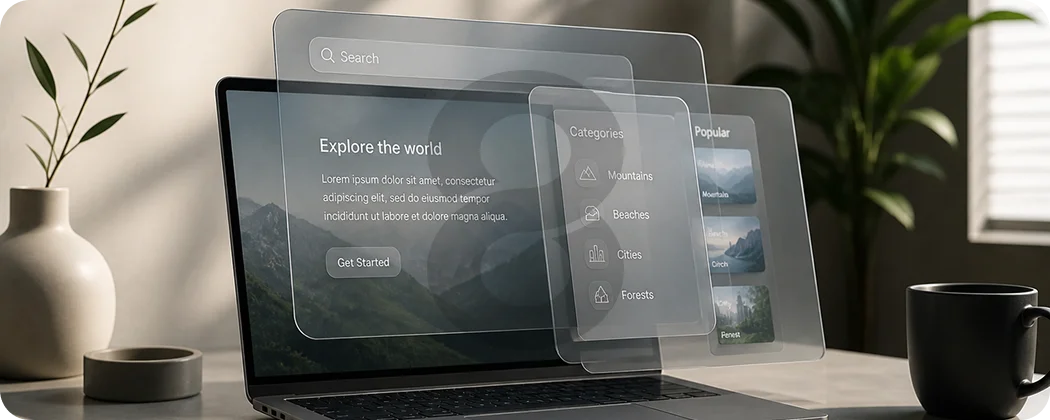
In the 2020s, glassmorphism, the frosted-glass aesthetic style that was so much of the early 2020s, has since grown in 2026 to what designers are now calling “depth layering.” Instead of merely smudging and making things transparent because it looks pretty, contemporary mobile app designers are applying depth through layers to convey hierarchy, priority, and state. The depth layering is effective because:
- It reflects the processing of the physical world by the human brain: foreground = attention and background = context
- Users instinctively understand what is interactive vs. informational
- It decreases the cognitive load by providing a natural visual hierarchy with no extra text or icons
- It is compatible with both iOS and Android design languages
This Trend Can Be Best Utilized In:
- Dense productivity applications and screens
- Business applications that should feel comfortable without being simplistic
- Where layers of data require clear priority signals can be found in finance and analytics apps
- Any application where visual complexity is a requirement by the app design company
3. Haptic Storytelling and Microinteractions

The art of micro-interactions is, perhaps, one trend that will distinguish truly charming apps and those that will be forgotten in 2026. The system uses small animations and transitions and feedback loops to create responses for every user action which includes button taps and task completions and error cases. The time duration of each element exists as a separate unit that lasts less than one second. They combine to create an emotional connection between product and user. What micro interactions will do to your app:
- Increase perceived quality and polish
- Lessen the cognitive burden by verifying actions in real time
- Familiarity and trust with repeated use
- Significantly enhance retention rates and App Store ratings
The year 2026 also takes it a step further with the introduction of haptic storytelling, the application of vibration patterns to reinforce what the users are viewing on the screen:
- A payment confirmation gives a good final haptic pulse
- A notification of a warning is different from a success alert
- A drag-and-drop interaction fits into place with a gentle clicking sound
- Error states are accompanied by a different rhythm to ensure that the user knows in advance that their eyes will work on the screen
In terms of teams estimating the price of developing an app, spending on micro-interactions can add less than 10–15 percent to the development time and multiply user satisfaction by a large amount. It is a design investment with one of the highest ROIs.
Read More: How 8ration Cut App Load Time by 60% Without Rewriting Core Logic
4. Multimodal and Voice-First Interfaces
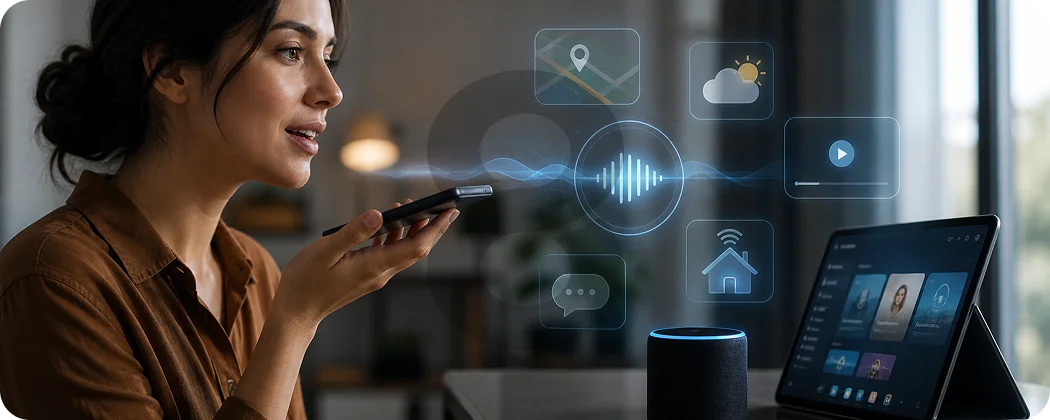
The voice-first design transition has been slow, and the year 2026 is when it will become the norm when it comes to non-utility applications. Not only are social platforms and shopping apps designing voice as a main, not subordinate, input tool, but even creative apps are developing it.
The reason this is important to your mobile app design strategy:
- Voice input is attractive to all groups of people based on its accessibility and speed
- Hands-free, in-car, and wearable contexts are increasing quickly
- Applications that disregard voice are starting to feel unfinished to the contemporary consumer
- UX strategy of voice flows is now a part of the best mobile app development company partnerships
The appearance of what a multimodal design would look like in practice:
- Searching and swiping through visual results and tapping to confirm is a one-fluid motion dictated by a search query typed in by a user
- Navigation changes depending on the input: touch, voice or gesture
- No information is lost when the user changes between input modes
- The voice feedback is equally considered as the visual feedback
The most affected industries are those where the trend is the most pronounced:
- Retail and online shopping (browsing whilst cooking or commuting)
- Healthcare (clinician documentation not breaking patient eye contact)
- Logistics and field services (on-the-go workers who will not be able to stare at a screen)
- Any company considering developing an app to support my business in a high-motion environment
Read More: Designing for Trust: The UX Principles Behind Every App We Ship at 8ration
5. Ethical Design and Open Data UX
In 2026, more than any other time in history, users are more conscious of their privacy and the apps that help them feel empowered, not legalistic, about their privacy. This has led to ethical design, a philosophical tradition that makes user autonomy, data transparency, and cognitive respect central to each design choice. Typical patterns to be substituted with moral ones: Basic concepts of foldable-first design:
- Continuity, the experience should not be discontinuous with the physical form factor changing
- A video conference switches seamlessly between compact and expanded mode
- The intelligent reflowing of documents occurs as the amount of screen real estate increases
- Without making the user lost, navigation structures adjust
When Developing Android Applications, What Teams Need to Consider:
- The technical foundation is Google Jetpack Compose and Adaptive Layout libraries
- Design thinking should include what content grows, what changes, and what remains
- Test throughout the entire fold/unfold lifecycle, not only fixed screen sizes
- Treat the partially folded tabletop case as a real use case and not an edge case
The Competitive Opportunity
- A business application that runs brightly on a Galaxy Z Fold is an indication of grandeur and design
- Foldable optimization is sufficiently infrequent to be a significant differentiator
- Premium foldable device owners are likely to be high-value, high-engagement customers
6. Inclusive and Accessible Design as a Standard

The normalization of accessibility, not as a checkbox compliance option but as a quality standard, may be the most significant change in mobile app design in 2026. Accessibility is no longer an expert vertical to studios of the best mobile app development company. It is embedded in the system of design since the early days.
What Accessible-by-Default Design Looks Like
- Elegantly scaling dynamic type that does not disrupt layouts.
- Color contrast ratios that are not stretch goals but are WCAG AA or higher.
- Generous touch targets (44×44 or bigger) where users with motor difficulties may be able to use them.
- Screen readers’ compatibility was also tested on a per-sprint basis, rather than pre-launch.
- Haptic and sound effects that match all the visual interactions.
The Business Case is Undeniable:
- There are more than 1 billion individuals in the world who live with some kind of disability.
- The support costs of accessible apps are lower, and they have higher ratings in the App Store.
- The demographics, which are older-aged- a rising and high spending market- are benefiting immensely.
- The same design that accommodates users of a screen reader accommodates users who are distracted, one-handed, or in low-light situations.
To Anyone Considering The Price of Developing An App:
- A small cost addition is provided by an accessible design that is built in.
- It can be 3-5 times more expensive to retrofit accessibility than it would be to do it initially.
- The skill of accessibility is a high-value skill in mobile app designers – and worth the money.