




The ride-hailing industry is experiencing significant growth. The people from both busy cities and small towns have turned away from traditional taxi stands to use their smartphones which provide immediate service. Uber, Lyft, Bolt, Ola and DiDi have transformed urban transportation through their mobility applications which every entrepreneur wants to join. The question that most people get stuck on is: how much does taxi booking app development cost? Pick any five different agencies, and you’ll get five wildly different answers ranging from $10,000 to $500,000.
That’s not a typo. It’s as broad as that. And if you’re not sure why, you’ll either pay too much for features you don’t need or pay too little to end up with a hip-to-hip app that nobody wants to use. This guide is a realistic, honest look at taxi app development costs, all of the factors that affect the cost, the comparison among various app types, hidden expenses you don’t hear about and how to develop smartly without overspending.
Why Taxi App Development Cost Varies So Wildly
Before you get into numbers, it’s essential to understand the reasons why there is such wide variation in costs. A taxi booking app isn’t a single thing. It is a system of related systems:
- A mobile app for the rider (iOS and/or Android)
- An app for the driver (iOS and/or Android)
- An administrator panel (backend)
- A server infrastructure (cloud hosting, database, API)
- Third-party integrations (maps, payments, SMS, etc.)
The complexity of each of these can vary, and each choice you make, starting with the platform you build on, the location of the developers you hire, the amount of features you add or remove, impacts the final taxi booking app development cost.
The global taxi app market is projected to grow from USD 238.1 billion in 2023 to USD 468.4 billion by 2033, expanding at a 7% CAGR.
Types of Taxi Apps and How They Compare in Cost
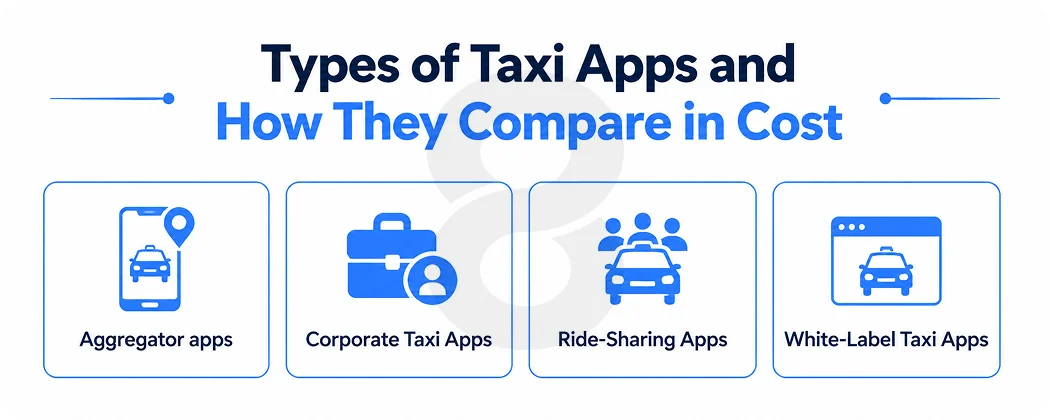
Not all taxi apps are built the same. The type of app you build is one of the biggest cost drivers.
App Type |
Description |
Estimated Cost |
| Dedicated Taxi App | Passenger books from an owned/contracted fleet | $30,000 to $170,000 |
| Aggregator App | Marketplace connecting riders with multiple operators | $40,000 to $200,000 |
| Corporate Taxi App | Built for businesses, expense tracking, billing | $60,000 to $250,000 |
| Ride-Sharing App | Multiple passengers share one vehicle, route optimization | $50,000 to $180,000 |
| White-Label App | Pre-built framework with custom branding | $5,000 to $30,000 |
The most frequent ones are dedicated taxi booking apps. Riders sign up on the platform with a pool of drivers that work for the company or are self-employed. These mobile applications require powerful real-time matching, GPS tracking, dynamic pricing, and smooth payment.
Aggregator apps
Aggregator apps act as a marketplace, connecting passengers with multiple independent taxi operators. The app doesn’t own any vehicles, it just facilitates the booking. Those will be somewhat more complex on the back end as they will have multiple operators, multiple pricing structures, and maybe multiple vehicle types.
Corporate Taxi Apps
Corporate Taxi Apps are created expressly for businesses and companies to oversee employee travelling, monitor travelling costs, create travelling insurance, and incorporate traveling with corporate billing systems. They need other functions such as invoice generation, role-based access and reporting dashboards.
Ride-Sharing Apps
Ride-Sharing Apps introduce one more level of algorithmic complexity, using the same vehicle and passengers moving in the same direction. All of these functions require real-time optimization, splitting and multi-stop logic.
White-Label Taxi Apps
White-Label Taxi Apps provide you with a ready-made platform that you can personalize and deploy in no time. These are significantly cheaper, but have fewer customization and scalability options.
Read More: The Complete Guide to White Label App Development for Agencies
The Core Components That Drive Taxi App Development Cost
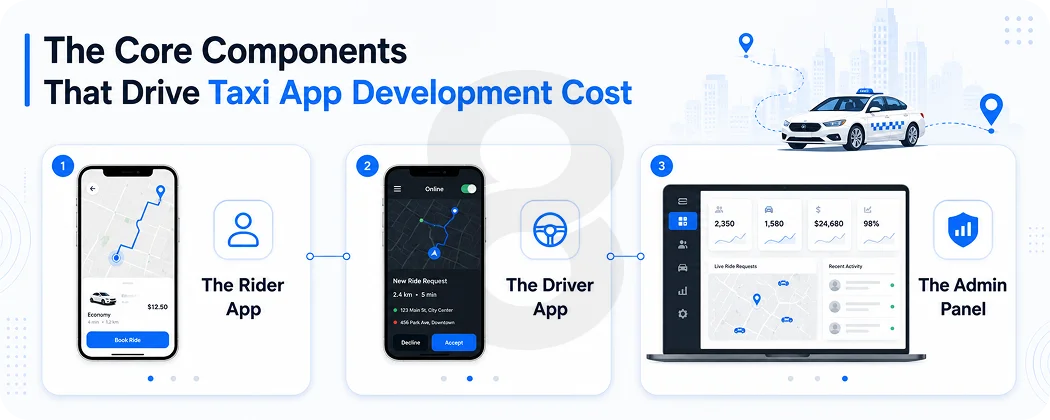
Whether you’re building an MVP or a full-scale enterprise platform, every taxi app has three core components.
Component |
Key Features |
Estimated Dev Hours |
| Rider App | Booking, GPS tracking, payments, ratings, notifications | 400 to 800+ hours |
| Driver App | Trip alerts, navigation, earnings dashboard, availability | 350 to 750+ hours |
| Admin Panel | Driver management, analytics, pricing control, support | 200 to 500+ hours |
The Rider App
The Driver App is underestimated in terms of complexity. Drivers must accept and reject rides, navigate to pick-up and drop-off locations, access their earnings, set their availability and communicate with passengers. Technical features such as offline mode, battery optimization and background GPS tracking increase complexity.
The Driver App
The Driver App is often underestimated in terms of its actual operational difficulties. Drivers must handle ride requests which they need to either accept or decline while they proceed to their designated pickup and drop-off locations and they should monitor their earnings and manage their availability and maintain contact with passengers. The system becomes more difficult to manage because offline mode support and battery optimization and background GPS tracking features increase its technical demands.
The Admin Panel
From there, operators can monitor drivers, track rides in real-time, provide customer service, set pricing and surge zones, implement promotions, handle payments, and analyze performance data. The admin panel can be a significant component of your taxi booking app development cost, and with a well-built platform, you can easily add $15,000 to $50,000 to your overall cost.
Read More: Uber-Like App Development Cost: 2026 Full Breakdown
Full Cost Breakdown by App Tier
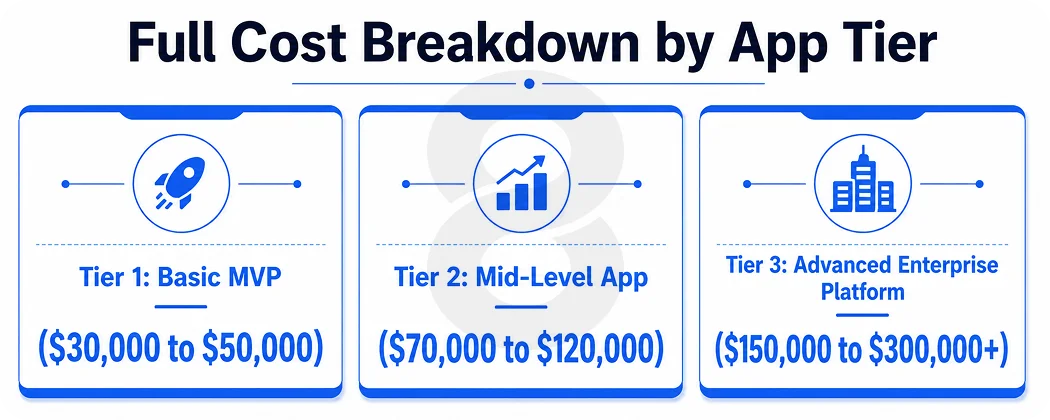
App Tier |
Target Use Case |
Cost Range |
Timeline |
| Basic MVP | Single city, validating demand | $30,000 to $50,000 | 3 to 5 months |
| Mid-Level App | Dual platform, scaling to multiple cities | $70,000 to $120,000 | 5 to 8 months |
| Advanced Enterprise | Regional/global scale | $150,000 to $300,000+ | 9 to 18 months |
Tier 1: Basic MVP ($30,000 to $50,000)
Ideal for startups looking to assess demand in one city or market. It is delivered with only one platform (iOS or Android), basic gps, one payment gateway, push notifications and a basic admin panel. Not what you’ll find is multi-language support, advanced analytics, surge pricing, in-app chat or scheduled rides.
Tier 2: Mid-Level App ($70,000 to $120,000)
Perfect for startups with proven demand and intending to expand to multiple cities and/or both platforms. Includes iOS and Android apps, enhanced user experience, fare estimate, trip history, user ratings and reviews, discount codes, driver earnings overview and an all-inclusive admin panel with analytics.
Tier 3: Advanced Enterprise Platform ($150,000 to $300,000+)
Ideal for companies that operate or have activities in the region and/or internationally. Tier 2 and Tier 3 features, surge pricing, in-app chat, multi-language/multi-currency, loyalty programs, wallet integration, AI matching, advanced fraud detection, multi-operator capabilities and full analytics/reporting.
Read More: Automotive App Development Cost in 2026 (Full Breakdown)
How to Reduce Taxi Booking App Development Cost Without Cutting Corners
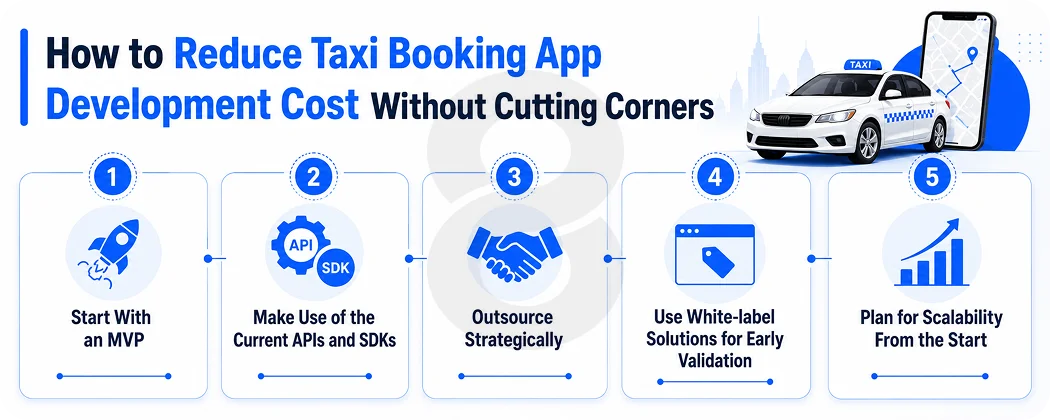
To keep taxi booking app development cost without compromising the quality, there are several ways that can be done.
Start With an MVP
Start off with only the minimum features necessary to prove demand. Real users will tell you what to build next and not build features that are expensive and no one uses.
Choose cross-platform development. Most use cases can be developed with Flutter and React Native in 30 to 40% of the time as compared to building 2 separate native apps, without compromising quality.
Make Use of the Current APIs and SDKs
Do not develop a mapping system, use Google Maps. Avoid creating a payment processor, use Stripe. Avoid creating an SMS gateway, use Twilio. These third party solutions are proven and can save you months of development time.
Outsource Strategically
Take a creative look at what’s possible for backend and frontend development off-shore and maintain product management and QA closer to home. This pairing can sometimes provide the greatest return.
Use White-label Solutions for Early Validation
Even if you’re still not certain whether there is a need for your taxi service, you can test the market with a white-label solution at a small fraction of the price of custom development. If validated, invest in a custom build.
Plan for Scalability From the Start
Start thinking about scalability right from the beginning. It’s far more costly to rebuild a poorly-designed backend when it can’t scale up than to have the architecture correct first time.
Read More: Top Automotive Software Solutions Driving the Future of Mobility
Development Timeline Breakdown
Phase |
What Happens |
Duration |
| Discovery and Planning | Requirements, user flows, architecture, roadmap | 2 to 4 weeks |
| UI/UX Design | Wireframes, prototypes, visual design | 4 to 8 weeks |
| Frontend Development | Rider app, driver app, admin panel UI | 8 to 16 weeks |
| Backend Development | APIs, databases, real-time systems, integrations | 10 to 20 weeks |
| QA and Testing | Functional, performance, security, device testing | 4 to 8 weeks |
| Deployment and Launch | App store submissions, server setup, go-live | 2 to 4 weeks |
A basic MVP takes 4 to 6 months. A mid-level app takes 6 to 10 months. A full enterprise platform can take 12 to 18 months.
Read More: Custom GPS Tracking Apps: Boost Your Fleet Efficiency
Hidden and Ongoing Cost
Cost Category |
Details |
Estimated Amount |
| App Store Fees | Apple: $99/yr, Google: $25 one-time + revenue share | $25 to $99/yr + 15 to 30% of revenue |
| Cloud Hosting | AWS, GCP, or Azure depending on usage | $500 to $20,000+/month |
| Maintenance and Updates | OS updates, bug fixes, security patches | 15 to 20% of build cost annually |
| Legal and Compliance | GDPR, PCI DSS, local licensing | $5,000 to $30,000 |
| Marketing and Acquisition | Driver and rider incentives, paid ads | $50,000 to $200,000+ |
| Customer Support | Chatbots, outsourced or in-house staff | $2,000 to $10,000/month |
Emerging Trends Affecting Taxi App Development Cost in 2025 and Beyond
Trend |
Impact on Cost |
Potential Revenue Uplift |
| AI and Machine Learning | Adds 18 to 30% to development cost | Up to 25% revenue increase |
| EV Integration | Adds 15 to 30% to feature scope | Long-term brand differentiation |
| Super App Functionality | Dramatically increases complexity | Opens multiple revenue streams |
| Voice and Wearable Booking | Moderate integration cost | Expands accessibility reach |
| Autonomous Vehicle Readiness | Architectural planning cost now | Future-proofs the platform |
The integration of AI and machine learning for driver matching, demand prediction, fraud detection, and dynamic pricing ushered in a new norm from premium to expectation.
With the rise of electric vehicles (EVs) into mainstream transportation, EV Integration is becoming a critical need. Today, taxi apps must provide users with capabilities such as battery health information, EV charging station mapping, and tracking carbon savings.
Super app functionality is taking platforms beyond ride-hailing to food delivery, package delivery, and payments. This adds up a lot of complexity but many revenue streams.
Voice and wearable booking and autonomous vehicle readiness are investments that are ahead of the curve and prepare your platform for the future.
The global ride-sharing market was valued at USD 42.9 billion in 2024 and is expected to hit USD 96.9 billion by 2030, growing at a 13.7% CAGR.
Final Thoughts: What Should You Actually Budget?
Stage |
Recommended Budget |
Focus |
| First-time founder, testing demand | $30,000 to $60,000 | Lean MVP, single platform |
| Validated concept, scaling up | $80,000 to $150,000 | Cross-platform, solid UX |
| Regional/global scale from day one | $200,000 to $300,000+ | Enterprise architecture |
Now, here’s a truthful response to the query that everyone is asking:
For New Founders
For first-time founders who are building their first product in a new space, expect to spend $30,000 to $60,000 for a lean MVP on one platform. Test demand, solicit feedback and invest in scaling accordingly.
For Those Who Have Concepts
If you already have a validated concept and are in a position to play in the big leagues, allocate $80,000 to $150,000 for a solid cross-platform product that offers a suite of features users want and expect.
If you intend from the start to build for regional or global markets, you must be prepared to spend $200,000 to $300,000+ and consider it to be a multiyear project.
In all the cases, it should be kept in mind that taxi application development costs are only the initial expenses and go on from there. Your first 2 years could easily be as much or more than the original construction in the marketing, operations, driver acquisition, customer support and continuous maintenance.
The winners of this space are not always the ones that invest the most in developing their startups. They are the ones who spend wisely, validate quickly, and iterate tirelessly. Start lean. Think about your users when building. Scale what works.
The global ride-hailing industry will be worth more than $200 billion in the near future. It is space for new gamers, but only those who are wise in their construction and not simply their finances.
Looking to develop a taxi app? The most critical step is to have the scope and architecture correct before you write any code. A clear product roadmap and technical plan will save you reworking tens of thousands of dollars down the road.