It’s very rare that enterprise software fails due to bad code. It doesn’t work because no one had ever laid out the road before the team began traveling. A department approves a budget, a vendor is selected, and months later, and the new tool still doesn’t communicate with the ERP system. Employees work around the tool, and IT quietly puts it in the corner by the last few “transformation” projects that have fallen by the wayside.
From what constitutes an enterprise application through to the true cost elements, and from a concept to a project that teams can use daily, this guide outlines the process of enterprise app development as it really is in 2026.
What Is Enterprise App Development?
Enterprise app development involves the creation, construction, and upkeep of custom-made applications tailored to the internal functions, workforce, or to deal with enterprise partners of a particular enterprise.
Imagine a logistics dashboard used by only 40 dispatchers, a field service app that synchronizes inventory from 200 warehouses, or a procurement portal for a manufacturer that integrates with its supplier network.
It’s not the same kind of app development as consumer apps. A consumer app in a crowded app store. An enterprise app has a captive and required audience, and as simple as it sounds, it typically isn’t. Staff will seek a way around it, usually in the form of a spreadsheet. This is the one fact that influences just about all of the decisions in this roadmap.
Read More: How to Create an App: 8 Steps to Build an App
Why Enterprise App Development Matters in 2026
The amount of investment speaks for itself. The global enterprise application market is expected to cross $340 billion by 2026 and the application development software market will witness a 30 percent CAGR increase until 2030, according to Grand View Research.
These pressures, legacy systems unable to keep up, distributed employees who want to access data on their mobile devices, and customer expectations for real-time service are already affecting all industries, and large enterprises are already taking up the lion’s share of that spending.
The most significant thing that has evolved in the past two years is speed. The enterprise mobile app development guide states that app store launches jumped significantly year over year in early 2026, with AI playing a major role in cutting down on app development times. Thus, the advantage is no longer just being the first to have a custom business app, but being the first to be able to make changes to the app after release.
Types of Enterprise Applications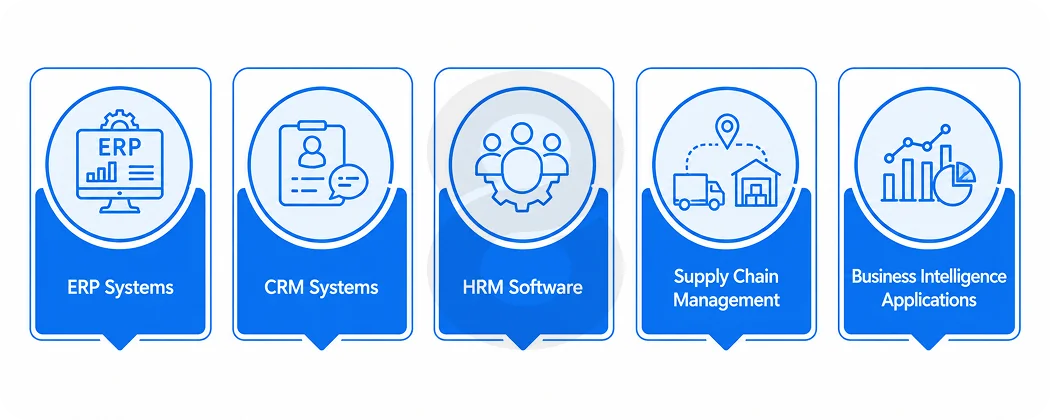
There are five general types of enterprise software. A clear understanding of which one (or both) your business requires determines the overall course of the roadmap.
| Application Type | Primary Function | Typical Owner |
|---|---|---|
| ERP Systems | Centralizes Finance, Inventory, and Operations Data Across Departments | Finance & Operations |
| CRM Systems | Manages Customer Interactions, Sales Pipelines, and Support History | Sales & Customer Service |
| HRM Software | Handles Recruitment, Payroll, Performance, and Employee Records | Human Resources |
| Supply Chain Management | Tracks Procurement, Logistics, and Inventory Movement in Real Time | Supply Chain & Logistics |
| Business Intelligence Applications | Turns Operational Data into Dashboards, Forecasts, and Reports | Executives & Analysts |
ERP Systems
ERP systems provide a single source of truth for finance, procurement and inventory, which are typically disconnected data in most growing organizations that silently create most of the reporting inaccuracies. Generally, in building one, a discovery period begins to outline which modules are worth investing in.
CRM Systems
CRM systems bring all customer interactions together, whether initial contact or renewal, eliminating the need to work on different, conflicting records. Retailers and marketplaces that construct this layer tend to directly tie it to the storefront behavior and sales data in their stores.
HRM Software
HRM software automates the entire employee lifecycle, from hiring and onboarding to payroll, performance management, and offboarding, reducing manual HR admin tasks. A good HRM tool makes non technical tasks quick and easy.
Supply Chain Management
As global logistics networks continue to be under pressure, supply chain apps provide real-time insight into inventory, shipment, and supplier performance. This is one of those areas where logistics software development and manufacturing are most closely interwoven.
Business Intelligence Applications
Instead of being a dump of data from all the other systems in the stack, BI applications fetch that data and transform it into dashboards that executives can actually act upon, rather than just wait for the first week or so after they are created. Businesses increasingly add AI-powered recommendations to their BI platforms, transforming from reporting to automation.
Read More: Top 10 Mobile Apps for Businesses in 2026
Key Benefits of Enterprise App Development
Those businesses that invest in custom applications reap benefits in four areas: operational efficiencies, improved decision making, increased security, and improved collaboration. Businesses that invest in custom applications will experience benefits in four areas: operational efficiency, improved decision making, increased security, and improved collaboration.
The compounding effect is most important. Usually, a single workflow is not what makes a business succeed on its own, but when heaps of workflows are chained together across departments, then you are on the right track to a successful enterprise.
Read More: Mobile App Design: The Complete Business Guide
Enterprise App Development Process: Step-by-Step Roadmap
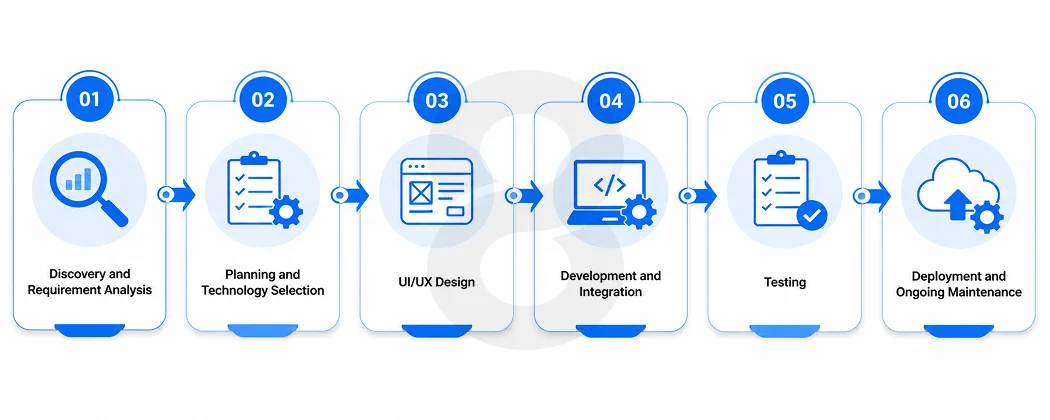
Discovery and Requirement Analysis
Plot out real procedure before writing a spec doc. Interview the users of the app (and their managers) and note all of the systems which the new system should read from/write to. This is the one thing that helps to avoid most of the scope creep that comes out of the woodwork on enterprise budgets later.
Planning and Technology Selection
Determine the application type: native, cross-platform or web-based; and cloud, on-premises or hybrid. This is also where the team establishes a realistic budget and timeline based on the integration list from discovery, instead of the other way around.
UI/UX Design
Most vendors think that enterprise users will be satisfied with a clunky interface, but they know that’s not the case when they have to work with it for eight hours every day. The real point of design is to get the job done in the shortest time possible, not for visual polish.
Development and Integration
This is where the app is developed in stages and system integration testing with the real ERP, CRM or legacy database occurs on an ongoing basis instead of as an end goal. When developing an enterprise, one of the most significant item of timeline is typically the documentation of legacy systems, which often is not well documented.
Testing
Enterprise apps require functional testing, security testing, load testing with usage volumes, and user acceptance testing with the people who will use the app every day. Any of these checks missed are the way bugs slip through to a support ticket queue straight after launch.
Deployment and Ongoing Maintenance
Test with one team or one region before rollout in the entire organization, gather authentic feedback and then roll out. There is no end to enterprise apps. When systems are connected, processes change, policies evolve, and integrations fail when they get upgraded, plan for continuous maintenance and support from the start.
Read More: Mobile App Development Process: From Idea to Launch
How to Choose the Right Enterprise App Development Approach
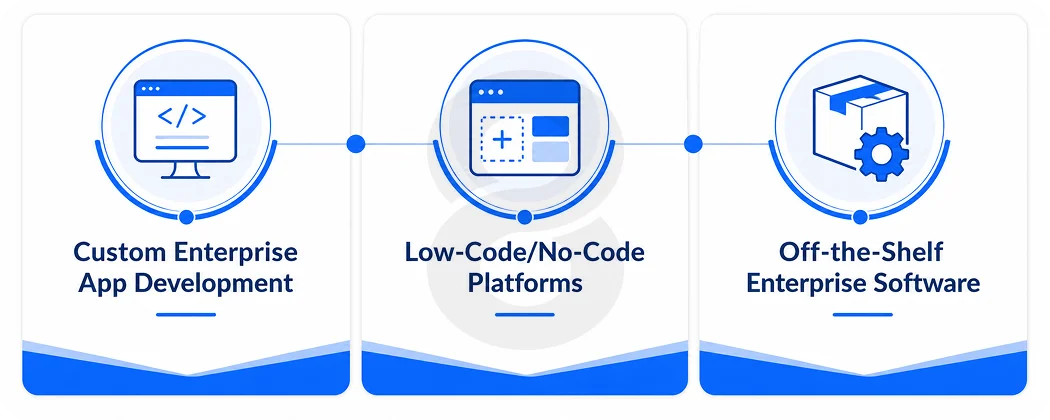
There are three real paths, and the right one depends less on budget and more on how specific your business process actually is.
| Approach | Best For | Trade-off |
|---|---|---|
| Custom Enterprise App Development | Businesses with Unique Workflows or Heavy Legacy Integration Needs | Higher Upfront Cost, Longer Timeline, Full Control |
| Low-Code / No-Code Platforms | Teams Needing to Launch Internal Tools Quickly with Limited Engineering Resources | Faster Delivery, but Limited Flexibility at Scale |
| Off-the-Shelf Enterprise Software | Standardized Processes Such as Basic Accounting or Email | Lowest Upfront Cost, but Requires the Business to Adapt to the Software |
Custom Enterprise App Development
Custom development makes sense when the business process is specific enough that generic software would force the company to change how it operates. It costs more up front but avoids the long term tax of working around a tool that was never built for the job.
Read More: Top Custom Enterprise App Development Companies
Low-Code/No-Code Platforms
Low-code and no-code platforms have become a realistic option for internal tools that don’t need deep integration or complex logic. They shorten time to launch considerably, though they tend to hit a ceiling once requirements grow more specific.
Read More: 10 Best No Code App Builders for 2026
Off-the-Shelf Enterprise Software
Off-the-shelf software works well for standardized, well understood processes. The risk is settling for it when the business process is genuinely unique, which usually ends in expensive workarounds a year or two down the line.
Essential Features Every Enterprise Application Should Have
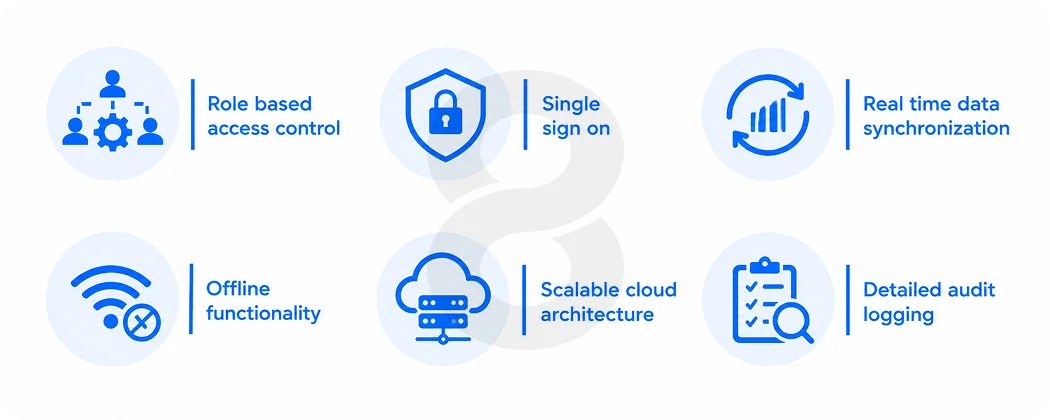
Strip away the marketing language and most enterprise applications succeed or fail on the same six fundamentals. Skip one of these and the app doesn’t crash, it just quietly stops being used.
- Role based access control: Nobody wants a finance dashboard cluttered with HR fields, and nobody should be able to see payroll data just because they logged in. Access should map to the job, not be an afterthought bolted on before launch.
- Single sign on: One login for the entire tool stack. Every extra password prompt is another reason an employee opens the old spreadsheet instead.
- Real time data synchronization: A dashboard showing yesterday’s inventory count isn’t a dashboard, it’s a history book. Data needs to move as fast as the business does.
- Offline functionality: Field teams don’t stop working because a warehouse has bad signal. An app that locks up without connectivity gets abandoned by the people who need it most.
- Scalable cloud architecture: The app that works for 50 users has to still work when the company doubles. Rebuilding from scratch a year after launch is an expensive way to find out it didn’t scale.
- Detailed audit logging: When a compliance auditor or a security incident asks “who changed this and when,” the app needs an answer already sitting in the logs, not a scramble to piece one together.
Enterprise App Development Cost: Key Factors That Affect Pricing
Cost is the question every buyer asks and the one most agencies dodge with “it depends.” A focused internal tool, think a single approval workflow or a reporting dashboard, generally lands in the tens of thousands of dollars.
A mid sized platform with role based access, a handful of integrations, and both web and mobile interfaces moves into six figures. A multi module enterprise platform with legacy system integration, custom security architecture, and phased rollouts across regions can run well past that.
What actually moves the number isn’t the number of screens. It’s three things: how many existing systems the app has to talk to, how strict the compliance and security requirements are, and how much of the backend has to be built from scratch versus configured on top of an existing platform.
Common Challenges in Enterprise App Development (and How to Overcome Them)
The biggest challenge is not technical; it’s adoption. Mobile apps often fail to load quickly or crash on minor updates, leaving them to be forgotten regularly, and a pretty significant portion of users will abandon an app entirely if it doesn’t load fast enough or it ships with glaring bugs. The solution is to take the pilot phase seriously, as much as the build itself, and not as a formality that precedes the roll out of the build.
Legacy integration is the second most prevalent challenge. Older ERP and CRM systems don’t always have clean docs, so integration testing should be ongoing during the development process, rather than until the final weeks of a project.
The third is security and compliance, particularly in regulated sectors such as healthcare and finance where adding security late in development is always more expensive than security built in from the architecture phase.
Read More: 5 Challenges Solved by Enterprise DAM Software in Blockchain
Enterprise App Development Trends to Watch in 2026
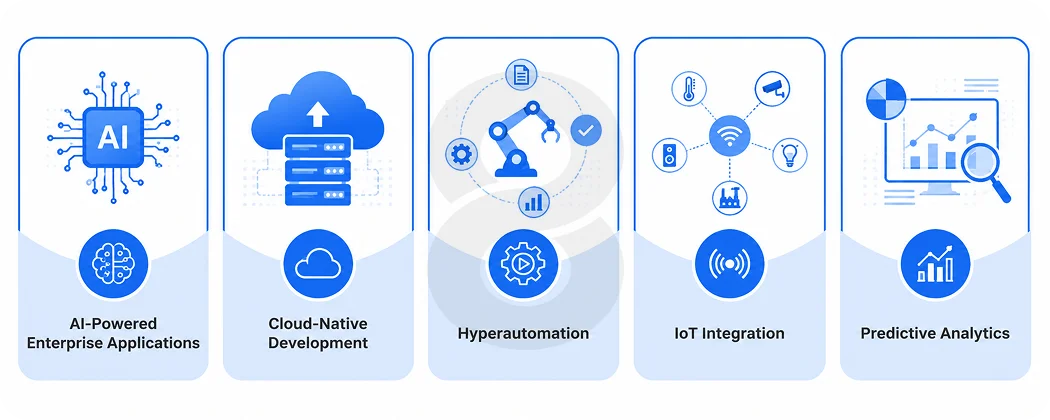
AI-Powered Enterprise Applications
AI is going beyond being just a marketing buzzword and becoming an integral part of enterprise applications. The most obvious successes have been intelligent workflow automation, such as routing approvals and highlighting exceptions without a human having to review every case, and AI assisted support, where AI chatbots are increasingly taking the load of routine internal help desk inquiries.
Cloud-Native Development
While regulated industries still rely on a hybrid deployment for compliance, the overwhelming majority of new enterprise deployments are now based on cloud, where scalability and reduced upfront investment in infrastructure are paramount.
Hyperautomation
Hyperautomation connects a series of automated processes, RPA, AI and process mining, enabling entire workflows of manual processes to be automated end to end, rather than just individual tasks.
IoT Integration
IoT connectivity is becoming standard in manufacturing and logistics apps, letting businesses track assets, run predictive maintenance, and catch issues before they cause downtime through dedicated IoT app development.
Predictive Analytics
Predictive analytics is shifting BI applications from reporting on what already happened to flagging what’s likely to happen next, which is where the real operational value now sits, particularly for ecommerce and manufacturing businesses managing high transaction volumes.
Read More: Top Trends App Development Agencies Should Follow in 2026
How to Choose the Right Enterprise App Development Company
Look past the portfolio screenshots and ask three practical questions: has this company built for your industry’s specific compliance requirements before, do they involve actual end users during discovery rather than just stakeholders, and do they have a clear plan for integration testing with your existing systems rather than treating it as an afterthought.
8ration works with enterprises across fintech, healthcare, manufacturing, logistics, and retail, handling the full lifecycle from discovery workshops with real end users through to phased rollout, with design, mobile app development, and testing running in parallel with core engineering so issues surface early instead of at the finish line.
Read More: Mobile App Maintenance Services: What Startups and Enterprises Actually Need
Final Thoughts
Enterprise app development succeeds or fails long before the first line of code gets written. It succeeds when discovery actually involves the people doing the job, when security and integration are designed in from the start rather than patched on later, and when rollout treats adoption as seriously as the build itself.
If you’re mapping out an enterprise app for your organization, talk to 8ration’s team about scoping a roadmap that fits your systems, your compliance requirements, and the people who’ll actually use it every day.