


A single-team sales dashboard typically falls in the $8K to $30K range. Add third-party integrations and you’re looking at $30K to $90K. Enterprise builds start around $90K and can go well beyond $250K. The spread is wide because CRM dashboard development is priced by what sits behind the interface rather than the interface itself.
Two dashboards can look nearly identical on screen while one costs eight times more to build, usually because of integrations, data volume, and security requirements. This breakdown covers every tier and where teams overspend without realizing it.
What is a CRM Dashboard and What Does It Do
A CRM dashboard is the visual control layer of a customer relationship management system. It pulls everything from contact records and deal stages to revenue numbers and team activity into one screen. The dashboard is what your team stares at all day. That’s why it gets scoped and priced as its own project even when the core CRM logic is already in place.
Core functions of a CRM dashboard
- Contact and account management with full interaction history
- Sales pipeline tracking across deal stages
- Revenue and performance reporting
- Activity logging for calls, emails, and meetings
- Data visualization through charts, funnels, and widgets
- Role-based views so a sales rep and a CEO see different things
Who needs a custom CRM dashboard
The usual buyers are SaaS companies tracking trial-to-paid conversion or financial platforms that need customer data handled under strict compliance rules. Companies in regulated spaces often go custom specifically because off-the-shelf tools limit how data is stored and audited. It’s a recurring theme in fintech software and real estate platform projects.
There’s also a broader market shift pushing companies in this direction. The global CRM market came in at $73.4 billion two years ago and Grand View Research projects it will reach $163.16 billion by 2030. As SaaS licensing fees climb alongside that growth, more companies are doing the math and realizing that owning their system outright often pencils out better long-term.
Read More: Top 10 CRM Software Platforms of 2026
How Much Does CRM Dashboard Development Cost
CRM dashboard development costs $8K to $250K or more. The pricing depends on feature depth and compliance requirements. Here is a complete breakdown of each tier.
Basic CRM dashboard ($8K to $30K)
At the basic tier, you’re getting contact management and straightforward role permissions. It’s a good fit for small teams who’ve outgrown spreadsheets but don’t need their CRM talking to other tools yet. Automation is limited, integrations are minimal, and that’s fine for a first version. Plenty of teams run on a basic dashboard for two or three years before the business actually justifies more.
Mid-range CRM dashboard ($30K–$90K)
This is where most growing companies land. At this level, the budget covers custom workflows, email and calendar sync, and mobile-responsive layouts. The price jump from the basic tier comes almost entirely from integration complexity and data architecture. Every external system you connect to adds development and testing time, and that adds up fast.
Enterprise CRM dashboard ($90K–$250K+)
Enterprise builds are a different animal. You’re looking at multi-module systems spanning sales, support, and operations, plus AI-assisted features like lead scoring, plus compliance work for frameworks like GDPR or HIPAA.
These projects also carry dedicated DevOps and QA costs that smaller builds tend to roll into general development. If your dashboard will serve hundreds of users across departments or your industry regulator can fine you for mishandled data, you’re in this tier.
Ongoing maintenance and hosting
Budget $200 to $2K per month depending on scale. Cloud hosting for a small dashboard can run anywhere from $50 to a few hundred dollars monthly. Enterprise infrastructure with redundancy and active monitoring costs considerably more. On top of that, plan for routine bug fixes and small feature updates. The standard industry rule of thumb is 15–20% of the original development cost per year.
| Dashboard Tier | Estimated Cost | Timeline |
|---|---|---|
| Basic | $8,000 – $30,000 | 1–3 Months |
| Mid-Range | $30,000 – $90,000 | 3–6 Months |
| Enterprise | $90,000 – $250,000+ | 6–12+ Months |
What Factors Drive CRM Dashboard Development Costs
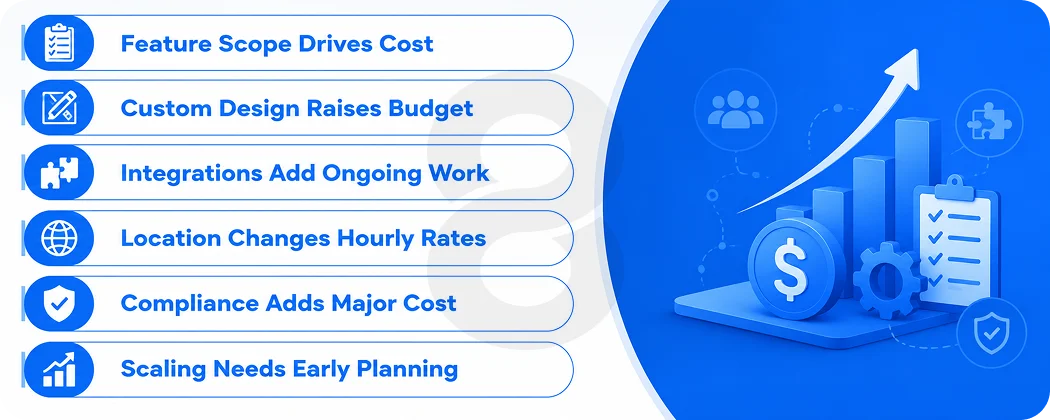
Two projects with the same page count can differ in price by six figures. These are the variables that actually move the number, roughly in order of impact.
Feature complexity and number of modules
Feature scope is the single biggest cost driver. A pipeline view with a contact list is a few weeks of work. Add workflow automation, a custom report builder, forecasting, and territory management, and you’ve roughly quadrupled the scope. Each module brings its own data model and testing overhead. Being honest about which features you actually need at the start will save you more bucks than any other decision.
UI/UX design requirements
A dashboard assembled from a component library like Material UI costs a fraction of a fully custom design system. Custom design makes sense when the dashboard is customer-facing or when your team will live in it eight hours a day and small friction compounds. Dedicated UI/UX design typically adds $5K–$25K to a project. For internal tools, that budget is often better spent on data quality.
Third-party integrations
Whether it’s email platforms, payment gateways, telephony providers, or legacy ERPs, every external system you wire in adds both development hours upfront and a maintenance liability that doesn’t go away. Third-party APIs get updated, deprecated, or restructured on the vendor’s schedule, not yours, and integrating changes on their timeline becomes your team’s problem.
Complex system integration work is regularly the single largest line item in mid-range and enterprise budgets, and it is the item clients most often underestimate.
Development team location
Rates vary significantly by geography. US-based agencies typically bill $100-$200 per hour. Eastern European teams run $40–$80, and South Asian teams $20-$50. According to the Bureau of Labor Statistics, the median software developer salary sits at $133,080 per year. It’s around $64 an hour in base wages, before overhead, management, and QA enter the picture.
The fully loaded cost to a US agency is substantially higher than that. A lot of companies handle this by keeping product ownership and architecture decisions in-house while distributing the actual development work to lower-cost regions.
Data security and compliance
If your CRM touches health data or anything covered by GDPR or HIPAA, you’re looking at encryption at rest and in transit and third-party security review. Compliance requirements can add 20-40% to a project’s cost, which is the main reason fintech and healthcare dashboards consistently sit at the top of the price range.
Scalability architecture
A monolith built for 30 users is cheaper upfront than a service-based architecture designed for 3,000. The mistake is paying for scale you won’t reach for five years. The opposite mistake (building a quick monolith for a company that’s doubling headcount annually) is actually worse, because rearchitecting a live system with real production data in it costs far more than getting the architecture roughly right the first time.
Read More: CRM on Android: How to Build a Custom CRM App for Your Business
What Features Should a CRM Dashboard Include
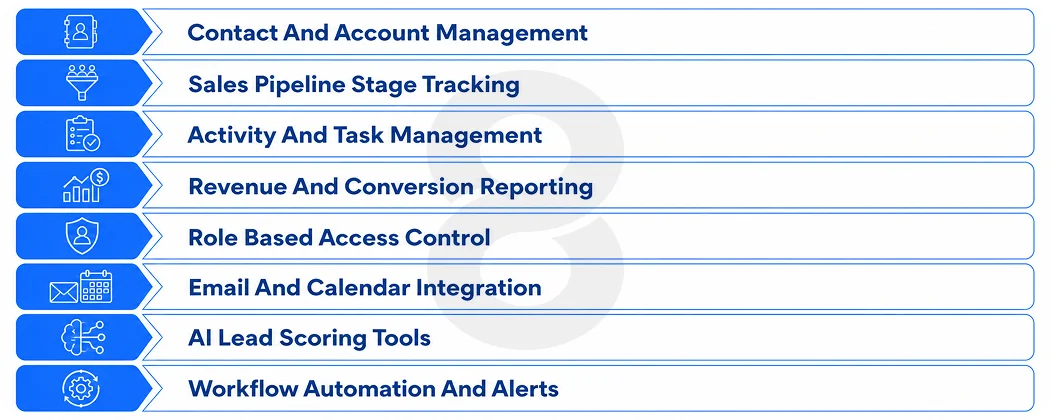
Feature selection is where budgets are made or destroyed, so it helps to separate what every dashboard needs from what only some businesses need.
Must-have features for any CRM dashboard
- Contact and account management with interaction history
- Sales pipeline visualization with drag-and-drop deal stages
- Activity feed and task management
- Reporting and analytics widgets for revenue and conversion
- Role-based access control
- Email and calendar integration
Advanced features for growth-stage businesses
- AI-powered lead scoring and predictive analytics, usually delivered through dedicated AI development work on top of the core dashboard
- Custom report builder so teams stop exporting to Excel
- Workflow automation for follow-ups and stage changes
- Real-time notifications
- A mobile-responsive layout or native companion app
- API-first architecture so future integrations do not require rework
Features you probably don’t need in v1
AI chatbots, custom forecasting models, territory management, multi-language support leave all of it out of your first release unless your business already depends on them. These are the features that inflate quotes, delay launches, and get redesigned anyway once actual usage data shows you how your team really works.
Custom CRM Dashboard vs Off the Shelf Software
The build vs buy question comes down to timing and scale. Off the shelf CRMs win in the first year or two. Custom wins when per-user licensing starts compounding or when the platform simply can’t bend to fit how your team actually operates.
| Criteria | Custom Dashboard | Salesforce | HubSpot (Sales Hub) | Zoho CRM |
|---|---|---|---|---|
| Upfront Cost | $8K–$250K | Setup + Licensing | Setup + Licensing | Setup + Licensing |
| Monthly Cost | Hosting Only | $25–$550/User | $15–$150/User | $14–$52/User |
| Customization | Full | Limited | Limited | Moderate |
| Data Ownership | Full | Vendor-Held | Vendor-Held | Vendor-Held |
| Integration Flexibility | Full | Ecosystem-Bound | Ecosystem-Bound | Moderate |
| Long-Term Cost | Lower at Scale | High | High | Medium |
SaaS figures here reflect published per-user pricing as of mid-2026. Vendors adjust these regularly, so check the official Salesforce pricing page and its equivalents before making any final decisions.
The math tends to tip toward custom somewhere around 25–50 users. A 40-person team on a $175/user enterprise SaaS tier is spending $84K a year on licenses alone. Under 15 users, off the shelf is almost always the right call.
Read More: Hire CRM Developer vs. Buy Ready-Made CRM Software: What’s Right for Your Business?
How Long Does CRM Dashboard Development Take?
Timelines follow the same tiers as cost. Basic dashboards take 1 to 3 months, mid-range builds take 3 to 6 months, and enterprise systems run 6 to 12 months or longer.
Basic dashboard (1 to 3 months)
A typical breakdown: 1 to 2 weeks of discovery… 2 to 3 weeks of design… 4 to 8 weeks of core development… and 1 to 2 weeks of QA and launch. Teams with a clear, agreed-upon feature list sometimes compress this further. Though skipping discovery to save a week tends to cost a month somewhere down the line.
Mid-range dashboard (3 to 6 months)
The phases are the same, but integration work stretches the middle significantly. Each third-party connection typically adds one to three weeks once you account for implementation, sandbox testing, and handling the edge cases those APIs never actually document. Reporting engines also eat more QA time than most teams expect. A wrong number on a revenue chart is a worse problem than a missing feature.
Enterprise dashboard (6 to 12+ months)
Sensible enterprise projects ship in phases rather than as one big bang release. An MVP covering core pipeline and reporting goes live somewhere around months four to six. However, compliance hardening, AI features, and secondary modules follow in scheduled increments. Phased delivery lowers risk and means the business gets real value long before the full system is finished.
What Tech Stack is Used in CRM Dashboard Development
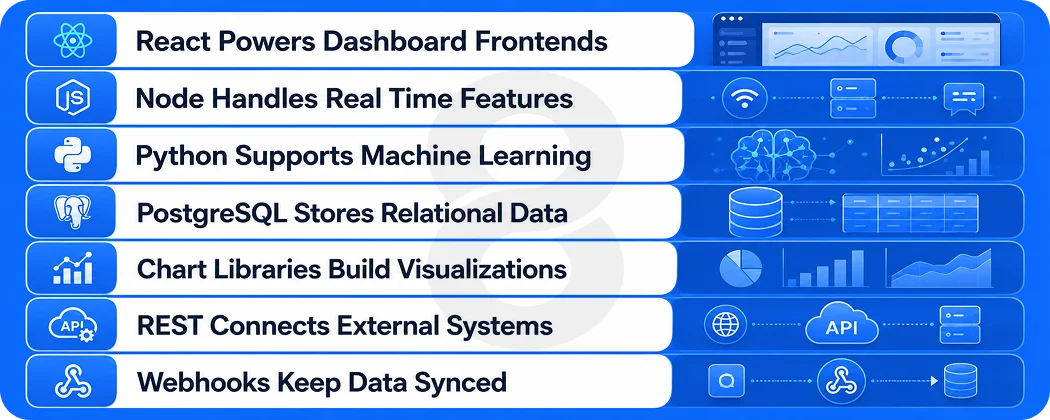
The stack matters less for cost than features do but it matters quite a bit for hiring and long-term maintenance. So it’s worth having a clear picture of what sensible defaults look like.
Frontend
React is the dominant choice for dashboard work, with Vue and Angular as the common alternatives. In the 2025 Stack Overflow Developer Survey, React and Node.js ranked as the most widely used web technologies among professional developers.
It translates directly into a larger hiring pool and lower maintenance costs over the life of your dashboard. Angular still shows up in large enterprises that already have Angular teams in place.
Backend technologies
Node.js and Python (Django or FastAPI) cover most CRM builds. Node pairs naturally with React frontends and handles real-time features well, while Python is the stronger pick when the roadmap includes machine learning for lead scoring or forecasting.
Database layer
PostgreSQL is the default for CRM data. Customer records are inherently relational (contacts tied to companies tied to deals tied to activities) and PostgreSQL handles that structure cleanly.
Data visualization libraries
Chart.js and Recharts handle standard dashboard widgets at low cost. D3.js enables fully custom visualizations at meaningfully higher development effort, so it belongs in projects where a specific chart is the product rather than decoration.
API and integration layer
REST remains standard, GraphQL earns its complexity when many client apps consume the same data, and webhook support is what keeps your dashboard in sync with email platforms, payment providers, and telephony tools without constant polling.
Read More: How Much Does It Cost to Hire a CRM Developer in 2026
How to Reduce CRM Dashboard Development Costs
Most budget overruns are self-inflicted. These six decisions consistently keep projects on the affordable end of their tier.
- Start with an MVP. Build the 3 or 4 features your team uses daily instead of the 15 on the wishlist. You can always extend a live product, and usage data will reorder that wishlist anyway.
- Use a component library such as Material UI or Ant Design for the interface. Custom design systems are for customer-facing products, and an internal tool rarely earns one.
- Push integrations to Phase 2. Launch with email and calendar sync, then add the rest once the core dashboard has proven itself.
- Choose a development partner over a solo freelancer for anything beyond a basic build. A dashboard touches design, backend, data, and QA at once, and an established custom software development team absorbs those handoffs without you playing project manager.
- Plan the data architecture upfront. A badly designed database is the most expensive thing to fix after launch, because by then it is full of production data.
- Define user roles and permissions before development starts. Permission scope creep is one of the quietest budget killers in CRM projects, since every new role multiplies the testing surface.
How 8ration Builds CRM Dashboards
8ration runs CRM and dashboard projects through a fixed sequence of discovery, prototyping, iterative development, QA, and handoff, with software consulting up front to lock scope before anyone writes code and dedicated software testing before anything ships. The team works across fintech, SaaS, and service businesses, which is where custom data platforms come up most often.
The relevant proof is in shipped data-heavy products. Munitora is a livestock and farm management platform 8ration built around centralized record keeping and operational dashboards for a traditionally offline industry. Cinnamon is a patient access platform handling support programs and real-time assistance, the kind of build where data handling rules shape the architecture from day one.
Both projects follow the same principle 8ration applies to CRM work, which is shipping a focused core system first and expanding it against real usage rather than speculation. Pricing is scoped per project, with the phased delivery model described earlier used on anything above the basic tier.
Read More: CRM App Development: Complete Guide to Custom CRM Software & Mobile Apps
Is Custom CRM Dashboard Development Worth the Cost
For a team under 15 people with standard sales workflows, no. Buy an off-the-shelf CRM, spend the savings on actually selling, and revisit the question in two years.
For companies past 25 to 50 users, businesses in regulated industries, and any team whose process genuinely does not fit the SaaS mold, custom CRM dashboard development usually wins the three-year math, since license fees compound while a build cost is paid once.
The honest middle path is starting with a mid-range MVP in the $30,000 to $60,000 range and letting real usage justify every dollar after that. If you want a number for your specific feature list before committing to anything, a short scoping conversation with 8ration will get you one.