


Metaverse app development is the work of building apps where people meet inside a shared 3D world and interact through avatars in real time. Social platforms run on it, and so do games, corporate training programs, and virtual showrooms.
The metaverse hype died down after 2022, and honestly the work got better for it, since the companies still spending here are spending because the math works rather than because a board member read a trend report.
Grand View Research projects the market will grow from $105.4 billion in 2024 to $936.57 billion by 2030, which is 46.4% a year. This guide covers what goes into metaverse app development and how to find a development partner before you burn six months on the wrong scope.
What is Metaverse App Development
Metaverse app development covers the design, engineering, and launch of apps built around shared virtual spaces that persist. Log off, and the world carries on without you. That detail sounds small, but it is the entire difference between a metaverse app and a regular multiplayer session or a video call with a 3D background.
Building one means juggling a few hard problems at the same time. The rendering layer has to draw a believable world on a midrange Android phone and a $3,500 headset alike, which is a rougher constraint than it sounds.
Then comes networking, which has to keep hundreds of people synchronized closely enough that lag never breaks the illusion. And underneath everything sits identity and economy, the part that lets someone buy a thing, trade it, and find it waiting when they come back tomorrow.
How metaverse apps differ from VR and AR apps
People swap these terms around constantly, and the confusion gets expensive at the scoping stage. Virtual reality means one person inside a headset, fully cut off from the physical room, which is why virtual reality app development revolves around a single device pipeline.
Augmented reality goes the other way and layers digital objects over the real world through a phone camera. Retail and home design brands love augmented reality apps for exactly that reason. A metaverse app might use VR, might use AR, or might use neither.
The shared world underneath is what defines it. Someone in Karachi and someone in Dallas open different devices, walk into the same space, and whatever one of them changes, the other one sees.
Types of metaverse apps
Social worlds get the most attention, built around hangouts, events, and creator communities. Gaming lives next door, and some of it stays casual while some of it goes deep into blockchain game territory, where players own the items they grind for. Then you have commerce, where a store becomes a 3D showroom with virtual try on features and product walkthroughs.
The categories nobody tweets about are growing faster, though. Enterprises want training simulators and collaboration spaces for teams spread across time zones. Real estate firms have figured out they can sell property through virtual tours before the foundation is even poured, and event companies keep booking branded virtual venues because they cost a fraction of a physical one.
All of these run on the same technical foundation, which is why a single development team can usually cover several of them.
Read More: Top 8 Augmented Reality Frameworks to Power Your Next Spatial App
Why Businesses are Investing in the Metaverse Now
The investment case rests on numbers that outlived the hype. McKinsey put the metaverse’s potential value at up to $5 trillion by 2030, and ecommerce alone could account for as much as $2.6 trillion of it. Enterprise is on its own trajectory too. Grand View Research values the enterprise metaverse market at $42.56 billion in 2025 and expects $667.34 billion by 2033.
There is one stat worth taping to the wall before you plan anything. Precedence Research found mobile held 59.27% of the platform segment in 2025. Read that again if you are budgeting around headsets. Your users are on phones, and that reality should shape your graphics budget, your control scheme, and the platform your first version ships on.
Industry use cases that are working
The consumer land grab of 2022 mostly fizzled. What survived is duller, and it makes money. A manufacturer puts new hires in front of virtual equipment so the mistakes happen in simulation instead of on the factory floor.
A retailer stands up a 3D showroom and watches return rates drop. Hospitals rehearse procedures in simulated theaters before anyone touches a real patient and event companies run product launches in branded worlds since nobody needs a flight or a hotel. None of it trends the way virtual land speculation once did. The invoices clear anyway.
Key Features of a Metaverse App
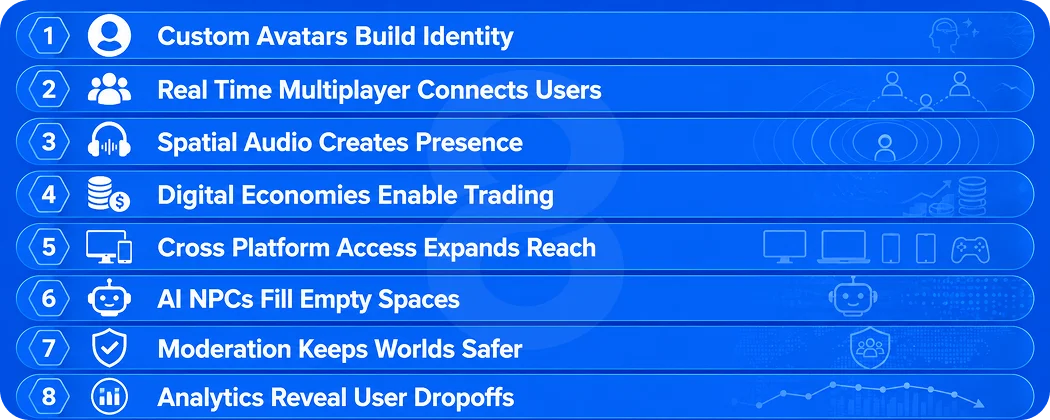
Feature lists vary by use case, but the apps that keep users share a common core.
- Avatars users can customize and keep between sessions, because identity is the hook that brings people back.
- Real time multiplayer with position, voice, and interaction data synchronized across every connected device.
- Spatial audio matters more than people expect. When a conversation across the room actually sounds far away, the space starts feeling like a place instead of a chat app with graphics.
- The app needs an economy where people can buy, sell, and trade digital goods. Blockchain can sit underneath that, but it does not have to.
- Cross platform access has to work, so the person on a phone and the person in a headset can stand in the same room together. Lock the app to one device and you shrink your audience before launch.
- AI now runs the NPCs, and their job is to welcome newcomers and keep quiet corners from feeling abandoned. The good ones talk without sounding like a script.
- Moderation and safety tools belong in the first release, since a shared world left without them turns hostile in a matter of weeks.
- Analytics should show where users actually go and where they quit. You cannot fix a drop off point you never saw.
Read More: 15 Real-World Examples of Augmented Reality Transforming Modern Industry
Metaverse App Development Tech Stack
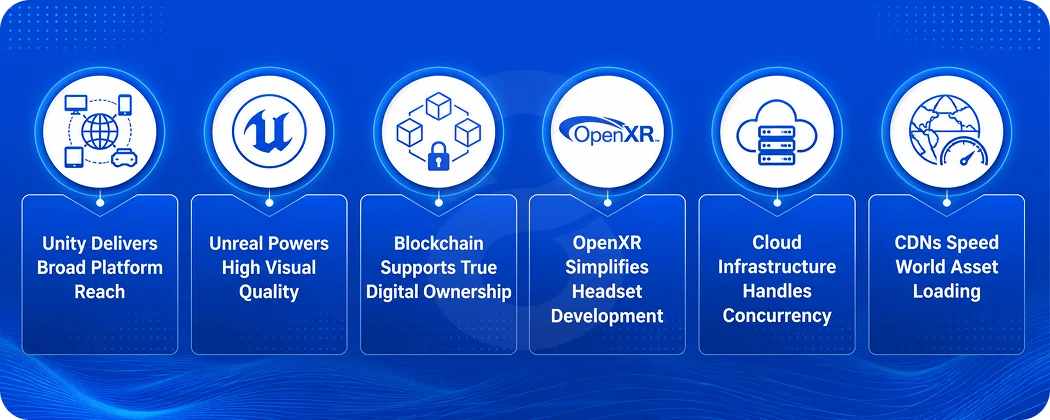
The stack has settled since the experimental years. Here is what production teams actually use in 2026.
Game engines
Unity and Unreal Engine build most of the metaverse between them. Reach is Unity’s whole argument. One codebase from a Unity game pipeline ships to iOS, Android, WebGL, and every headset that matters, and the asset ecosystem around it shaves months off production.
Unreal wins on visual quality. Studios choose Unreal Engine when the world itself is the selling point, as in photorealistic showrooms and architectural walkthroughs. Plenty of projects prototype in Unity and never find a reason to leave it.
The blockchain and Web3 layer
Here is an unpopular opinion from people who build both kinds of apps. Most metaverse apps do not need blockchain. If users only need to buy cosmetics and access passes, a standard payment system costs less and is far easier to support. Blockchain earns its place when true ownership matters, meaning users can trade assets with each other or carry them beyond your platform.
In those cases, smart contract development handles the ownership logic and crypto wallet integration lets users actually hold what they buy. Decide this early, because bolting Web3 onto a finished app is expensive, and it shows.
AR, VR, and mixed reality SDKs
Every device family has its own SDK sitting between your engine and the hardware, and this is where platform politics show up in your codebase. Phone AR is the easy part. ARKit covers iOS and ARCore covers Android. Both are mature enough that they rarely surprise anyone.
Headsets got simpler once OpenXR settled in, since one API now reaches almost all of them, though Meta still pushes its own SDK for Quest extras like hand tracking and passthrough. Most teams just run OpenXR with the Meta layer bolted on top.
Then there is Apple. visionOS shares almost nothing with the rest of the headset world, and pretending otherwise burns budgets. Everything from the interaction model to the review process works differently over there, which is why Vision Pro app gets planned as its own workstream from day one rather than a port at the end.
Backend, networking, and cloud infrastructure
Nobody screenshots this layer, and it still decides whether the app survives launch day. World state has to stay synchronized somehow, either through a multiplayer framework like Photon or a custom setup built on WebSockets.
Cloud hosting has to scale with concurrent users rather than downloads, which surprises teams used to standard mobile economics. A CDN delivers 3D assets so worlds load in seconds instead of minutes. Skimp here and every beautiful thing the art team made will stutter.
Read More: VR App Development: Costs, Features & Factors
How to Develop a Metaverse App: Step by Step
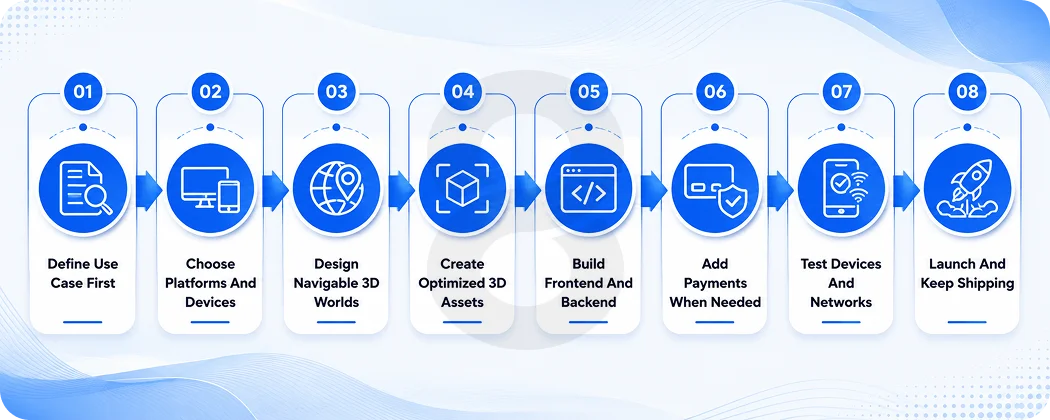
The process below reflects how experienced teams actually run these projects, including the parts that usually go wrong.
1. Define the use case and audience
Start with who shows up and why they come back a second time. A training simulator for 200 employees and a social world chasing a million downloads are different products with different budgets. Write the retention loop down before anyone opens an engine.
2. Choose platforms and devices
Mobile first is the default for consumer apps given where the users are. Headset first makes sense for training and simulation, where employers supply the hardware. This single decision shapes your graphics budget, your controls, and half your timeline.
3. Design the world and the user experience
UX in 3D space follows different rules than screens. Users get lost, so worlds need landmarks and sightlines the way cities do. Onboarding deserves extra attention, since the first five minutes decide whether a new user ever returns.
4. Create and optimize 3D assets
Asset production eats the most calendar time on most projects. Every model needs polygon budgets and level of detail versions so the same scene runs on a phone and a headset. Licensed asset libraries speed things up, while custom art defines worlds people remember.
5. Build the frontend and backend
Engine work covers movement, interaction, avatars, and interface, while the backend handles accounts, world state, inventory, and matchmaking. Run these tracks in parallel with integration checkpoints every few weeks, because finding sync bugs at the end is misery.
6. Add payments and the Web3 layer if needed
Wire in purchases, subscriptions, or marketplace fees, and add smart contracts plus wallet support only if your ownership model demands it. Payment flows need real testing under load since a checkout that fails inside a virtual store kills trust instantly.
7. Test across devices and network conditions
Test on the worst phone you plan to support, then on every headset. Simulate packet loss and crowded servers, and put real users in the world before launch. Motion comfort testing matters too, because a world that makes people queasy will collect refunds.
8. Launch and keep shipping
A metaverse app launch is the start of live operations rather than the end of development. Worlds that receive fresh content every few weeks keep their populations, while worlds that go quiet empty out fast and rarely recover.
How Much Does Metaverse App Development Cost
Most metaverse app development projects come in somewhere between $40,000 and $250,000. The low end buys a focused pilot, meaning one environment, basic avatars, nothing fancy. A persistent platform with a live economy starts around $250,000, and once you count a year of live operations it can clear $500,000 without trying.
Be suspicious of anyone who hands you a number before asking how many concurrent users you expect, because that number is a guess dressed up as a quote.
| Project Tier | Typical Cost Range | Timeline |
|---|---|---|
| Pilot experience with one environment and basic avatars | $40,000 to $90,000 | 3 to 5 months |
| Mid-scale app with multiplayer, custom avatars, and an in-app economy | $90,000 to $250,000 | 5 to 9 months |
| Full platform with a persistent world, Web3 layer, and creator tools | $250,000 and up | 9 to 18 months |
The wildly different figures you will see across the web mostly reflect different project scopes rather than different pricing, so compare quotes against a written feature list instead of against each other.
What moves the number
Graphics fidelity is the biggest lever, since photorealism can double an art budget on its own. Concurrency targets drive backend cost, and supporting 1,000 users in one space is a different engineering problem than supporting 50.
Device coverage adds cost per platform, Web3 features add contract development and audits, and custom art costs several times more than licensed assets. Team rates vary by region too, which is why identical scope gets quoted at very different prices in the US, Europe, and South Asia.
Ongoing costs after launch
This is the part most first time buyers miss. Servers bill by concurrent usage and grow with your success. Moderation needs staffing or tooling from day one. Content updates have to ship every few weeks or the world empties out, and headset OS updates break something at least once a year.
A common planning figure is 15 to 25 percent of the build cost annually, and teams that skip this line item usually relaunch within two years.
Challenges in Metaverse App Development
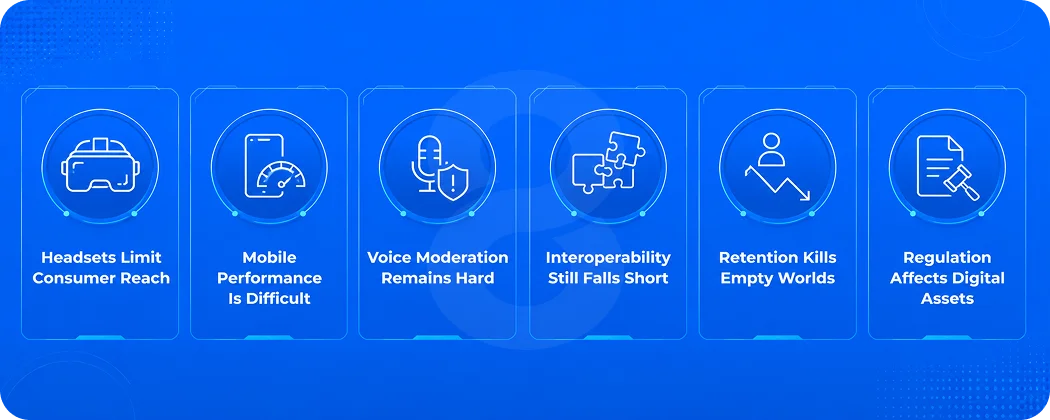
Hardware remains the awkward part. Headsets are still expensive for consumers, which is why the mobile numbers above matter so much, and building one world that performs on both a midrange phone and a high end headset is genuinely hard engineering. Moderating real time voice chat at scale is an unsolved problem that every social world wrestles with.
Interoperability standards exist mostly on paper, so assets rarely move between platforms despite years of promises. Regulation around digital assets varies by country, which matters the moment you sell tokens across borders.
And then there is retention, the quiet killer. Plenty of worlds launch to press coverage and sit empty by month three. Design for the second visit, not the screenshot.
Read More: Hire VR Developers: Complete Guide to Hiring Skilled Virtual Reality Developers
How to Choose a Metaverse App Development Company
Start by asking to walk into something the company has shipped, today, on your own phone, because a portfolio screenshot tells you nothing about how a world actually performs. Look for depth in both Unity and Unreal as well, since a team that only knows one engine will recommend that engine every single time, whatever your project needs.
And notice what they ask you in the first call. Good partners want to know about concurrent users, target devices, and what brings a user back on day seven. If the conversation jumps straight to a quote, so should your exit.
Honesty about blockchain is a useful filter, and a company that pushes tokens onto a training simulator is selling its own margins. Ask about live operations experience, because shipping is the easy half. Finally, get post launch support terms in writing before you sign anything, including response times and what an update costs.
Metaverse Development Trends to Watch Beyond 2026
AI is the shift that actually matters. Generative tools now produce environment variations, quest content, and NPC dialogue that used to consume entire art and writing budgets, which is why generative AI development keeps showing up inside metaverse project scopes rather than as a separate line of work.
Spatial computing keeps pulling AR and VR toward each other as passthrough devices improve, and the industrial metaverse, meaning digital twins of factories and infrastructure, keeps growing regardless of consumer sentiment.
Interoperability is inching forward through groups like the Metaverse Standards Forum, though a truly portable avatar remains more roadmap than reality.
Read More: Virtual Reality vs Augmented Reality: Choosing the Right Tech for Your MVP
Metaverse App Development With 8ration
8ration’s team builds AR, VR, and full metaverse products, with Unity and Unreal teams covering everything from 3D environment design to multiplayer backend infrastructure.
A few shipped projects make the point. FitCoach is an AR fitness app with virtual trainers and real time form correction. VisionHome lets homeowners place furniture and plan renovations inside their actual rooms, and CraftMaster teaches occupational skills through 3D guided training. Enterprise clients have shipped VR training programs and Vision Pro apps with the same team.
If you are scoping a metaverse project, the engagement starts with a working session on your use case, target devices, and budget, and you leave with a written scope you can compare against any other quote on the market.