


Everyone has a story about the AI pilot that went nowhere. The demo looked incredible. The deck had a chart pointing up and to the right. Six months later the thing is sitting in a branch nobody merged, the person who championed it has switched teams, and the next budget meeting is a little awkward.
If you’ve lived that, you already know the hard part of AI system integration isn’t the AI. It’s everything around it. The data that turned out to be a mess, old system with no clean way to get records out of it, security review nobody scheduled, and tool that worked great in a sandbox and fell apart the second real customers touched it.
So the question in the title matters more than it looks. Choosing who builds this with you shapes the outcome far more than which model ends up running underneath. A good partner saves you a quarter of runway and a lot of credibility.
A bad one burns both and hands you a half wired system you now have to keep alive. What follows is a guide to telling them apart, written for the person who signs the contract and then has to explain the result.
Why So Many AI Projects Die After the Demo
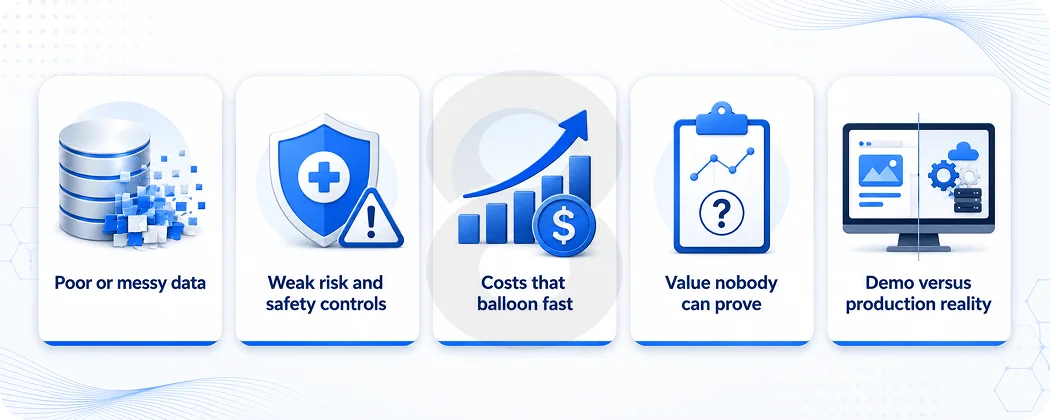
Here’s the part nobody really wants to say out loud. The tech, most of the time, does its job. What sinks these projects lives somewhere else entirely, miles away from whether the model is any good.
When Gartner dug into why so many of these get scrapped, the reasons were almost dull. Data that turned out to be a mess. Risk controls nobody had bothered to set up. Costs that crept past the budget while everyone just sort of watched it happen.
And value that, when you went back and asked for it later, nobody could really point to. Sit with that for a second. Not one of those is the AI’s fault. It’s the conditions you dropped the AI into.
The model that answered perfectly in the pitch starts confidently making things up the moment it hits a gap in your records. And the cost that looked tiny per request turns into a real number once thousands of people are hitting it every day.
This is the gap that swallows budgets. Teams treat the proof of concept as the finish line when it’s barely the starting block. Getting something to work once, for one person, in a clean setting, is the easy 20 percent.
The other 80 percent is making it reliable, secure, affordable, and connected to the systems that run your business. That is the part a development partner is for and it’s the part the slick ones gloss over.
The Unglamorous Work Behind AI System Integration
Strip away the marketing and the work is plumbing. It’s the job of connecting a model to the data, applications, and workflows your business already runs on, so its answers are grounded in your reality instead of generic internet sludge.
That gap, by the way, is the whole thing. Drop an AI tool in on its own and the best you’ll get is generic, because it has no clue who you are. It doesn’t know what your customers bought last week or what’s stacking up in your support queue.
Wire it into the systems you already run and the whole picture shifts. Now it’s pulling from real records, working off your rules, getting real work done inside the tools your team already has open. The model never changed. What you get out of it did, and the one thing that moved was how well somebody connected it.
| Approach | What it means | Fits when | The catch |
|---|---|---|---|
| Embedded AI features | Switching on the AI already baked into tools you own | You want quick wins with little setup | Generic outputs, almost no room to customize |
| API integration | Connecting outside AI services to your apps through APIs | You need real control over inputs and outputs | You now own the data flow, the security, and the upkeep |
| Retrieval augmented generation (RAG) | Feeding a model your own documents and data at the moment of the query | Answers must come from your content, not guesses | Quality depends entirely on how clean your data is |
| A standard integration layer (iPaaS or MCP) | One governed layer that connects many models to many systems | You’re wiring AI across several tools and want a single place to manage it | Newer tooling, still maturing for heavy enterprise use |
| Fully custom build | Models and pipelines built around your exact workflows | Prebuilt options don’t fit and the use case is core to the business | The highest cost and the longest timeline |
Read More: How AI-Powered Mobile Apps Are Transforming Businesses in 2026
Why Model Context Protocol Matters in AI System Integration
One shift has changed how the smart partners think. The Model Context Protocol is an open standard Anthropic introduced in late 2024 and handed to the Linux Foundation a year later, and by now every big AI provider has gotten behind it.
The nickname people use is a universal adapter, and that’s about right. Instead of a pile of one off connectors that each break in their own special way, you get one path for any model to reach into your tools and your data. Forget the acronym for a minute.
What you’re really listening for is whether the partner sitting across from you knows the thing exists and has an opinion on it, whether your build belongs on top of it or has no reason to, instead of stitching together fragile little connections that somebody is going to be babysitting forever.
What Separates a Partner from a Vendor
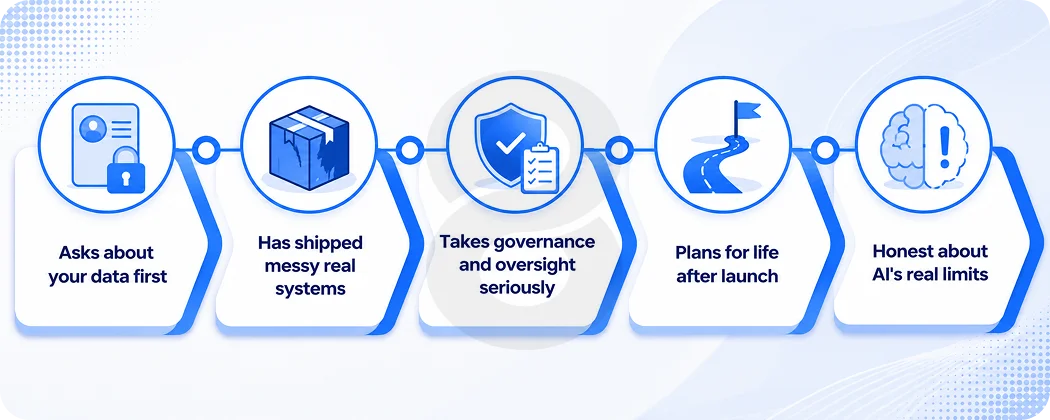
A vendor sells you a thing and moves on. A partner cares whether the thing still works in a year. On a sales call they can sound identical, so you have to listen for what they bring up before you do.
They ask about your data first
A partner asks about the state of your data almost immediately, because that’s where projects live or die. If clean, organized information is the fuel, most companies are running on fumes and don’t realize it yet. Someone who skips straight to model talk without asking what shape your records are in is either inexperienced or hoping you won’t notice the bill for cleanup later.
They’ve shipped into messy, real systems
Connecting AI to a brand new app is easy. Connecting it to a twelve year old system that powers half your revenue and has no clean export is hard and that’s usually the actual job. Ask what they’ve wired into. If every example is a greenfield side project, they haven’t met the kind of resistance your stack will throw at them.
Read More: AI and Machine Learning: How a Modern App Development Firm Stays Ahead
They take governance seriously
Now move all of that into finance, or into healthcare platforms, where the rules have real teeth. A wrong answer there isn’t a bad look you shrug off in standup. It can land you in front of a regulator. So a partner worth hiring brings up guardrails and monitoring and keeping a human in the loop before you even think to ask.
The good ones will also tell you, flat out, where AI has no business being. That can read like a downside. It’s the opposite, because it means they’ve already gone looking for the spots where this stuff comes apart.
Read More: Healthcare Automation Solutions Explained: From Scheduling to Claims Processing
They plan for life after launch
Ask what happens after launch. Models drift as the world changes, costs need watching, and things go wrong at 2am. If the engagement quietly ends at go live, you’re not getting a partner, you’re getting a handoff and a problem. The teams worth paying for treat launch as the middle of the story, not the end.
| Worth paying for | Time to walk away |
|---|---|
| Asks about your data quality before pitching a model | Leads with the model or the demo, never your data |
| Brings up governance, monitoring, and life after launch | Treats the project as finished at go live |
| Has shipped into regulated or legacy environments before | Only shows clean greenfield demos |
| Scopes a small first use case with a clear metric | Promises company wide transformation in one phase |
| Explains how they’ll document and hand off the work | Keeps everything in their heads so you stay dependent |
| Honest about what AI can’t do for your case | Says yes to everything you ask |
Warning Signs Worth Walking Away From
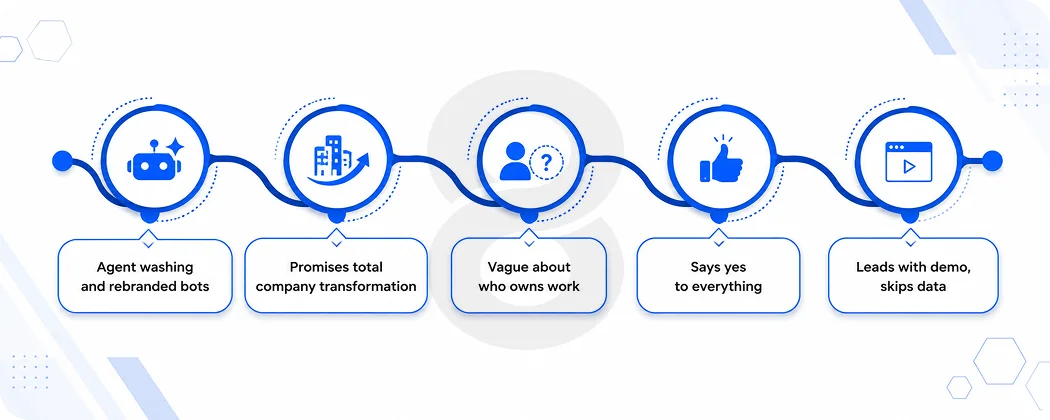
Some red flags are loud once you know to listen for them.
Agent washing is the big one
As AI agents became the thing everyone wanted, a lot of vendors simply relabeled their existing chatbots, scripted automations, and assistants as agents and raised their prices.
Gartner expects more than 40% of agentic AI projects to be canceled by the end of 2027, partly because so many of these projects were driven by hype and built on tools that were never really agents.
If a partner is selling you an agent, make them show you what it decides and does on its own, versus what’s just a flowchart with a fresh coat of paint.
Other red flags to watch for
Watch for anyone who promises to transform your entire company in one sweep. Real integration starts narrow and earns the right to expand. A pitch for everything, everywhere, at once is a pitch for a budget black hole.
Watch for vagueness about ownership too. If they get cagey about who holds the code, the models, and the documentation when the contract ends, assume the answer is them, which means you’re locked in. And watch for the team that says yes to every single request.
Anyone who’s logged real hours on this has quietly stopped believing AI fixes everything. So when someone tells you “that part isn’t worth automating” or “your data isn’t ready for that yet,” don’t take it as them being difficult. They lost fortune once and haven’t forgotten how it felt.
Questions you should ask before any commitment
So before you put your name on anything, make them sit with a few simple questions. How they handle these will tell you a lot more than any glossy case study ever could.
- What shape does our data need to be in for this to work and if it isn’t there yet, who’s the one cleaning it up?
- Which pieces of this run on our own systems and which ones quietly lean on outside services we’ll keep paying for every month?
- How do we know if the pilot landed and what’s the number we’re chasing?
- The first time the model tells a real customer something wrong, what’s the plan?
- When the contract wraps, who walks away owning the code, models, and docs?
- Have you built this inside a company that looks like ours and has the same rules and creaky old systems?
How a Good Partner Runs an Integration
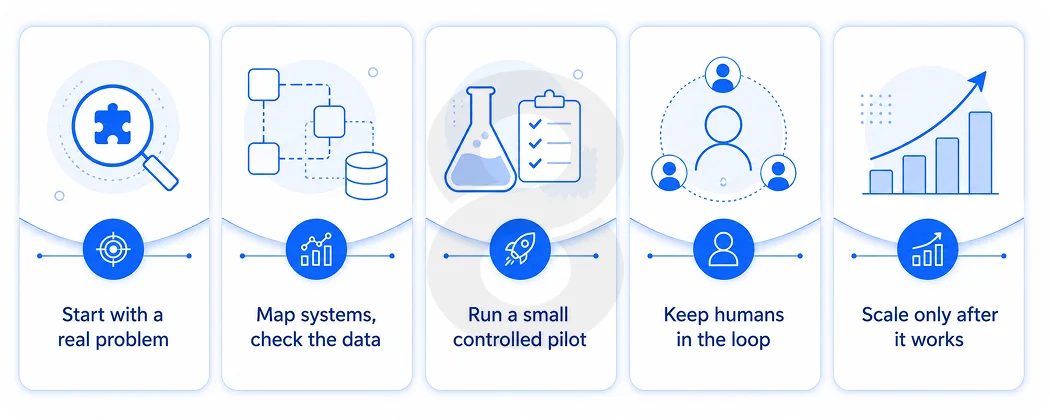
The process matters as much as the people, and a healthy one looks roughly the same no matter who’s running it.
Start with a problem
The good teams won’t open with the algorithm, and they’ll push back if you try to steer them there. What they want from you first is a real goal with a number on it. Maybe that’s cutting invoice processing time in half, or getting support response times down, or catching fraud earlier than you manage today.
Once that’s pinned down, they go hunting for the smallest slice of prediction or automation that would move it. Naming the payoff this early earns its keep. It forces everyone to say out loud what a win even looks like before a line of code exists, and it quietly drags out the question most vendors would rather skip, which is whether you need AI for this at all.
Half the time a plain old rule change gets you most of the way there, with no model and nothing to break.
Map the systems and check the data
After that comes the unglamorous bit, tracing how the work moves through your shop today. Which systems touch it, which people touch it, where the data ends up living. Draw all of that out and the real integration points start to surface on their own, the exact spots where AI has to slot in to be worth anything.
Then they look hard at whether your data is usable, because gaps, silos, and incompatible formats are cheaper to find now than after the build.
Pilot small and keep people in the loop
Only now does anything get plugged in and it gets plugged in small. A tight little pilot lets everyone watch the AI work under real conditions without putting the whole company on the line. And the oversight here isn’t something you bolt on at the very end.
People stay in the loop the entire way, eyeballing what comes out and stepping in the second it looks off, which happens most in those early days, while the system is still earning anyone’s trust.
Scale only after it proves out
After the pilot proves out, scaling is deliberate. The model gets retrained as your data shifts, performance gets watched, and the thing keeps getting tuned. That last part never really ends, which is exactly why the partner you pick should plan to be around for it.
Read More: AGI vs AI: Which Technology Drives Better Business Automation?
What AI System Integration Costs and Why Quotes Vary So Much
The honest answer to “what does this cost” is “it depends,” and anyone who fires back a precise number before understanding your data should make you nervous.
The price is driven by a few things. How complex the use case is. How much work your data needs before it’s usable, which is often the biggest hidden cost. Whether you’re connecting to clean modern systems or wrestling with old infrastructure.
The compute and licensing the models run on. And the ongoing care after launch, since monitoring and retraining are a recurring line, not a one time fee.
That’s why estimates swing so wildly. A scoped pilot that wires an existing model into one workflow through an API sits at the low end. A custom build with its own data pipelines, tight security, and regular retraining can run into six figures and several months. Both are called AI integration, and they are not remotely the same project.
How you engage matters too. A fixed scope is predictable but rigid. A time and materials arrangement flexes as you learn, which suits work where the path isn’t fully clear at the start. And some teams don’t want a finished build handed to them at all.
They’d rather add experienced engineers to their own team and keep their hands on the roadmap. None of these is the right answer in the abstract. The right one depends on how much certainty you need versus how much you expect to change your mind.
How 8ration Approaches AI System Integration
8ration treats integration as an engineering problem with a business goal attached, which is the only way it tends to work.
The process starts with discovery. The team digs into your company, users, and what you’re trying to achieve, then maps a route that fits your existing systems instead of fighting them. Design and prototyping come before full development, so you see and react to the real flows early rather than discovering surprises at the end.
Development runs in short agile sprints with something tangible after each one, which keeps the work visible and the direction correctable. Then everything goes through proper testing, deployment, and monitoring after launch, because the team has watched enough projects to know that go live is the middle of the job.
What helps here is that 8ration isn’t married to one stack. The engineers pick tools that fit your goals, whether the work means wiring intelligence into the custom software that already runs your operations, surfacing it inside an app your customers use every day, or building custom AI solutions around data nobody else wanted to touch.
With more than a decade of work across finance, healthcare, logistics, and retail, the team has met the kind of legacy resistance and compliance pressure that sinks less experienced shops, and they document and hand off the work so you’re never held hostage by knowledge that lives only in someone else’s head.
If you’re weighing partners, the practical move is to bring 8ration your real situation, the messy data, the aging systems, the goal you can’t quite hit, and get an honest read on what’s possible before any contract exists.