Cable TV is dying. The audience has left, and they won’t be coming back.
Currently, more than 70% of all OTT users globally binge-watch content regularly, and Statista estimates that the worldwide OTT user base will grow to 4.9 billion by 2029. That’s over half the world’s demand.
Netflix wasn’t the first to have the most content, but it was the first to make the experience so soothing, so satisfying, so addictive that it’s hard for anyone to want to leave. And here is the thing: that blueprint is now yours to build on.
This guide will cover all of the major aspects of building a streaming app like Netflix, including the core features, tech stack, actual price tag, and the way it can be launched.
Why Building a Netflix-Like App Is a Smart Business Move Right Now
It’s the perfect time, and it’s all in the numbers. Statista predicts that the revenue of the SVOD segment will exceed $98.37 billion by 2026. Meanwhile, 65% of all streaming already happens on mobile and TV apps rather than web browsers, per Uscreen. Research and Markets predict that the overall OTT streaming industry will increase from USD 221 billion in 2025 to USD 551 billion by 2030.
This is not a media trend. It’s a complete paradigm shift in consumer behaviour. From niche fitness to regional content to an educational video service to a “Netflix” experience, the infrastructure and consumer demand are up and ready. It’s not a question of whether to build, it’s a question of how to build.
Read More: Inside Netflix Tech Stack – Lessons for Developers
What Makes Netflix So Addictive? Core Features to Replicate
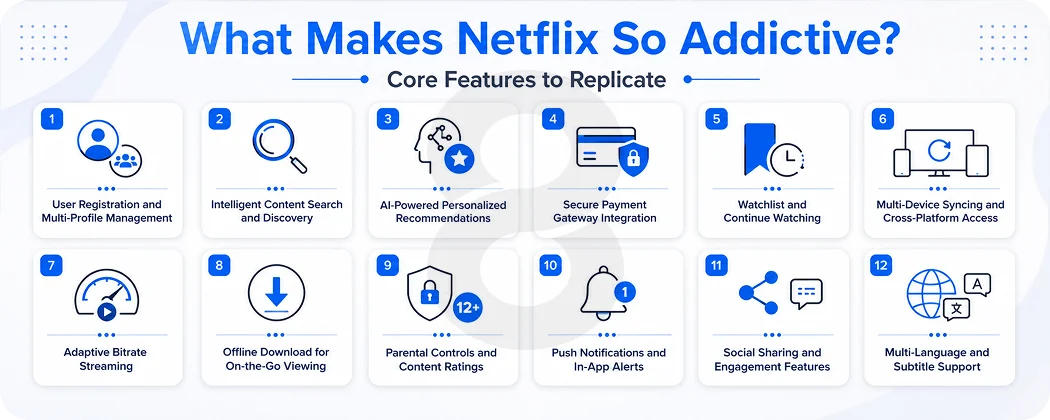
To build a streaming service like Netflix, you have to know what makes it so sticky. Netflix has been successful because of certain features, specifically, very well thought-out and orchestrated. These are the features your Netflix clone software app should have.
1. User Registration and Multi-Profile Management
Onboarding is essential and needs to be frictionless. Users should be able to register within seconds using email, social media single sign-on, and/or phone number. What’s more, having multiple user profiles under a single subscription is more akin to Netflix’s family-friendly approach and directly contributes to retention.
2. Intelligent Content Search and Discovery
In a library with thousands of titles, you can’t have an effective search and filter system. Users have to locate the content based on genre, language, release year, actor, mood, and popularity. Without it, all the best content libraries are unviewed.
3. AI-Powered Personalized Recommendations
This is the heartbeat of Netflix’s engagement engine. Netflix algorithms now drive the viewing decision for 80% of users based on pause time, rewind usage and time-of-day trends. Machine learning constructs a powerful recommendation engine, and turns passive viewers into loyal subscribers.
4. Secure Payment Gateway Integration
The process of converting to a subscription must be smooth and the checkout process must be secure. Having different payment methods, such as credit cards, digital wallets, and local payment methods, means less drop-off at the most crucial moment of the user journey.
5. Watchlist and Continue Watching
The two seemingly simple features are compelling retention tools. Users can add content to a watchlist, and “Continue Watching” eliminates the hassle. They both decrease churn and boost session rate.
6. Multi-Device Syncing and Cross-Platform Access
Today, every user has to switch between smartphones, tablets, smart tvs and laptops during the day. A real Netflix-like app guarantees watch history, preferences and position remain flawlessly synced up on all devices. One of the best ways to do this is to build a cross-platform app with frameworks such as React Native or Flutter.
7. Adaptive Bitrate Streaming
That’s where true excellence comes in and sets outstanding apps apart from the mediocre variety. Adaptive bitrate streaming (ABR) adapts video quality based on the user’s network speed and conditions, allowing for steady, buffer-free video viewing from fiber connections at home to mobile data on a train.
8. Offline Download for On-the-Go Viewing
The ability to download material to view offline is a tremendous selling point, particularly in areas where internet connections are unreliable. It is a direct uplift to the engagement of commuters, travelers, and users in emerging markets.
9. Parental Controls and Content Ratings
Granular parental controls are an effective way to establish trust on platforms aimed at families. Your platform is safe for families with children thanks to PIN-protected profiles, age-based content filters and screen time management.
10. Push Notifications and In-App Alerts
Smart and contextually relevant push notifications re-engage those who haven’t opened the app recently. Repeat usage without intrusion: new episode alerts, curated recommendations and personalized reminders.
11. Social Sharing and Engagement Features
Content recommendations are popular among users. Native social sharing, rating and review capabilities allow for natural word-of-mouth marketing and engagement that can’t be completely matched by paid advertising.
12. Multi-Language and Subtitle Support
In order to have a global reach, localization is essential. Multi-audio tracks, subtitles, and UI languages open up a compelling new audience and a more inclusive platform, regionally and demographically.
How to Create a Streaming App Like Netflix: Step-by-Step Process
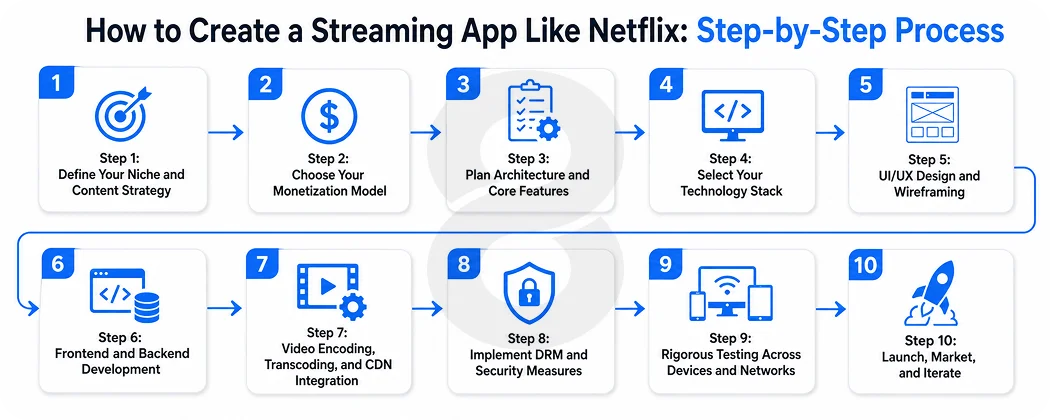
Creating a streaming app is a multi-layered engineering and product challenge. But if you divide it into distinct stages, it is easy to do. The professional OTT app development teams do it the following way:
Step 1: Define Your Niche and Content Strategy
The real trick of the most successful streaming sites is to cater to a certain customer very well, rather than to everybody. Before coding a line of code, consider the following questions: Who will use your program? What is the material that you will license or create? Will you pursue a genre, region or demographic? Having a niche limits competition and makes your marketing message more focused.
Step 2: Choose Your Monetization Model
The four main revenue models for a Netflix-style application are SVOD (subscription), AVOD (ad-supported), TVOD (transactional/pay-per-view), and freemium. The majority of the successful platforms today have a hybrid model. For example, you can provide a free (ad-supported) tier to attract more users and promote a paid (ad-free) tier. This should be decided by your content strategy and target audience.
Step 3: Plan Architecture and Core Features
In this step, your development team sketches the entire system architecture. This includes the feature roadmap, CDN configuration, database schemas, API design, and definition of microservices. The choices you make here will have a direct impact on the scalability, performance, and costs of the long-term maintenance of your system.
Step 4: Select Your Technology Stack
The technology decisions are the do-or-don’t decisions for video streaming apps. Getting the stack wrong can cause performance problems, security issues, and rework. The recommended tech stack is explained in detail in the following section.
Step 5: UI/UX Design and Wireframing
A gorgeous and intuitive interface is a competitive edge. Start the design process by making wireframe sketches and interactive prototypes of each and every important screen prior to development. Pay attention to visual hierarchy, the discovery of content, and uniformity of experience across device form factors.
Step 6: Frontend and Backend Development
This is the main construction phase. The frontend developers create the experience the viewer can access, while the backend developers create the systems used to process payments, content, user data, etc. and deal with authentication. An agile sprint-based method is the ideal way to work on a platform this complex.
Step 7: Video Encoding, Transcoding, and CDN Integration
Raw video has to be transcoded to multiple resolutions (360p, 720p, 1080p, 4K) and formats that are supported by all target devices. This can be done at scale with tools such as FFmpeg or AWS Elemental MediaConvert. A CDN (content delivery network) like Amazon CloudFront or Akamai helps deliver content to users around the world with low latency.
Step 8: Implement DRM and Security Measures
If the platform is licensed from a studio or a content creator, their DRM system is required for the platform. The industry-standard DRM systems are Widevine (Google), FairPlay (Apple) and PlayReady (Microsoft). In addition to DRM, AES-128 encryption for streams and secure user authentication safeguard your content and your users’ data.
Step 9: Rigorous Testing Across Devices and Networks
Before launch, your QA team will need to test all the features on all the devices that are supported, all the operating systems, all the browsers, and all the network speeds. Streaming applications are particularly important for performance testing, as the number of users can spike during play.
Step 10: Launch, Market, and Iterate
Successful launching is a mix of app store optimization (ASO), content marketing, influencer marketing and targeted digital advertising. Once launched, ongoing user behavior monitoring, engagement metrics and performance data ensure continual improvement. The best streaming apps are never settled; they are constantly evolving, and they do so based on feedback from users.
Read More: On-Demand App Development Cost in 2026
The Right Technology Stack for Video Streaming App Development
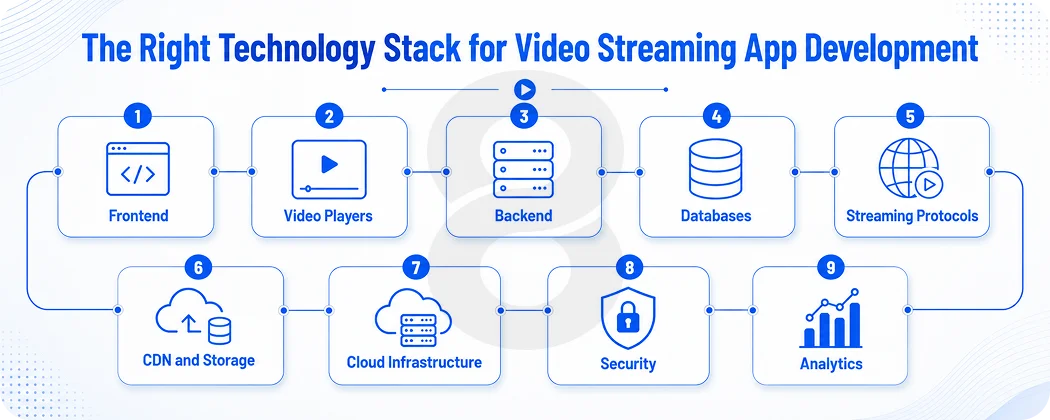
The selection of the right tools is of utmost importance for video streaming app development. Let’s take a look at the major technologies that drive Netflix-level platforms.
- Frontend: React.js or Vue.js for web; React Native or Flutter for mobile; Swift (iOS) and Kotlin (Android) for native development.
- Video Players: Video.js or Plyr for web; ExoPlayer (Android) and AVPlayer (iOS) for native mobile.
- Backend: Node.js for real-time, event-driven logic; Python (Django/Flask) for complex backend systems; Go for high-performance microservices.
- Databases: PostgreSQL or MySQL for structured data; MongoDB for unstructured metadata; Redis for caching to minimize latency.
- Streaming Protocols: HLS (HTTP Live Streaming) for broad compatibility; MPEG-DASH for adaptive streaming; WebRTC for ultra-low-latency live features.
- CDN and Storage: Amazon CloudFront or Akamai for content delivery; Amazon S3 or Google Cloud Storage for video file storage.
- Cloud Infrastructure: AWS, Google Cloud Platform, or Microsoft Azure for hosting, scaling, and DevOps automation.
- Security: Auth0 or Firebase Authentication for user management; Widevine, FairPlay, and PlayReady for DRM; SSL/TLS for encrypted data transmission.
- Analytics: Prometheus and Grafana for real-time performance monitoring; Mixpanel or Google Analytics for user behavior tracking.
Read More: Why Media Companies Are Losing Audiences Without the Right Entertainment Software
Advanced Technologies That Separate Great Streaming Apps From Good Ones
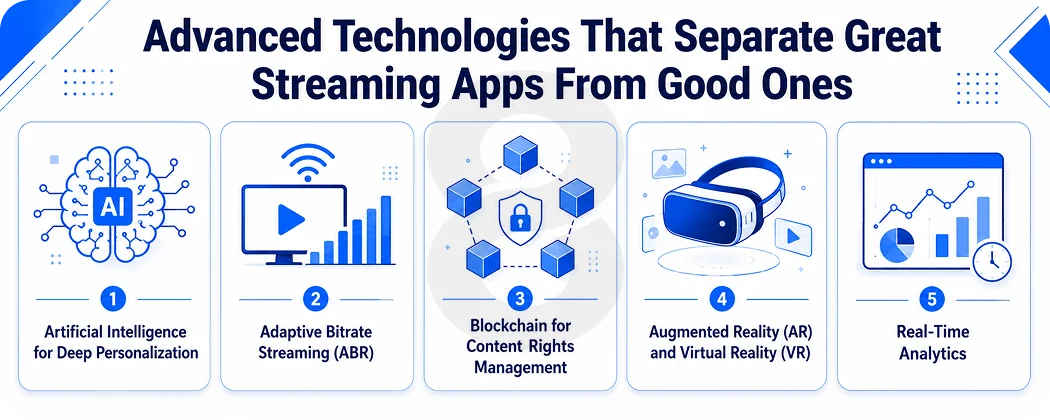
The key to creating a successful Netflix-like platform for 2026 and beyond lies in leveraging new technology that will make the experience more streamlined and enjoyable for users. It is here that AI-powered OTT apps are revolutionizing the industry.
Artificial Intelligence for Deep Personalization
AI can do so much more than just drive recommendations. It allows for personalizing thumbnails dynamically, predicting churn, automatically tagging content, AI-powered video compression, and smart targeting of ads. Engineered platforms with AI are seeing improved engagement, session durations and reduced churn. This is a direct competitive advantage.
Adaptive Bitrate Streaming (ABR)
As stated above, ABR is crucial to quality user experience. It automatically switches to the highest possible video quality based on the connection at the time of usage and adjusts dynamically with changing connections. Bandwidth savings are also achieved with codecs such as HEVC (H.265) and AV1, which offer high-quality images.
Blockchain for Content Rights Management
This transparency and immutability of content ownership and licensing deals are especially relevant for platforms that collaborate with independent creators or global content libraries. It simplifies rights control and minimizes conflicts.
Augmented Reality (AR) and Virtual Reality (VR)
AR and VR are just starting to transform the high end of the streaming market, especially for live performances, concerts and sports. In 2026, around 25% of the world’s population will be using AR and VR technology, which will open up new monetization opportunities for progressive platforms.
Real-Time Analytics
Advanced analytics platforms provide a real-time view of user behavior on your platform. Understanding what scopes make you lose subscribers, which genres make you lose, and which make you get re-engagement is key to making data-driven decisions at every stage of your product and content strategy.
Read More: 10 Top Web Application Development Frameworks in 2026
How Does a Netflix-Like App Make Money? Monetization Models Explained
Netflix app development is a business investment, so your revenue model should be given proper consideration as well as your tech stack.
- Subscription (SVOD): Monthly or annual tiers, varying by video quality, screens, and feature sets such as offline downloads. It’s a model that generates steady, recurring income and is at the heart of Netflix’s operations.
- Ad-Supported (AVOD): A free or low-cost tier that is funded through pre-roll, mid-roll, or overlay ads. This expands your user base and makes money from ads.
- Pay-Per-View (TVOD): Users pay a single fee to view a particular title. It is great for new theatrical releases, live sports events, and exclusive first shows.
- Freemium: A free trial, but refraining from features and upselling to paid users over time.
- Brand Collaborations and Merchandising: There are opportunities for branded merchandise, sponsorship deals, and unique co-branded experiences to emerge through popular original content.
Most modern platforms have multiple of these models and aim for flexibility and maximization of revenue per user.
How Much Does It Cost to Create a Streaming App Like Netflix?
Having a clear understanding of the app development cost from the outset is key to being able to have a good business plan. The development prices for a Netflix clone app range widely based on the depth of features, variety of platforms, location of the team, and infrastructure options.
Let’s look at a realistic breakdown of the costs that can be expected for a complete video streaming site:
Development Phase |
Estimated Cost Range |
| Discovery, Planning & Architecture | $4,000 to $8,000 |
| UI/UX Design | $6,000 to $18,000 |
| Frontend & Backend Development | $25,000 to $90,000 |
| Video Encoding, Transcoding & CDN Setup | $6,000 to $22,000 |
| Payment Gateway Integration | $2,500 to $9,000 |
| Admin Panel & Content Management System | $5,000 to $14,000 |
| QA Testing & Bug Resolution | $4,000 to $12,000 |
| Post-Launch Maintenance (Annual) | $6,000 to $18,000 |
| Total Estimated Range | $58,000 to $191,000+ |
The basic features of streaming can be developed in a basic MVP (Minimum Viable Product) at a lower cost. A full-fledged platform, though, with AI recommendations, multi-lingual support, DRM, live streaming and analytics will gravitate towards the higher end.
The formula is straightforward:
Total Development Cost = Total Development Hours × Hourly Developer Rate.
The developer rates range from $25 per hour in South Asia to $150 per hour in North America. Planning carefully, prioritizing features for your first release, and partnering with a team experienced in creating a streaming app will keep costs in check without compromising quality.
Common Challenges in Streaming App Development (And How to Solve Them)
Developing a platform of this complexity means facing some definite technical and operational challenges. If you are familiar with them beforehand, you can be prepared for them.
- Scalability under traffic spikes: A viral content moment can cause traffic to spike in a matter of a few hours. The three biggest weapons against downtime are microservices architecture, auto-scaling cloud infrastructure, and CDN load distribution.
- Video encoding complexity: Multi-resolution, multi-codec, and multi-device support demand a powerful transcoding pipeline. At scale, streamlining of this becomes easier with cloud-based services, such as AWS Elemental MediaConvert.
- Content piracy and DRM enforcement: In addition to these, multi-DRM systems (Widevine, FairPlay, PlayReady), AES-128 stream encryption, and watermarking provide a robust content protection mechanism.
- Multi-device compatibility: The rendering behaviors and performance of each device type (smart TV, mobile, web, tablet) are different. A cross-platform development strategy, along with in-depth testing on real devices, guarantees consistency.
- User retention after the trial period: In the end, it is a content and UX problem. Personalization engines, frequent drops, notification strategies, community features, and much more help to maintain user engagement after the first month.
Final Thoughts!
The timing couldn’t be better for developing a richer and more distinctive streaming platform. Great content is just a part of the equation in this space. It demands a technically sound platform, smart personalization, an impregnable security system, and a scalable monetization model.
Learning how to build a streaming application like Netflix involves knowing every aspect of the stack and designing for your users as the primary concern of every decision you make.
The vision becomes reality with the right development partner. Ready to build? This is the beginning of your next chapter.