




Thousands of digital transactions happen in the world every half of a second, and fraudsters are no less fast to attack them. Security is no longer an option in the current financial ecosystem.
Depending on the complexity and compliance requirements, development of a FinTech application that includes AI fraud prevention normally requires 6 to 9 months and requires strategic investment.
That is why such complex monitoring systems have become the key to the modern platforms, which allow preventing the risk before it happens rather than dealing with the damage after the fact. Juniper Research estimated that the loss caused by online payment fraud will exceed $362 billion worldwide between 2023 and 2027.
This guide provides roadmaps, budgets, and major decisions to assist.
How Real-Time Fraud Intelligence Works in Modern FinTech Apps
Real-time fraud intelligence should be understood first before speaking of timelines and budgets.
Machine learning models and predictive algorithms are used to detect AI fraud and analyze transactions in real-time. Rather than using fixed rules, AI is constantly learning from the behavior of users and the patterns of fraud.
The contemporary fraud detection system usually involves:
- Behavioral biometrics analysis
- Transaction anomaly detection
- Risk scoring engines
- Device fingerprinting
- Predictive modeling
- Automated decision engines
The fraud detection platform, which is an AI-powered platform, can assess thousands of data signals within milliseconds and enable transactions to be approved, flagged, or blocked in real time. This real-time feature is important since financial fraud in finances occurs in seconds.
Why FinTech Apps Require AI-Driven Security From Day One
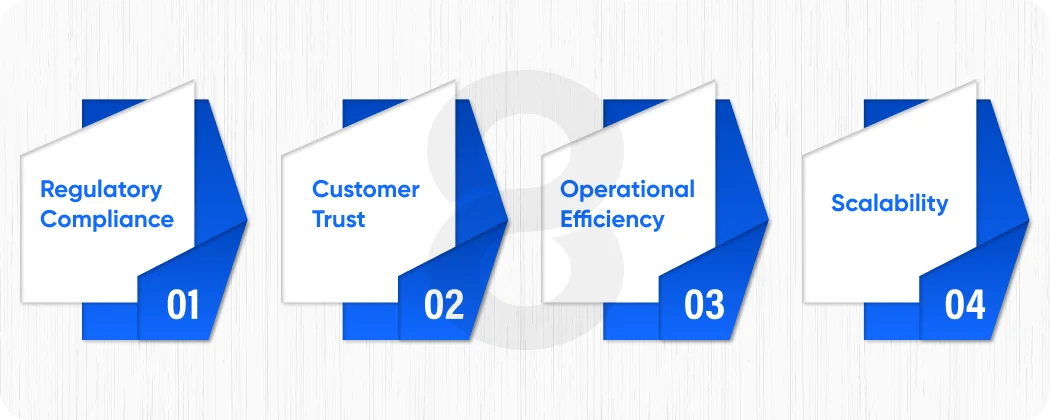
Financial applications are carried out in high-risk situations where users base their data and transactions on money. Hence, incorporating fraud intelligence in the future is costly and ineffective.
Fraud detection is being integrated in companies more directly into the architecture when developing fintech apps.
Key reasons include:
1. Regulatory Compliance
The financial authorities must also ensure that their AML and KYC compliance frameworks are rigorous so as to curb any money laundering, identity theft, and illicit transactions, and so as to make sure that the financial technology platforms remain open, accountable, and legal in the entire world.
2. Customer Trust
The security breaches or fraud cases destroy the trust of the users of the financial applications within a short period, and that is why strict protection systems are critical to the sustainability of credibility, retention enhancement, and long-term user retention.
3. Operational Efficiency
AI automates fraud, risk scoring, and transaction analysis, which saves much manual review and human error, increases the speed of decision-making processes, and enables the teams to concentrate on strategic business operations.
4. Scalability
With the rising volume of transactions and changing behavioral patterns, the AI models keep learning, which helps the fintech platforms to scale safely without compromising accuracy, performance efficiency, and the effectiveness of their fraud prevention services.
Therefore, the early integration minimizes the long-term costs and enhances the resiliency of the system.
Read More: How to Predict and Manage the “Token Tax” in High-Scale Generative AI Applications
Core Components of a FinTech App with AI Fraud Detection
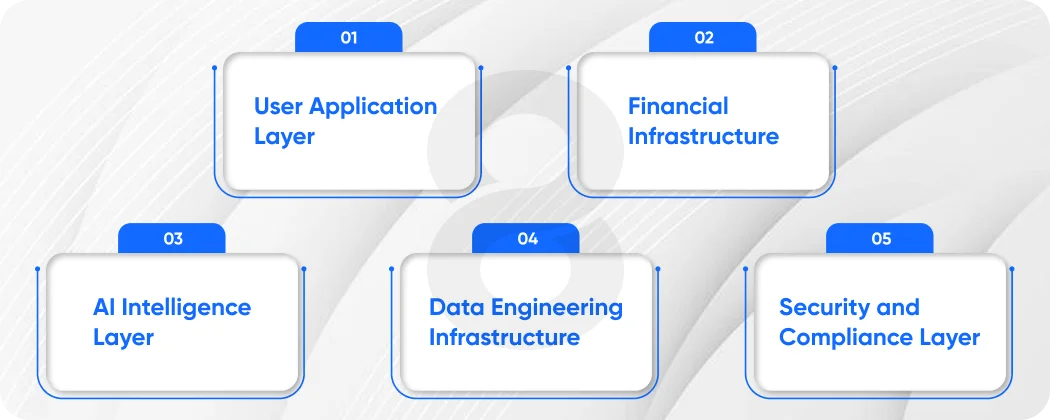
You need to be aware of the technical layers so that you can estimate timelines and budgets.
1. User Application Layer
- Mobile apps (iOS and Android)
- Web dashboards
- Admin panels
2. Financial Infrastructure
- Payment gateways
- Banking APIs
- Wallet systems
- Ledger architecture
3. AI Intelligence Layer
This is where AI fraud detection operates.
- Components include:
- Machine learning pipelines
- Feature engineering modules
- Model training environments
- Real-time inference engines
4. Data Engineering Infrastructure
- Data lakes
- Streaming pipelines
- Event processing systems
5. Security and Compliance Layer
- Encryption protocols
- Identity verification
- Risk monitoring dashboards
The layers will add to the cost and the development timeline.
Read More: Agentic SOC – Transitioning from Human-Led Detection to Autonomous AI Threat Response
Average Development Timeline (Phase-by-Phase)
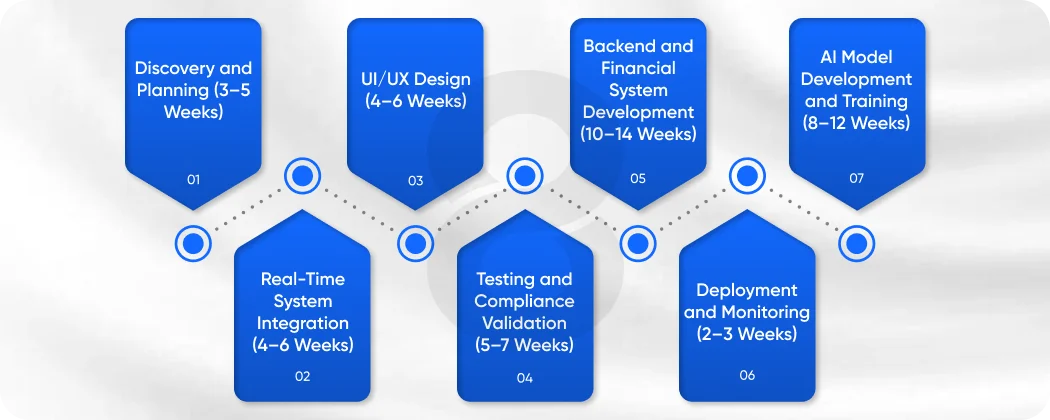
A safe FinTech product needs to be built in an organized manner. The following is a realistic schedule that is adhered to by seasoned AI app development teams.
Phase 1: Discovery and Planning (3–5 Weeks)
This preliminary step lays the groundwork for the creation of fintech apps and the AI-based consulting service and harmonizes the strategy to reduce risks of fraud, technology selection, and project goals:
- Market research
- Compliance analysis
- Fraud risk assessment
- Feature roadmap
- Technology stack selection
Output: Product structure and project scope.
Phase 2: UI/UX Design (4–6 Weeks)
In designing, secure and user-friendly interfaces would be created to make users cognizant of the alerts and transactions, which is the vital front-end interaction in AI fraud detection:
- Secure user flows
- Transaction journeys
- Risk alert interfaces
- Admin dashboards
The importance of security-driven UX lies in the fact that the warning about fraud should not be too complicated to be comprehended by the users.
Phase 3: Backend and Financial System Development (10–14 Weeks)
Back-end development contains the integration of basic financial infrastructure and AI integration services, allowing the smooth linkage of the transaction pipelines and fraud detection systems:
- Payment integrations
- API development
- Database architecture
- Authentication systems
- Compliance modules
Phase 4: AI Model Development and Training (8–12 Weeks)
The services of AI integration are also used by many companies at this stage to make sure that fraud detection links to transaction pipelines without any problems.
- Payment integrations
- API development
- Database architecture
- Authentication systems
- Compliance modules
A special fraud-detecting AI agent can be programmed to automatically examine the patterns of behavior. Also, AI predictive analytics models predict the likelihood of fraud through past trends.
Phase 5: Real-Time System Integration (4–6 Weeks)
To retain AI-based fraud detection running in real-time and with low latency and automatic notifications, it is crucial to integrate AI models with live systems:
- Streaming data processing
- Real-time decision engines
- API connections
- Automated alerts
Latency optimization is important since the process of fraud detection has to be executed in milliseconds.
Phase 6: Testing and Compliance Validation (5–7 Weeks)
Accuracy, security, and compliance are confirmed through rigorous testing, which will ensure that your fraud detection system operates as required in real-world scenarios:
- Security penetration testing
- Model accuracy validation
- False-positive analysis
- Load testing
This phase is normally accompanied by financial compliance audits that usually run simultaneously.
Phase 7: Deployment and Monitoring (2–3 Weeks)
Accuracy, security, and compliance are confirmed through rigorous testing, which will ensure that your fraud detection system operates as required in real-world scenarios:
- Security penetration testing
- Model accuracy validation
- False-positive analysis
- Load testing
Total Estimated Timeline: 6-9 months to a FinTech production-ready application with real-time AI fraud detection. More complicated enterprise solutions can take up to 12 months.
Read More: How to Build a “Digital Workforce” of Specialized AI Agents for Supply Chain Automation
Average Budget Breakdown
The overall expenses associated with the creation of a FinTech application with AI fraud detection will depend on the complexity of the project, its location, the experience of the team, technology needs, and the extent of custom AI development.
# |
Development Stage |
Average Cost (USD) |
| 1 | Discovery & Strategy | $10,000 – $25,000 |
| 2 | UI/UX Design | $15,000 – $35,000 |
| 3 | Backend Development | $60,000 – $120,000 |
| 4 | Mobile App Development | $40,000 – $90,000 |
| 5 | AI Model Development | $50,000 – $120,000 |
| 6 | Testing & Compliance | $20,000 – $40,000 |
| 7 | Deployment & Infrastructure | $15,000 – $30,000 |
Total Estimated Budget:
$200,000 – $450,000+.
Enterprise banking platforms can exceed $700,000 depending on scale.
Key Factors That Influence Cost and Timeline
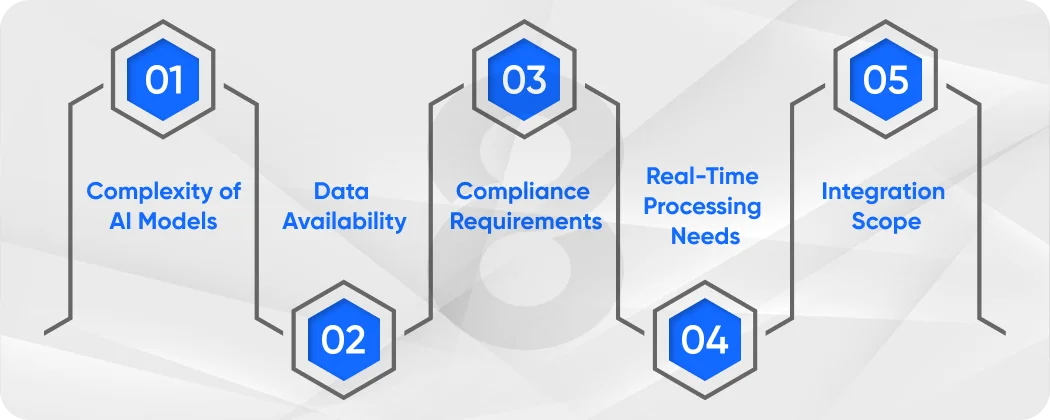
Complexity of AI Models
The advanced behavioral learning models involve a lot of training, engineering, and optimization. An increase in model sophistication will increase development cycles because of the requirement to test, tune, and validate the model.
Data Availability
AI systems are very sensitive to quality datasets to make correct predictions. In case of limited or inconsistent data, it takes the teams more time to gather, clean, label, and validate information.
Compliance Requirements
Financial applications that run in regulated markets are under strict laws such as GDPR, AML, and KYC. Adding compliance workflow, audits, and reporting mechanisms creates substantial work on development.
Real-Time Processing Needs
The detection of fraud in real time requires a very low-latency infrastructure that can handle thousands of transactions in real time. Scalable streaming pipelines and optimized architectures are more technologically complex and require more development time.
Integration Scope
The API of banking, payment gateways, verification of identities, and the integration of third-party financial services involve a lot of coordination on the back-end, security verification, and testing of the integrations to facilitate a platform-to-platform and reliable communication flow.
Read More: What is Spatial Intelligence? Examples, Uses, and Improvement Tips
Technology Stack Commonly Used
An AI fraud detection stack consists of:
Frontend:
- React Native
- Flutter
Backend:
- Node.js
- Python
- Java
AI Frameworks:
- TensorFlow
- PyTorch
- Scikit-learn
Data Processing:
- Apache Kafka
- Spark Streaming
Cloud Infrastructure:
- AWS
- Google Cloud
- Azure
Scalable and intelligent monitoring of fraud is made possible by these technologies.
ROI: Why Investing in AI Fraud Detection Pays Off
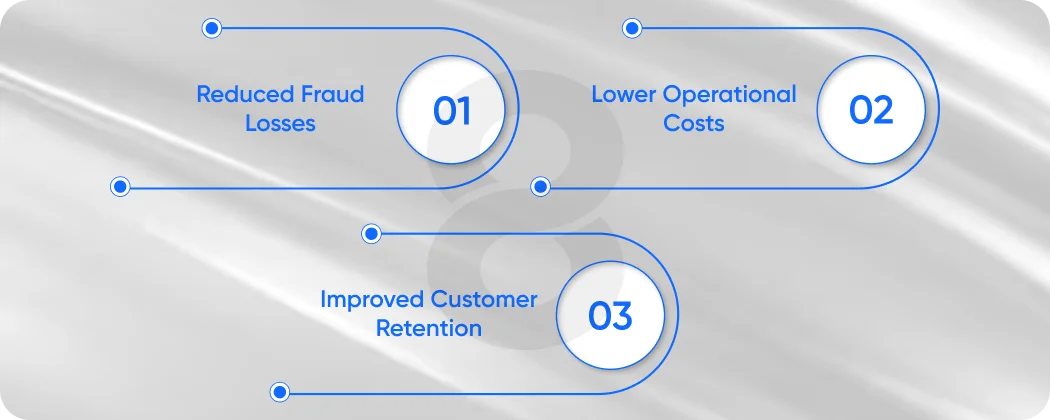
Even though preliminary investment in development might appear huge, applying smart fraud prevention can provide a quantifiable payoff throughout the years with less financial risk, increased operational efficiency, better compliance, and improved customer confidence.
Reduced Fraud Losses
The high-tech AI systems can study behavioral trends and abnormalities in transactions in real-time, which can detect threats early and reduce financial losses, as well as stop fraudulent activities before they affect users.
Lower Operational Costs
Automation simplifies the process of fraud monitoring and investigation, relieves organizations of the need to rely on the manual review team, minimizes operational costs, and enables organizations to invest in innovation and growth.
Improved Customer Retention
Safe and stable financial systems make users more confident, less concerned about their account security, and willing to invest more time, contributing to the overall increase in brand credibility and loyalty, as well as enabling the businesses to keep their clients.
Statista predicts that the number of industries that will implement AI software will reach and exceed $300 billion by 2026. Early investment by the companies helps in achieving a competitive edge.
Companies investing early gain a competitive advantage.
Read More: What Is Agentic AI? Definitions And Real-World Examples
Best Practices for Successful Implementation
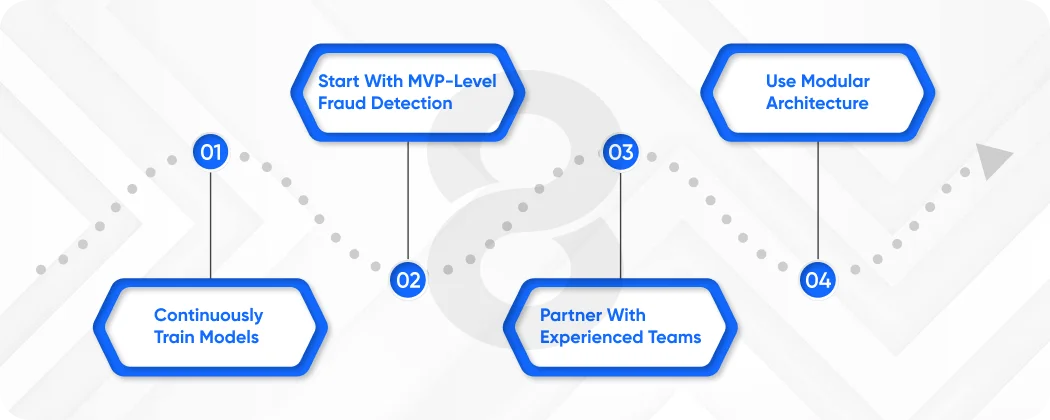
Start With MVP-Level Fraud Detection
Start with the necessary fraud detection facilities to track high-risk transactions and user behavior, which will enable launching faster early validation, managing cost, and improving it based on real-world data.
Use Modular Architecture
Design your FinTech system in modular architecture design so that AI modules are autonomous, allowing easy upgrades and integrations, and faster experimentation and future growth without re-establishing core infrastructure.
Continuously Train Models
Regularly retrain AI models with new transaction data, behavioral information, and new fraud cases to keep the detection rate constant, decrease logical errors, and respond to new and changing cyber-attacks successfully.
Partner With Experienced Teams
Get the support of knowledgeable development and AI consulting services providers that are aware of compliance, data engineering, and fraud analytics, which will ensure faster delivery, cost optimization, and production-ready security systems.
Read More: Artificial Intelligence in Automotive Industry – Trends & Use Cases
Common Mistakes Businesses Should Avoid
- Treating AI as a plug-and-play feature
- Ignoring data quality
- Underestimating compliance needs
- Delaying fraud detection integration
Early development is a great way of minimizing the risk of developing.
Read More: 10 Types of Machine Learning Models for Smarter Decision Making
Future Trends in AI Fraud Detection for FinTech
The next generation of fraud prevention includes:
- Autonomous fraud detection AI agent systems
- Federated learning for privacy protection
- Explainable AI models
- Real-time behavioral biometrics
- Self-learning risk engines
With the development of AI, the task of fraud detection will be interactive instead of being reactive.
Final Thoughts!
Developing a secure financial platform does not depend on speed and design only. It should integrate into the fundamental architecture to ensure intelligent security so that it can secure users and transactions.
The production-ready FinTech app will, as a rule, require 6 to 9 months and considerable capital investment, yet long-term gains will be greater than the initial expenditures.
Companies focusing on a superior security framework, adherence, and scalable architecture create a deeper trust, mitigate risks, and set themselves up for long-term expansion in an ever-competitive digital financial environment.: