



Every team hits this question before writing a single line of code: React or Angular? And the frustrating truth is there’s no clean answer. React is technically just a library. It handles what users see on screen and leaves everything else up to you. Angular ships as a complete framework. It hands you routing, forms, and a dozen other things right out of the box. One trades structure for flexibility. The other trades flexibility for structure.
Fast-moving product teams tend to gravitate toward React. Large enterprises managing big engineering teams and strict coding standards usually find Angular a better fit. Both have serious corporate muscle behind them and both are running software you’ve almost certainly used today. What follows is a straightforward guide to figuring out which one actually makes sense for your project, your team, and what you’re working with.
React vs Angular at a Glance
Here’s a quick side by side look before we get into the detail.
| Feature | React | Angular |
|---|---|---|
| Type | UI Library (View Layer) | Full Framework |
| First Released | 2013, by Meta | 2016 (Angular 2+), by Google |
| Language | JavaScript with JSX, TypeScript Optional | TypeScript First |
| Latest Version (2026) | React 19, Compiler 1.0 | Angular 22 |
| Architecture | Component Based, Unopinionated | Component Based, Opinionated |
| Rendering | Virtual DOM | Signals with Zoneless Change Detection |
| Data Binding | One Way | Two Way Plus Signals |
| State Management | Bring Your Own (Redux, Zustand) or Hooks | Built In with Signals and RxJS |
| Learning Curve | Moderate | Steep |
| Built In Tooling | Minimal, You Assemble It | Routing, Forms, HTTP Included |
| Best For | SPAs, Startups, Fast MVPs, Interactive UIs | Large Enterprise Apps, Big Teams |
| Mobile Path | React Native | Ionic or NativeScript |
| Backed By | React Foundation and Meta |
What is React
React has been around since 2013, built originally by Meta. It’s a JavaScript library. Its job is the view layer and it stays in its lane. You build small and reusable components and decide for yourself how they fit together.
The latest major version is React 19. The biggest additions were the React Compiler reaching stable. It means React now takes care of a lot of optimization that used to fall on the developer. And React Server Components also hitting stable, letting you render on the server side and send less JavaScript down to the browser. Full details are in the official React documentation.
In late last year, React moved to an independent React Foundation rather than sitting entirely under Meta. For most developers this changes nothing practical but it does give the project a more neutral long-term footing
How React works
React builds everything from components, written in JSX, which is just JavaScript with markup living in the same file. When data changes, React doesn’t touch the whole page. It keeps a copy of the page structure in memory, works out what actually changed, and updates only that. For apps where things are constantly updating, that matters more than you’d think.
What React doesn’t do is just as telling. There’s no router, form handling, and data layer. You bring those in yourself. React Router for navigation, Redux or Zustand if state starts getting messy. Some developers love that flexibility. Others stare at a blank project and wonder where to start. Both reactions make sense honestly, because the freedom is real but so is the decision fatigue.
What React is best for
React suits teams that need to move fast and build something users interact with a lot. Startups especially. You can get something working in days and figure out the rest as the product takes shape. And if your team is building for mobile too, React Native shares enough of the same thinking that your skills carry over cleanly into cross platform app development.
Read More: Cross Platform App Development Guide: Everything Businesses Need to Know
What is Angular
Angular is Google’s full framework and it’s been around in its current form from a decade. That version was a complete rewrite of the original AngularJS… different enough that the two have separate names. React gives you a library and steps back. Angular gives you everything upfront. Routing, forms, HTTP handling, dependency injection… you’re not hunting for third party libraries to fill gaps because there aren’t many gaps to fill.
TypeScript is the default language. That matters because a whole category of bugs gets caught before your code runs rather than after it’s already in front of users.
Angular 22 landed in mid 2026 and marks what the team is calling the signal first era. Signals, the reactivity system, are now fully stable, and Signal Forms are too. Zoneless change detection is also now on by default, which quietly makes apps faster without you having to do much about it. The official Angular documentation covers everything in the current release.
How Angular works
Angular organizes everything into services and modules. Afterwards, it wires them together through dependency injection. If you haven’t worked with dependency injection before, the short version is that it keeps different parts of your app loosely connected. It makes testing a lot less painful than it sounds.
Two way data binding is built in, so your interface and your underlying data stay in sync automatically. You’re not writing extra code to keep them talking to each other. The older change detection system used to scan the whole app to figure out what changed, which added overhead.
Signals changed that. Angular now tracks changes at a granular level, much closer to how React and other modern tools handle reactivity.
What Angular is best for
Angular earns its place on big and complex applications where a lot of developers are working in the same codebase. The opinionated structure isn’t for everyone. But on a team of thirty engineers, it’s genuinely useful. Nobody’s inventing their own patterns because the framework already decided.
Banks and healthcare platforms tend to land on Angular for this reason. The code you write in year one still reads the same way in year four. That consistency is worth a lot when you’re maintaining something long term.
Read More: Angular Current Version vs. Legacy Builds: A Guide for CTOs Planning Their Next Hire
What Makes React and Angular Different
There are a lot of ways to compare React and Angular, but most of them don’t really help you make a decision. Here are the differences that actually do.
Library versus framework
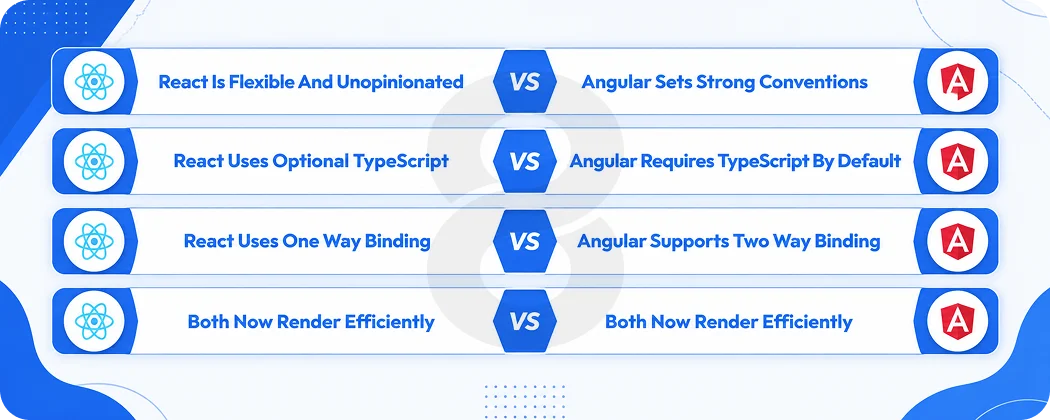
This is the big one. React handles the view layer and leaves everything else up to you. Angular makes most of the decisions for you upfront. That’s not a criticism of either. It’s just the tradeoff you’re choosing between. With React, you’re assembling your own stack, picking router, state tool, and form library.
More control, but also more things you can get wrong. With Angular that’s already sorted. Less setup, less flexibility, but you’re not spending a Friday afternoon debating which state management library to use.
Language and typing
React uses plain JavaScript with JSX, and you can add TypeScript when you want it. Most serious React teams do. Angular requires TypeScript with no opt out. If your team already writes typed code, Angular feels natural. If you want to start simple, React lets you.
Data binding and reactivity
Angular supports two way data binding so a change in the interface updates the data and the reverse happens automatically. React uses one way flow, where data moves in a single predictable direction. One way binding takes a little more code but makes large apps easier to reason about. Both frameworks have moved toward signals style reactivity in their latest versions, which narrows this gap.
The DOM and rendering
React pioneered the virtual DOM. It’s a technique that updates only what changed on the page. Angular now uses Signals with zoneless change detection to reach a similar result. In practice both feel fast on modern hardware, and the rendering approach rarely decides a project on its own anymore.
Read More: Web App vs Native App: A Complete Comparison for Business Owners (2026 Guide)
React vs Angular: Performance
Is React faster than Angular? For most apps in 2026, the difference is small enough that your users won’t notice it. Both frameworks are fast when built well and vice versa.
React tends to ship a smaller initial bundle because it’s a library so the first load can feel quicker. The React Compiler now handles memoization automatically, which removes a common source of unnecessary renders.
Angular apps sometimes carry a larger baseline but zoneless change detection and stable Signals have cut that overhead sharply. Also, Angular’s server side rendering and hydration have improved a lot.
The practical takeaway is simple. Performance depends on how you build than on which tool you pick. A messy React app will lose to a clean Angular app every time and the reverse holds too.
React vs Angular: Learning Curve and Developer Experience
React has a gentler on-ramp. Know JavaScript reasonably well and you can get your head around JSX and the basic hooks in a weekend. Most developers are writing useful, real code within two or three months.
The catch is that the hard stuff comes later. Once your app grows, you’re suddenly making decisions about state management, testing, and whichever other libraries you bolted on. That learning is scattered across the ecosystem rather than sitting in one place.
Angular front-loads all of that. Before you feel comfortable, you need TypeScript, the component and module system, dependency injection, and usually RxJS for handling async data. Most developers put the timeline at four to six months before things click. But when they do click, you actually know the whole thing. There’s no separate router to figure out, no state library to evaluate. It’s all just Angular.
Which should you learn first?
If you’re early in your career and want to get hired fast, React is the safer bet in most markets. It shows up more in startups and agencies, and what you learn transfers to React Native too. If enterprise work is where you’re headed, finance, healthcare, that kind of thing, Angular opens doors in a talent pool that’s smaller and a lot less crowded. React first for breadth. Angular later if you want it.
Read More: Progressive Web App vs Mobile App: Complete Comparison Guide for 2026
React vs Angular: Scalability and Enterprise Fit
Both frameworks scale to large apps. They just get there differently.
Angular was built with scale in mind… dependency injection, strict conventions, and a clear structure throughout. It means a hundred developers can work in the same codebase without things quietly falling apart. The rules aren’t suggestions, they’re built in, so you don’t end up with five different teams solving the same problem five different ways. That’s the reason so many large organizations standardize on it.
React scales but you’re the one who has to make that happen. A team that knows what it’s doing will be fine. The one that skips the architecture conversations early tends to regret it six months later.
Large React codebases that work well usually have one thing in common: somebody made the architecture decisions upfront and the team actually stuck to them. Plenty of huge products run on React. They simply had to design the guardrails Angular gives you for free.
React vs Angular: Ecosystem, Community, and Long Term Support
React has the bigger community and it’s not particularly close. The last year Stack Overflow Developer Survey puts React at around 47% adoption among professional developers. It’s more than double Angular’s share.
React also scored higher on the “want to keep using it” measure, which is a decent proxy for how developers actually feel about a tool day to day. A larger community means more tutorials, more third party components, and a much better chance that someone on Stack Overflow has already hit whatever problem you’re facing.
Angular’s community is smaller but more focused. Google ships a major version every six months, same schedule, clear support window, no surprises. This helps teams always know where they stand and when they need to upgrade. React doesn’t really have an equivalent to that. Being a library, it leaves more of that planning up to you.
Read More: Native App vs Hybrid App Development: A Business Owner’s Decision Guide
React vs Angular: Job Market and Hiring in 2026
If you’re hiring, React gives you a much bigger pool to pull from. More developers know it, which generally means faster hiring and more competitive salaries. Angular talent is genuinely harder to find, which cuts both ways. You’ll search longer and probably pay more, but the developers who do know Angular tend to have enterprise experience and that shows.
Overall the job market is healthy for both. The US Bureau of Labor Statistics projects web developer employment to grow 7% till 2034. That’s faster than most fields, with 14,500 new openings expected each year. Framework skills sit inside that demand. React just happens to be the more common requirement on job posts today.
React vs Angular for SEO
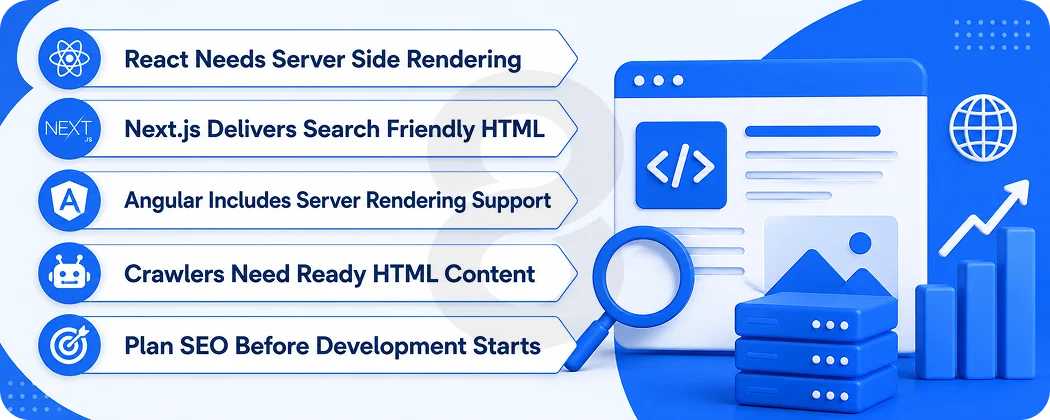
Search engines want pages that load fast and serve content the crawler can actually read. React on its own renders in the browser, which used to be a real problem. Crawlers would land on an empty page and have nothing to work with.
Pair React with Next.js though and you get server side rendering, which means the HTML arrives ready to read. That’s why plenty of content heavy React sites rank just fine.
Angular handles the same need through its built in server side rendering, so your pages arrive fully formed. Either way, if organic traffic matters, plan for server rendering from the start rather than bolting it on later.
Read More: Android vs iOS Development: Which Platform Should You Actually Build For?
When to Choose React vs Angular
By now the pattern is clear. The short version looks like this.
Choose React if…
- You’re building an MVP or a startup product and need to move fast.
- Your app leans on rich, interactive interfaces that update often.
- You want to pick your own libraries and keep the stack flexible.
- You plan to build a mobile app too and want to share skills with React Native.
- You need a large hiring pool and quick onboarding.
Choose Angular if…
- You’re building a large enterprise app that many developers will maintain.
- You want structure and consistency enforced by the framework itself.
- Your team already works in TypeScript and appreciates having conventions decided for them.
- You’re in a regulated industry like finance or healthcare where predictability and long term support actually matter.
- You’d rather have routing, forms, and HTTP handling built in from the start.
Consider something else entirely if…
Neither React nor Angular is always the right answer. A simple marketing site might be better served by something lighter like Astro or even plain HTML. A small content site rarely needs either. And if your team already knows Vue or another framework well, that existing knowledge is usually worth more than switching to whatever’s trending. Pick the tool that fits the job.
Can You Use React and Angular Together

Technically yes, though it’s rarely a first choice. Teams sometimes run both in one app using an approach called micro frontends, often with a tool like Module Federation. That usually happens during a migration, when a company is moving off one framework onto another, or when separate teams own separate parts of a product.
The honest caveat is that mixing two frameworks adds complexity and weight. It’s a transition strategy, not a long term plan. If you’re starting fresh, pick one and commit.
Companies Using React and Angular
Both frameworks power products at massive scale, which tells you neither is a risky bet. React runs interfaces at companies like Meta, Netflix, and Airbnb, where fast, interactive experiences matter. Angular shows up across Google’s own products and in large enterprises and financial platforms that value its structure. The takeaway isn’t that one is better. It’s that both are proven in production so your decision can rest on fit rather than fear.
Read More: React Native App Development Cost: Features, Timeline & Pricing Explained
How 8ration Picks the Right Framework for Your Project
8ration builds custom web applications for startups and established businesses, and choosing the right frontend is part of that work from day one. Our engineers work across the modern JavaScript ecosystem, React included, and we match the stack to your team and goals rather than pushing a favorite.
We’ve shipped production web apps across very different needs. Done Right Away connects homeowners with verified repair and maintenance pros. Trailer4Rent is a peer to peer rental platform serving customers across Canada. Family Plan brings scheduling and shared information into one place for busy households. Each started with the same question you’re asking now, which framework fits this product and this team.
If you’re weighing React vs Angular for your next build, our software consulting team can walk through your requirements, your timeline, and your hiring plan, then recommend a stack you can live with for years. And when you’re ready to build, our custom software development team takes it from plan to launch.