


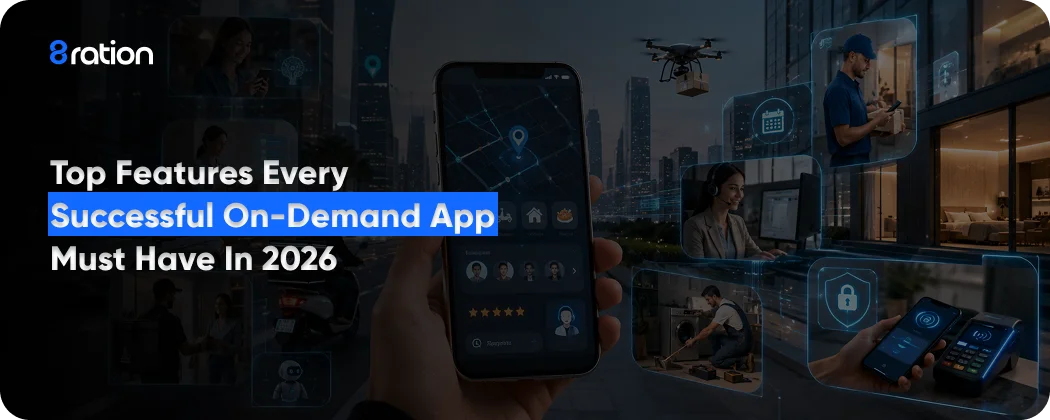
Users will abandon your app in seven seconds. Not because your idea is bad, but because a critical feature is missing.
The right on-demand app features are what separate platforms that scale from ones that stall. According to Business Research Insights, the global on-demand services market is valued at $216 billion in 2026 and is forecast to reach $346 billion by 2035, growing at a steady 5.4% CAGR. Competition heading into that window is fiercer than ever.
Whether you are looking to create on demand app solutions from scratch or exploring custom on-demand app development to stay ahead, this guide covers exactly what your app must have to win.
1. Real-Time Tracking and Live Location Updates
If there is one feature that defines the on-demand experience, it is real-time tracking. Users want to know where their driver is, when their food will arrive, or how far away their service provider is. That live visibility is not a nice-to-have. It is a trust-builder that directly impacts retention.
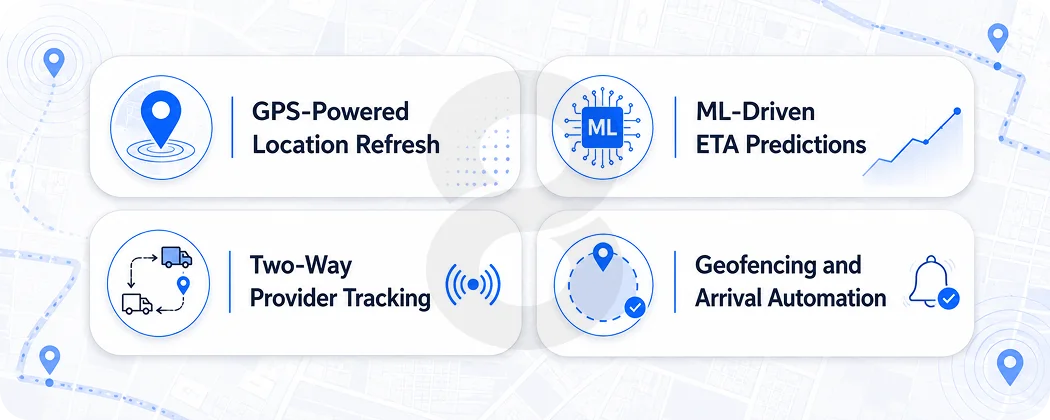
GPS-Powered Location Refresh
Modern on-demand app platforms integrate GPS tracking with sub-second refresh rates using WebSockets, Google Maps SDK, and MapBox APIs. Users see their provider moving on the map in real time, eliminating the anxiety of uncertainty and reducing inbound support queries significantly.
ML-Driven ETA Predictions
Static estimated arrival times frustrate users. The best on-demand mobile app implementations use machine learning models that recalculate ETAs dynamically, accounting for live traffic conditions, weather disruptions, and route deviations, so the number users see is one they can actually trust.
Two-Way Provider Tracking
Real-time tracking is not just a user-facing feature. For service providers, two-way tracking gives dispatchers full fleet visibility, enabling on-the-fly rerouting, idle time reduction, and smarter job allocation that cuts operational costs while improving on-time delivery rates.
Geofencing and Arrival Automation
Leading on-demand app platforms use geofencing to automate key moments in the service journey. When a provider enters a defined radius, the app automatically fires an arrival notification, unlocks the next workflow step, and timestamps the interaction for compliance and performance reporting.
2. Smart Search, Filters, and Personalized Discovery
Users open on-demand apps because they want something specific, fast. A clunky search experience or irrelevant results will push them to a competitor within seconds. This is why intelligent search architecture is a foundational on-demand app feature.
In 2026, the benchmark for search goes well beyond basic keyword matching. The leading on-demand app solutions now leverage:
- Natural language processing (NLP) to interpret conversational queries
- Collaborative filtering to surface personalized recommendations based on past behavior
- Faceted search and smart filters to help users narrow results by price, rating, distance, availability, or category
According to McKinsey, personalization can deliver five to eight times the ROI on marketing spend and lift revenue by 10% or more. Embedding that personalization directly into the discovery layer of your app is one of the highest-leverage investments you can make.
Read More: On-demand App Development: The Complete Guide for Startups and Enterprises
3. Seamless and Secure Multi-Modal Payment Integration
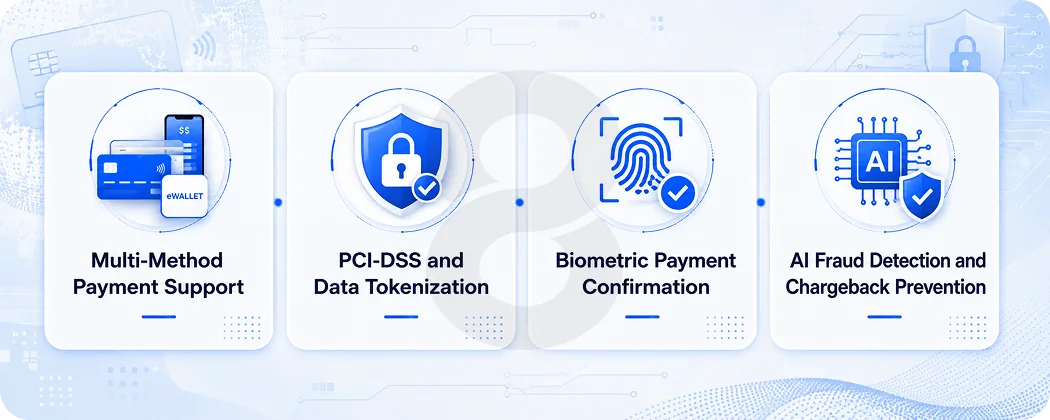
Friction at checkout kills conversions. Regardless of how well everything else performs, a slow, limited, or untrustworthy payment experience will cost you users at the single most critical moment in their entire journey.
Multi-Method Payment Support
A competitive on-demand app in 2026 supports credit and debit cards, digital wallets like Apple Pay and Google Pay, UPI, buy-now-pay-later options, and in select markets, cryptocurrency. Meeting users where they already transact removes the final barrier between intent and completed booking.
PCI-DSS and Data Tokenization
Security is not optional when handling financial data. On-demand app developers must implement PCI-DSS compliance, full tokenization of card data, and 3D Secure authentication as baseline requirements, ensuring sensitive payment credentials are never stored or transmitted in raw form within the application infrastructure.
Biometric Payment Confirmation
Adding Face ID and fingerprint authentication at the payment step dramatically reduces checkout abandonment. Users authenticate in under a second, eliminating manual re-entry of card details and building the kind of effortless experience that keeps them booking through your platform instead of switching to a competitor.
AI Fraud Detection and Chargeback Prevention
Advanced fraud detection algorithms analyze transaction patterns in real time to flag anomalies before they become costly chargebacks. When working with on-demand app developers, treat fraud prevention as core infrastructure, not an optional add-on, particularly as transaction volumes scale and attack surface area expands.
Read More: MVP Vs Full Product On-Demand App Strategy: Which One Saves More Money?
4. Robust Push Notification and Communication System
Communication is the backbone of on-demand service delivery. Users need to be informed at every stage of their experience: booking confirmation, provider assignment, estimated arrival, order ready, delivery complete. Each of those touchpoints is an opportunity to build trust or lose it.
A well-architected notification system in an on-demand app platform includes:
- Push notifications via FCM (Firebase Cloud Messaging) for Android and APNs for iOS
- In-app messaging for real-time chat between users and service providers
- SMS fallback for users who have notifications disabled
- Email summaries for receipts and order history
Critically, notification systems should be permission-aware and preference-driven. Notification fatigue is real. Users who feel bombarded will disable notifications or uninstall entirely. Smart segmentation and behavioral triggers ensure that the right message reaches the right user at the right time, rather than flooding everyone with generic updates.
Read More: Why Your On-Demand App Failed and How to Fix It Before Launch
5. AI-Powered Matching and Dispatch Algorithms
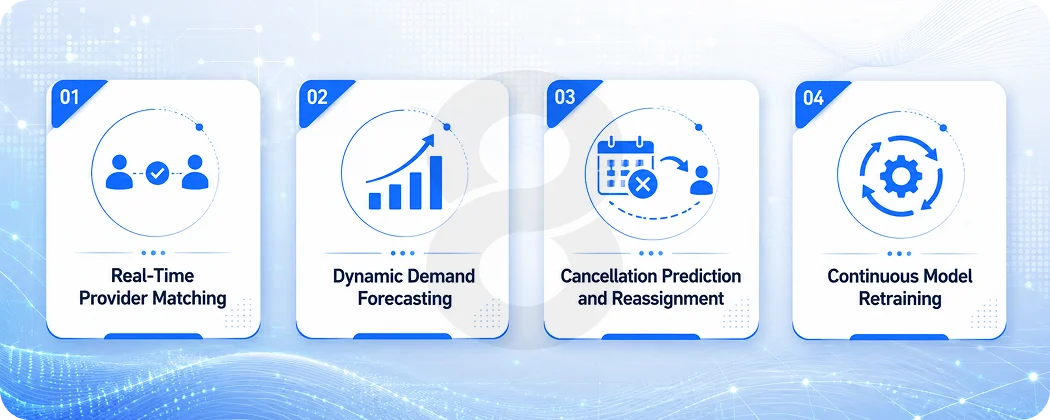
The speed and accuracy with which your app connects users to the right service provider is a direct determinant of satisfaction, retention, and lifetime value. Manual or rule-based dispatch systems simply cannot keep up at scale.
Real-Time Provider Matching
This is where intelligent automation solutions become a genuine competitive advantage. AI-driven matching engines simultaneously analyze proximity, provider rating, historical performance, service type, demand density, and real-time availability to surface the best possible match within milliseconds, not minutes.
Dynamic Demand Forecasting
Reactive dispatch is already too late. Advanced on-demand app development incorporates demand forecasting models that predict booking surges by location, time of day, and seasonal patterns, allowing the platform to pre-position available providers before demand peaks and prevent the dreaded “no providers available” failure state.
Cancellation Prediction and Reassignment
AI models trained on historical booking data can identify provider assignments at high risk of cancellation before the user even notices. When a risk threshold is crossed, the system proactively queues a backup match, dramatically reducing wait times and protecting the user experience from provider-side unreliability.
Continuous Model Retraining
A matching algorithm is only as good as its most recent training data. For businesses pursuing on-demand app development at scale, investing in pipelines that continuously retrain models on live behavioral signals ensures the system improves with every completed booking rather than degrading over time.
Read More: How Much Does It Cost to Build an On-Demand App in 2026?
6. Ratings, Reviews, and Trust Infrastructure
Marketplace trust is earned, not assumed. For any on-demand platform where users are inviting a stranger into their home, car, or workflow, social proof and accountability mechanisms are existential.
According to BrightLocal’s 2024 Consumer Review Survey, 75% of consumers regularly read online reviews before engaging a local service. That behavior translates directly into on-demand app usage. A transparent, two-sided rating system where both users and providers can rate each other creates accountability, surfaces quality providers, and helps the platform self-regulate over time.
Beyond star ratings, leading platforms add structured review prompts (asking about specific aspects of the service), photo upload capabilities, response functionality for providers, and automated flagging for suspicious or manipulated reviews. These layers of trust infrastructure are what allow a marketplace to scale without sacrificing quality.
Read More: How to Build a Successful Mobile Application Deployment Strategy
7. Advanced Scheduling and Booking Management
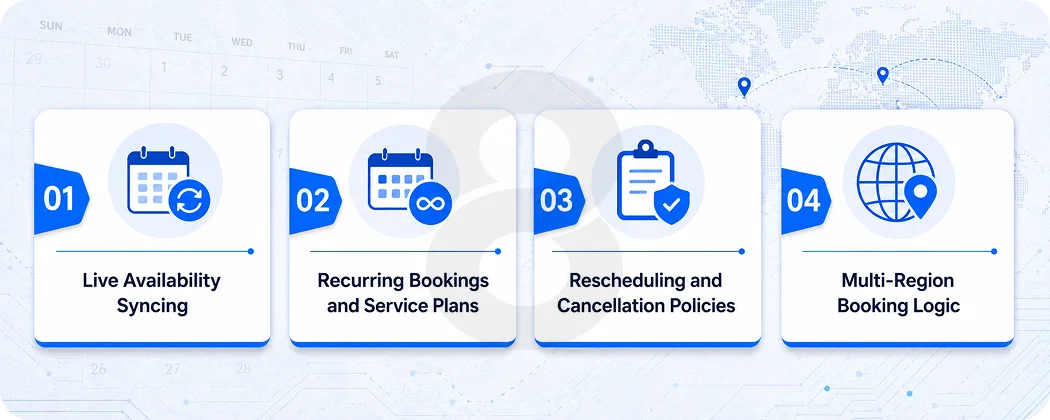
Not every on-demand interaction is truly instant. Many users want to book in advance, and a flexible scheduling engine that handles both real-time and future bookings is therefore a critical on-demand app feature for most verticals.
Live Availability Syncing
A seamless scheduling interface should reflect provider availability in real time, automatically updating open slots as bookings come in. Showing users accurate, live availability, rather than letting them select a time only to be told it is taken, eliminates frustration and reduces booking abandonment significantly.
Recurring Bookings and Service Plans
Power users want convenience. Offering recurring booking options, whether weekly cleanings, monthly maintenance, or daily deliveries, drives predictable revenue and deepens user commitment to your platform. Subscription-style scheduling also creates a natural moat that competitors with booking-by-booking models find difficult to overcome.
Rescheduling and Cancellation Policies
Life changes. A rigid cancellation policy drives users away permanently. Instead, configurable penalty tiers that account for lead time and booking history strike the right balance between protecting provider income and giving users the flexibility they expect from a modern on-demand app platform.
Multi-Region Booking Logic
For platforms operating across geographies, time-zone-aware scheduling is non-negotiable. Combining scheduling with dynamic pricing logic, such as premium rates for peak-hour or same-day bookings, also creates a powerful lever for demand management and incremental revenue optimization across all markets.
8. Scalable Multi-Role Architecture
An on-demand app is rarely a single-user-type product. Most platforms serve at least three distinct audiences simultaneously: end users (customers), service providers, and administrators. Each role requires a tailored interface, a different permission scope, and a unique set of tools.
Building a scalable multi-role architecture from day one, rather than bolting on admin dashboards or provider portals as an afterthought, is one of the most important decisions a team can make during custom software development. Role-based access control (RBAC), separate API scopes for each user type, and modular frontend architectures make it significantly easier to evolve the product without introducing security vulnerabilities or UX conflicts.
As platforms grow, this architecture also enables enterprise features: white-labeling for B2B clients, API access for third-party integrations, and sub-account management for franchise or multi-location operations.
Read More: What Does an App Development Agency Actually Do?
9. Offline Mode and Low-Connectivity Performance
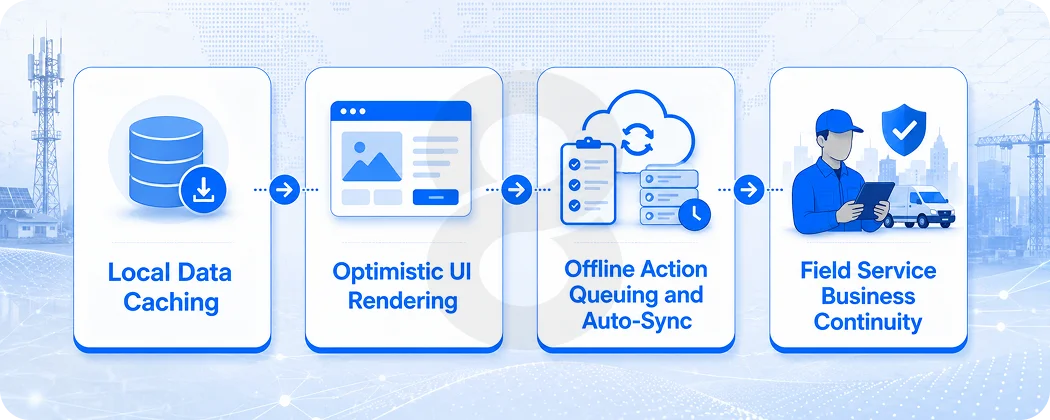
Your users are not always on WiFi. They are in subways, rural areas, and buildings with poor signal. An on-demand app that degrades completely when connectivity drops is a broken app in exactly the moments that matter most.
Local Data Caching
Progressive Web App techniques combined with local caching via IndexedDB or SQLite allow an on-demand mobile app to store critical data, recent bookings, provider profiles, and in-progress orders, directly on the device, keeping the core experience functional even when the network is entirely unavailable.
Optimistic UI Rendering
Waiting for a server response before updating the interface makes an app feel sluggish. Optimistic UI rendering updates the screen immediately based on the expected server outcome, then reconciles once connectivity returns. The result is a responsive, confidence-inspiring experience even under degraded network conditions.
Offline Action Queuing and Auto-Sync
Actions taken offline, confirming a delivery, submitting a service report, or updating a booking status, should never be lost. A robust queue system stores these actions locally and syncs them automatically to the backend the moment connectivity is restored, with conflict resolution logic to handle overlapping updates.
Field Service Business Continuity
For service providers in the field especially, offline functionality is not a convenience. It is a business continuity feature. A delivery driver who cannot confirm a drop-off due to poor signal should still complete their workflow without data loss, protecting both provider income and platform reliability metrics.
Read More: Why Every Fortune 500 Brand Partners with a Specialized App Development Firm
10. Analytics Dashboard and Business Intelligence Layer
Data is the product behind the product. Every interaction on your on-demand app platform generates signals: search behavior, booking patterns, cancellation triggers, peak demand windows, provider performance distributions.
Turning that raw data into actionable insight is what separates platforms that iterate intelligently from those that operate on gut feel.
A well-designed analytics layer provides:
- Real-time operational dashboards for monitoring live activity
- Cohort analysis to understand user retention across acquisition channels
- Provider performance scoring to identify top talent and at-risk churn
- Revenue attribution broken down by geography, category, and time
For growth-stage platforms, connecting this analytics infrastructure to A/B testing frameworks further accelerates iteration. Rather than debating which feature to prioritize, teams can validate hypotheses with live traffic and ship with confidence.
Read More: Why 80% of Apps Fail: A Founder’s Guide to Success
Choosing the Right Partner for Your On-Demand App
Building an app with all of the features above is not trivial. The technical debt, architecture decisions, and product nuances involved require a team that has done it before, successfully, at scale.
Partnering with an experienced on-demand app development company gives you access to pre-built infrastructure, battle-tested patterns, and domain expertise that would take years to develop in-house.
Whether you need a full product build or want to augment your existing team with specialized on-demand Android app development expertise, the right partner will accelerate your time to market, reduce your risk, and help you ship a product that actually converts.
Final Thoughts!
The bar for what users consider acceptable keeps rising. Real-time tracking, intelligent automation, frictionless payments, and trust infrastructure are no longer differentiators. They are table stakes.
The platforms that pull ahead in 2026 will be those that combine the right on-demand app features with sharp UX and solid engineering. Whether you are launching your first product or scaling an existing one, get the architecture right, invest in what your users actually need, and partner with a team that can deliver it.