


We’ve sat through enough discovery calls to know how this usually starts. Someone on the leadership team saw a branded AI persona on a competitor’s site or their kid showed them Character.AI and now there’s a Slack message that says “we need one of these.”
Then someone Googles the cost and finds numbers ranging from $5K to $1 million. That range is useless. It tells you nothing.
So here’s the honest version. Character AI chatbots, the kind with a defined personality, a name, a voice that matches your brand, cost more than a generic support widget and less than most agencies want you to believe.
The build takes weeks. And roughly half the budget goes into things you can’t see, like conversation design and guardrails, which is exactly why cheap builds fail in production.
This guide walks through what these bots actually are, what they cost at every tier, how long each phase takes, and where projects go sideways. Real numbers, sourced. No vague “it depends” hand waving without follow through.
What Are Character AI Chatbots for Business (And What They’re Not)
First, the name problem. Character.AI is a consumer app. Millions of people use it to roleplay with anime characters and fake celebrities, and that has nothing to do with your business.
But the name stuck, so now every second client walks into a call asking for ‘a Character AI chatbot’ when what they actually want is a custom conversational agent with a personality built for their brand. Worth clearing up early, because we’ve watched companies waste weeks talking to the wrong vendors about the wrong product.”
Under the hood, these are large language model applications. Most production builds now run on models like GPT or Claude, connected to your data through a RAG pipeline (retrieval augmented generation).
The character layer sits on top. It’s the system prompting, tone rules, and behavioral guardrails that make the bot feel like a consistent person instead of a generic autocomplete.
That character layer is the part people underestimate. Anyone can wire an API to a chat window in a weekend. Making the persona stay in character across ten thousand unpredictable conversations, without saying something off brand or flat out wrong, is where the actual work lives.
The market data says this isn’t a phase, either. Grand View Research puts chatbot spending at $11.8 billion this year and expects it to more than triple over the next decade, growing around 19.6% a year.
Most of that money still goes to customer service bots, though I’d watch the HR and internal knowledge tools. They’re the fastest growing slice, and nobody’s talking about them yet.
How Much Do Character AI Chatbots Cost in 2026?
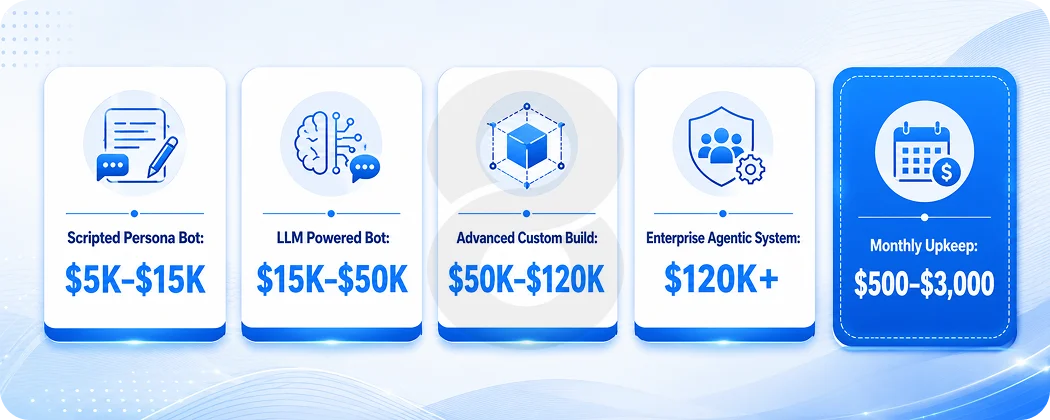
Here’s the part everyone scrolls to. The price depends on how much the bot has to do, not on how impressive the persona sounds in a demo.
| Tier | What You Get | Typical Cost | Ongoing Monthly |
|---|---|---|---|
| Scripted Persona Bot | Decision-tree logic with a branded voice, FAQ handling, and lead capture. | $5,000 – $15,000 | $100 – $500 |
| LLM-Powered Character Bot | Natural conversations, RAG knowledge base, plus one or two integrations (CRM, helpdesk). | $15,000 – $50,000 | $500 – $1,500 |
| Advanced Custom Build | Multi-channel deployment, deep integrations, memory, analytics, and compliance controls. | $50,000 – $120,000 | $1,500 – $3,000 |
| Enterprise / Agentic System | Multiple coordinated agents, workflow execution, custom fine-tuning, and enterprise-grade security. | $120,000 – $500,000+ | $3,000+ |
We didn’t pull these ranges out of the air. Most published cost guides land mid market builds somewhere between $15,000 and $35,000, and enterprise systems anywhere from $50,000 to well past $200,000 once integrations and compliance pile on.
What the guides won’t tell you is how to read a bad quote. $3,000 for a custom persona? That’s a template with your logo pasted on. $150,000 for an FAQ bot? That vendor saw your funding announcement.
A few cost drivers worth knowing before you get quotes:
Persona and conversation design
Generic bots skip this line item entirely, which is exactly why it catches buyers off guard. Before a single API gets wired up, somebody sits down and writes the character.
What it sounds like, how it handles a rude customer, what it says when it doesn’t know the answer, sample dialogues for the awkward moments. Cut this work and you get what half the branded bots out there already are, a support script wearing a costume.
Read More: AI Chatbot Cost & ROI: Budgeting for Custom Enterprise Solutions
Integrations
Connecting to Salesforce, Shopify, or a custom ERP adds API work and security review. Every system the bot touches adds cost. It also adds most of the value, so don’t cut it reflexively.
Compliance
Healthcare and finance builds need encryption, audit trails, and data handling that meets HIPAA or PCI standards. Expect this to add 20 to 35% to the budget. Painful, yes. Cheaper than a fine, also yes.
Read More: Healthcare Automation Solutions Explained: From Scheduling to Claims Processing
Model usage
Every message your bot sends runs through a model provider’s meter, and the meter never stops. Volume decides the bill. 500 conversations a month is pocket change, 50,000 is a real invoice, and success makes it worse because a bot that works gets used more. Six months after launch, this is the line item that has finance asking questions nobody prepared for.”
How Long Does It Take to Build a Custom Character AI Chatbot?
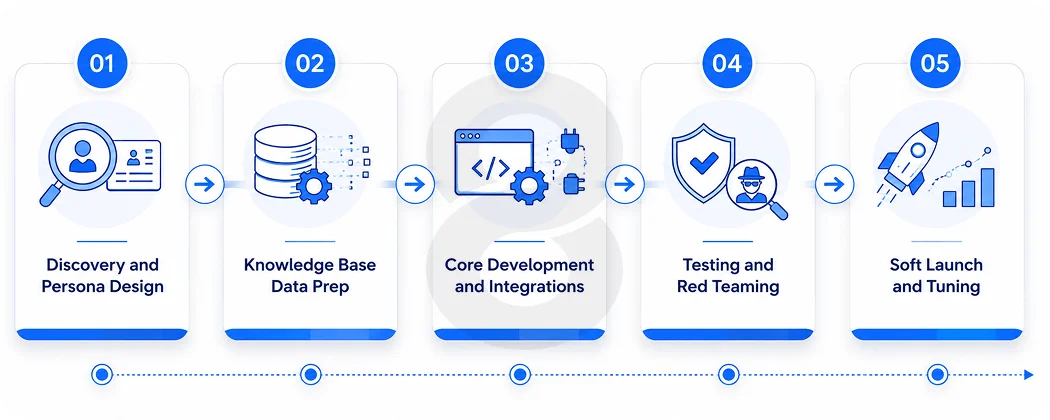
Vendors love saying “we can launch in two weeks.” Technically true if you count launching something. A character AI chatbot worth putting your brand name on follows a longer arc. Here’s what a typical mid market build looks like at a serious custom software development agency:
Weeks 1 to 2: Discovery and persona design
Defining the use case, mapping conversation flows, and writing the character spec. Who is this bot, what does it sound like, what will it never say. Boring on paper. Decides everything downstream.
Weeks 3 to 4: Data preparation
Cleaning and structuring your knowledge base for retrieval. Enterprise AI research consistently finds data prep consumes 40 to 60% of project effort, and chatbots are no exception. Your help docs are messier than you think.
Weeks 5 to 8: Core development
Building the RAG pipeline, wiring integrations, implementing the persona layer and guardrails, and setting up escalation to human agents.
Weeks 9 to 11: Testing and red teaming
Trying to break the character. Adversarial prompts, off topic tangents, attempts to make it promise refunds it can’t give. Every hour spent here saves a screenshot on social media later.
Weeks 12 to 14: Soft launch and tuning
Limited rollout, watching real conversations, tightening responses. Then full launch.
So call it 6 weeks for a lean scripted build, 10 to 14 weeks for a proper LLM powered character bot, and 4 to 6 months for enterprise systems. Anyone promising a custom persona bot in a week is skipping the testing phase, and you’ll find out where they skipped it in production.
The ROI of Character AI Chatbots: Where the Returns Come From
Nobody should build one of these because it’s trendy. The economics have to work, and increasingly they do.
The cost math is blunt. An AI chatbot interaction costs roughly $0.50 while a human handled ticket runs $6 to $40 depending on channel and complexity. McKinsey’s contact center research found AI agents cutting per call costs by around 50% while customer satisfaction scores went up, which almost never happens in cost cutting exercises.
Back in 2022, Gartner told everyone conversational AI would pull $80 billion out of contact center labor costs in the next four years. People rolled their eyes. Nobody’s rolling them now that the year on the calendar matches the year in the report.
If you want to know whether your bot earns any of that saving, ask one question, how many conversations does it finish alone? Get a good build and the answer is 70 to 90%. Buy a shallow FAQ bot and you’ll watch it stall out somewhere between 40 and 60%, handing the rest back to your agents.
Read More: The Decision Trace Protocol: Building Audit-Ready AI Agents for Regulated Industries
The character part specifically earns its keep in engagement. A bot with a consistent, likeable persona keeps people in the conversation longer and pulls better conversion, especially in ecommerce and consumer facing industries where chat engaged shoppers convert at several times the site average.
There’s an odd psychology at work here. When a bot with a name and a voice admits it needs to fetch a human, customers shrug and wait. When an anonymous chat widget does the exact same thing, they rate the experience a failure. Same handoff, completely different reaction, and the engagement data keeps confirming it.
So if you’re fielding a few dozen conversations a month, the math never works. Or, the risk isn’t worth it if you’re in a business where a wrong answer means a lawsuit.
Hidden Costs of Character AI Chatbot Development Nobody Puts in the Proposal
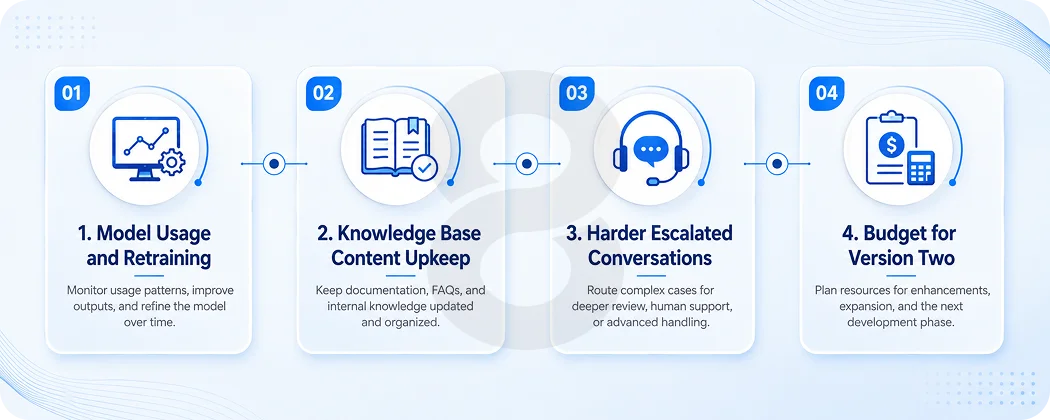
The proposal covers the build. Here’s what it usually doesn’t cover, learned the hard way by everyone who’s shipped one of these.
Ongoing model and retraining costs
A production chatbot needs monitoring, retraining as your products change, and prompt updates as models get deprecated. Budget $500 to $3,000 a month depending on scale. This is not optional maintenance you can defer. Models drift, docs go stale, and the bot starts confidently answering questions about products you discontinued in Q2.
Content upkeep
Your knowledge base is now a product dependency. Someone on your team has to own keeping it current. That’s headcount time, and it’s invisible until the bot starts lying.
Escalation staffing
The bot deflects volume but the conversations that do reach humans are harder on average, because the easy ones got contained. Your remaining agents handle a denser queue. Plan for it.
The second version
Almost every successful deployment expands. New channels, new languages, voice. Good news, the expensive foundations are already paid for. But budget for iteration, because launch is the start of the spend curve, not the end.
Read More: 10 Examples of Chatbots: Top AI Bots Transforming Businesses
Custom Character AI Chatbot vs Off the Shelf Platforms: Which Should You Choose?
Fair question, and the honest answer isn’t always “build.” Platform tools let you assemble a working bot in hours for $30 to $800 a month. For a small business handling basic FAQs, that’s the right call. Take the win and move on.
Custom makes sense when at least one of these is true: you need deep integration with your own systems, your persona and brand voice genuinely matter to the customer experience, you handle regulated data, or your conversation volume makes per resolution platform pricing more expensive than owning the system.
There’s also the ownership issue. On a subscription platform you’re licensing someone else’s technology, and you typically can’t buy out the bot or take the source code with you. Custom AI builds are yours.
The trap is the middle. Companies outgrow a platform, bolt customizations onto it for a year, and end up paying custom prices for rented software. If you can already see the integrations you’ll need in 18 months, price the custom build now and compare total cost, not month one cost.
Read More: Leveraging Model Context Protocol to Connect AI Agents Across Salesforce, Slack, and SAP
How 8ration Builds Character AI Chatbots
8ration makes AI powered products for startups and mid market companies across industries including healthcare, ecommerce, fintech, and logistics. On the conversational AI side, the team handles the full build.
Persona and conversation design, RAG pipelines on your knowledge base, integrations with your CRM and internal systems, guardrail testing, and post launch monitoring.
The services span AI development, mobile and web apps, and system integration, which matters for chatbot work more than it sounds.
Read More: AI System Integration: What to Look for in a Development Partner
A character bot is rarely a standalone project. It has to sit inside an existing product, talk to existing databases, and respect existing security rules. Teams that only do chatbots tend to hit walls there. Teams that build software for a living don’t.
Engagements start with a scoping phase that produces a fixed estimate before development begins, so the number you approve is the number you pay.