



Every board game you’ve ever played started the same way: someone had a half-formed idea and no clue what to do with it. Board game design is what happens next. It’s the craft of shaping that idea into something people can actually sit down and play and enough depth that the box comes off the shelf more than once.
The barrier to entry is lower than most people assume. Nobody’s first prototype looks professional and it shouldn’t. Some index cards, a borrowed set of dice, and a free weekend will carry you surprisingly far.
What separates finished games from abandoned ones isn’t budget or talent. It’s a process. That’s what this guide covers, step by step, whether you’re sketching a quick family card game, a three-hour strategy monster, or something hybrid with an app attached.
Why Board Game Design is Having Its Biggest Moment Yet
People have been pushing pieces around boards for something like five thousand years and somehow the hobby is in better shape now than it has ever been. Fortune Business Insights put the global board games market at around $16 billion in 2025 with a forecast of $39.34 billion by the next ten years. Roughly 42% of that money comes out of North America.
Technavio’s numbers point the same direction; its analysts expect the market to add another $5.67 billion between 2026 and 2030, with replayability, modular boards, and digital tie-ins doing most of the pulling. For a designer, those figures cut two ways.
First, there has never been more room for new titles, and crowdfunding has removed the old gatekeepers. Second, thousands of new games launch every year, so a “pretty good” design gets buried. The winners are games that nail one memorable mechanic and survive brutal playtesting.
There’s also a structural shift worth noting. A growing share of new titles blend physical play with digital layers, from scoring apps to full AR overlays. If your game concept has any digital ambition, teams that handle mobile game development end up involved earlier in the design process than most first-time designers expect.
Read More: How Much Does It Cost to Make a Mobile Game?
What Makes a Board Game Actually Fun? The Three Pillars
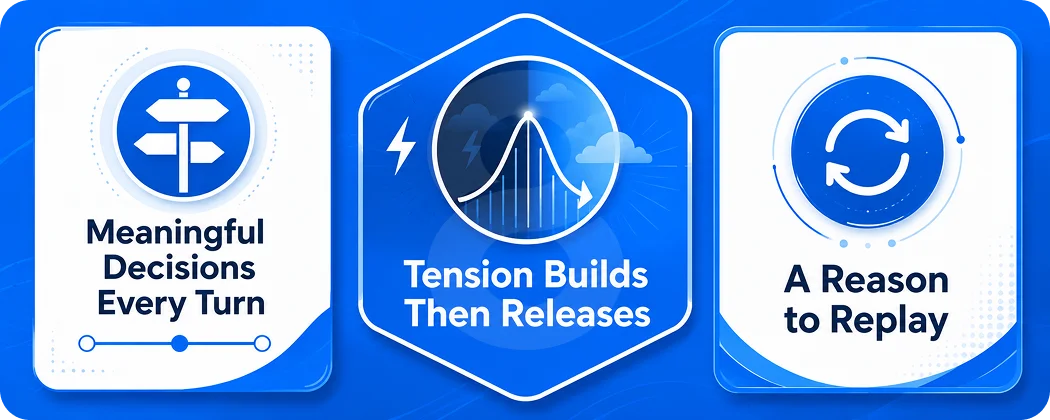
Before touching cardboard, understand what you’re really designing. Every successful board game balances three pillars.
Meaningful Decisions
The whole game lives inside the decisions you hand your players. When there’s always one obviously correct move, people aren’t playing, they’re solving, and once they’ve solved it they’re done with your game forever. Flip it the other way, where nothing a player chooses changes anything, and you’ve built an expensive coin flip.
What you want is the uncomfortable middle: turns where two options both look reasonable, both cost something, and the player genuinely isn’t sure. That little pause before someone commits to a move is the sound of a game working.
Tension and Release
Good games build pressure. A ticking timer, a shrinking resource pool, an opponent one move from winning. Then they release it in a satisfying payoff. Sketch your game’s arc on paper and mark where the pressure actually builds. If you stare at the sketch and can’t find a peak anywhere, that’s your answer and it’s back to square one.
A Reason to Play Again
Nobody keeps a game that only has one story to tell. Variability is what earns the second play and the tenth: boards that assemble differently each time, decks that never shuffle out the same way, player powers that force new strategies, goals that shift between sessions.
It doesn’t matter how brilliant the first playthrough felt. If session two is a rerun of session one, the box goes on the shelf and stays there.
How to Design a Board Game in 9 Steps
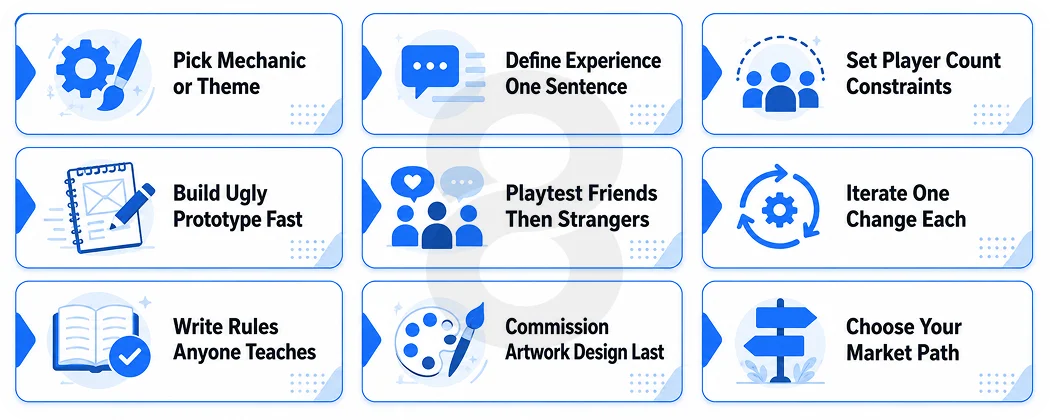
What follows is the whole road, starting from a scribble on a napkin and ending with something a factory could actually produce. Give yourself six months at minimum. Eighteen is more honest for anything with real ambition.
Step 1: Start With a Core Mechanic or a Theme
Some designers start with a mechanic (“what if players bid with cards they also need for scoring?”). Others start with a theme (“a game about restoring a coral reef”). Either door gets you into the same house.
The trap is standing in the doorway trying to walk through both at once; designers who insist on nailing mechanic and theme simultaneously tend to still be “refining the concept” a year later. Commit to one and let it drag the other along behind it.
Step 2: Define Your Player Experience in One Sentence
Before anything else, put the feeling into words. One sentence, written down, something like “the smug joy of bluffing your friends” or “four people quietly panicking against a timer.” From that point on, the sentence does your editing for you. A rule either feeds that feeling or it goes.
Step 3: Set Your Constraints Early
How many players? How long is a session? Who is it for, and how much rules weight can they carry? Answer those before you cut a single component. A half-hour family game and a three-hour brain-burner aren’t variations on each other.
They’re entirely different products with different price points, different buyers, and different manufacturing math, and changing your mind halfway through costs months.
Step 4: Build an Ugly Prototype Fast
Raid your closet. Index cards, poker chips, cubes borrowed from a game nobody plays anymore, labels written in marker. Twenty dollars and one weekend is the right budget, and anything more is procrastination in disguise.
The first version of every game ever made was wrong somewhere, including yours, so the whole point is finding out where as cheaply as possible.
Step 5: Playtest With Yourself, Then Friends, Then Strangers
There’s an order to this. Play against yourself first and you’ll catch the rules that flat-out break. Bring in friends next and watch where they hesitate, because hesitation means confusion. Then find strangers.
Friends will finish a boring game to spare your feelings. A stranger will check their phone by round three, and that reaction is worth more than a hundred kind reviews.
Step 6: Iterate Ruthlessly
Keep a log. After every session, write down what dragged, which rule needed explaining twice, whether the same strategy won again. Then fix one thing before the next test or you’ll never know which change actually helped.
Twenty versions is normal. Fifty isn’t unusual. Published designers will tell you the game that shipped barely resembles the one they started with.
Step 7: Write Rules Someone Else Can Teach
Hand the rulebook to a group and leave the room. If they can’t start playing within 15 minutes, rewrite. Rules writing is its own craft, and blind rulebook tests are non-negotiable.
Step 8: Commission Art and Graphic Design Last
Art applied to an unfinished design gets thrown away when mechanics change. Lock the gameplay first, then invest in illustration, iconography, and box design. Icon clarity matters more than illustration quality for how a game actually plays.
Step 9: Choose Your Path to Market
You can shop it to publishers, put it on Kickstarter yourself, or skip cardboard for now and launch digital. None of these is the “right” answer. They trade money, time, and creative control against each other in very different ways, and there’s a full breakdown further down this page.
Which Game Mechanics Should You Build Around?
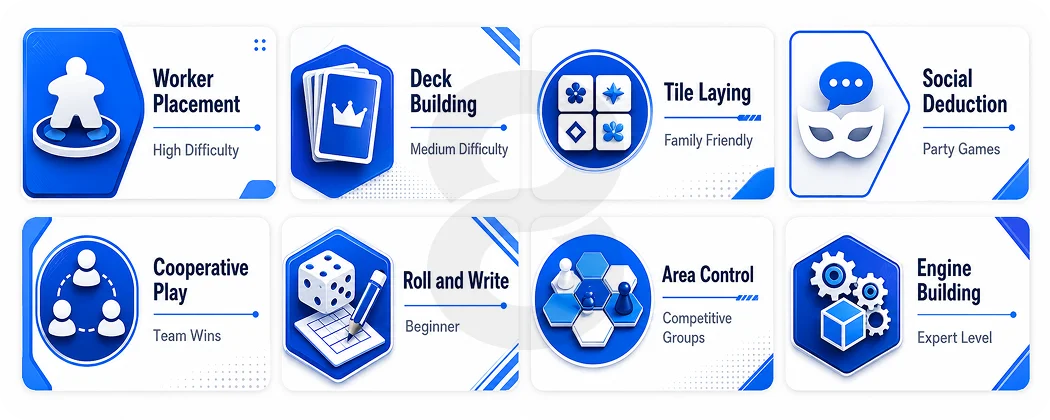
Mechanics are the verbs of your game: what players actually do each turn. Most successful games combine two or three mechanics, with one clearly dominant. Here’s how the most common ones compare.
| Mechanic | How It Works | Best For | Design Difficulty | Famous Example |
|---|---|---|---|---|
| Worker Placement | Players Assign Limited Pieces to Action Spaces | Strategy Fans & 60+ Minute Games | High | Agricola |
| Deck Building | Players Buy Cards to Improve a Personal Deck | Medium-weight Games with High Replayability | Medium | Dominion |
| Tile Laying | Players Place Tiles to Build a Shared Map | Families & Spatial Thinkers | Medium | Carcassonne |
| Social Deduction | Hidden Roles, Bluffing & Accusations | Parties & Large Groups | Low to Build, Hard to Balance | The Resistance |
| Cooperative Play | Players Win or Lose Together Against the Game | Families & Mixed Skill Levels | High (Game Must “Fight Back”) | Pandemic |
| Roll and Write | Dice Results Are Marked on Personal Sheets | Quick Games & Easy Production | Low | Qwixx |
| Area Control | Players Compete for Territory on a Map | Competitive Groups | High | Risk, El Grande |
| Engine Building | Early Choices Compound into Powerful Combos | Players Who Enjoy Optimization | Very High | Wingspan |
If it’s your first design, the honest advice is to aim small. Roll-and-writes and social deduction games cost almost nothing to prototype, and factories can produce them without exotic components, which is exactly why so many designers debut there.
Engine builders and worker placement games sit at the other end of the spectrum. They’re wonderful, and they will eat a year of your life in balance testing alone.
Read More: Game Programming Patterns: A Detailed Guide
The One Mistake That Kills Most First-Time Board Games
It’s not bad art but a weak mechanics. In fact. It’s designing in isolation.
First-time designers routinely spend a year polishing a game that only their household has ever played, then discover at their first public playtest that turn one confuses everyone and the dominant strategy was found in ten minutes. By then, they’re emotionally invested in rules that need to be torn out.
The fix is uncomfortable but simple: expose your game to outsiders early, when it’s still ugly and easy to change. Local game design meetups, unpub events, protospiel conventions, and online communities like Board Game Designers Forum exist exactly for this.
Designers who playtest publicly within their first month consistently ship better games than those who wait until “it’s ready.”
Watch for these three warning signs in any playtest:
- Players asking “wait, can I do that?” more than twice per game: Your rules have gaps.
- One player checked out while others are engaged: Your game has a runaway leader problem or too much downtime.
- Nobody asks to play again: The politest and most fatal signal of all.
Read More: Ideas for Game Development: How Businesses Can Enter the Gaming Market
Why Your Board Game Might Need an App (And When It Shouldn’t)
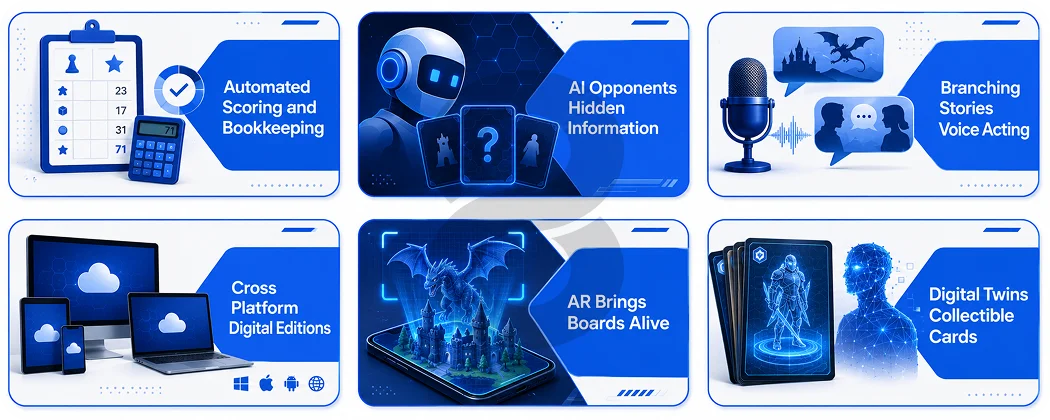
Fifteen years ago this section wouldn’t have existed. Today, games that pair a physical board with a digital layer sit comfortably in the mainstream rather than the novelty aisle. Mansions of Madness hands its soundtrack and storytelling duties to an app.
Plenty of modern legacy-style titles lean on one for hidden information and campaign saves. The stigma is gone. The question now is whether your particular game needs one.
A digital layer makes sense when it removes friction rather than adding it. Good reasons to add one:
- Complex bookkeeping: If your game needs a scoring spreadsheet, an app should do that math.
- Hidden information a human can’t manage: An app can play the “traitor” or run an AI opponent without anyone leaving the room, which is where AI game development techniques increasingly cross over into tabletop design.
- Narrative depth: A deck of cards can hold maybe a paragraph per card. An app can hold branching storylines, recorded voice work, and events that react to how the table is actually playing.
- Reaching players beyond the table: Build a proper cross-platform adaptation and your game stops being limited to whoever owns the box. This tabletop-to-screen conversion is bread-and-butter work for studios doing Unity game development, while Unreal game development tends to be the pick when the adaptation calls for 3D boards and a more cinematic look.
- Layering the physical and digital worlds: A few designers push past companion apps entirely and build an AR app around the game, so a phone camera turns flat printed tiles into scenes that move.
- Collectibility and ownership: A smaller but growing niche uses blockchain game development to give physical games digital twins, tradeable cards, or verifiable limited editions.
And the honest counterpoint: if your game works perfectly with cardboard alone, an app is a liability. It adds development cost, requires ongoing maintenance, and excludes players who came to the table specifically to escape screens. The test is simple. If removing the app makes the game worse, build it. If removing the app makes no difference, don’t.
How Much Does Board Game Design Cost?
The range is enormous because “board game design” can mean a weekend hobby or a commercial product launch. Here’s a realistic breakdown.
Prototype stage ($20 to $500)
This is the index-cards-and-borrowed-dice phase, plus maybe a handful of print-on-demand copies once you need blind testers who’ve never met you. The cost barely registers, which is deliberate. Park here as long as it takes, because every dollar spent past this point is a bet that the design already works.
Art and graphic design ($3,000 to $25,000+)
Cover art, board illustration, card art, iconography, rulebook layout. Costs scale with component count. Illustrating a 54-card game and illustrating a miniatures-stuffed strategy box are not the same invoice, or even the same order of magnitude.
Manufacturing ($15,000 to $50,000+ for a typical first print run)
Manufacturing ($15,000 to $50,000+ for a typical first print run). Factories don’t do small favors. Minimums usually start at 1K to 2K copies and while the per-unit price falls fast as quantities climb, so does your room to be wrong. Order 5K copies of a game with a broken rule and you own 5K paperweights.
Digital development (highly variable)
A simple scoring app sits at the low end. A full cross-platform digital adaptation with multiplayer, AI opponents, and live content is a proper software project with a budget to match. The spread is wide enough that guessing is pointless; scoping it properly against your actual feature list is the only honest way to get a number.
From Prototype to Publisher: Your Three Paths to Market
Once your design survives blind playtesting, you have three realistic routes.
Pitch to a Publisher
This is the arrangement where somebody else takes the financial risk. The publisher pays for art, manufacturing, and getting the game into stores; you collect a royalty, usually somewhere between 5 and 8% of wholesale, and keep your day job.
What you give up is control and speed, since a signed game can take two or three years to reach shelves. Getting signed is its own contest, too. Publishers wade through hundreds of pitches a year, which means your sell sheet has to earn its thirty seconds and your prototype has to play clean. Still, for a first game, this is the sane route.
Crowdfund It Yourself
Kickstarter and Gamefound turned self-publishing from a vanity project into a real career path and tabletop remains one of the categories those platforms are built on. The upside is obvious: the game stays yours, and so does the margin.
The downside arrives after the campaign ends, when you become a freight logistics company that also answers customer emails about dented boxes. Campaigns aren’t free to run either; between the video, the review copies, and the ads, expect 10 to 20% of what you raise to go straight back out.
And whatever you do, price your shipping before you set the funding goal. Plenty of funded campaigns have lost money on that mistake alone.
Go Digital-First
The newest path runs the whole thing in reverse. Ship the game as a mobile or PC title first and only commit to a print run once the audience exists. The advantages compound. A digital game can be patched when the balance is off; cardboard can’t.
A digital game quietly collects data from thousands of sessions while you sleep. And a digital launch costs a fraction of what a factory run does. It requires a development partner or serious technical skills, but it converts the riskiest part of board game publishing, the print run, into a decision backed by real numbers.
Read More: 30 Best Character Design Ideas for Your Next Gaming Venture
Where 8ration Fits Into Board Game Design
8ration is a custom software and game development company that works with tabletop designers and publishers at the point where board game design meets technology.
In practice, that covers a few specific jobs: building companion apps that handle scoring, timers, and narrative content; converting finished tabletop designs into full digital versions for mobile and PC using engines like Unity and Unreal; adding AI-driven opponents and solo modes so games remain playable outside a full table; and developing AR features that overlay animation and effects onto physical components.
The team also supports designers earlier in the pipeline with UI/UX work, since the visual logic of a board, its iconography, layout, and information hierarchy, follows the same usability principles as any digital interface.
For designers exploring the digital-first route described above, 8ration handles the development side while the designer retains full ownership of the game itself.
Its portfolio includes trivia and casual games alongside broader mobile and web products, which matters mainly because game projects fail on execution details like performance, onboarding, and cross-platform behavior rather than on the quality of the original idea.
Read More: How Long Does it Take to Make a Video Game
Final Thoughts
Board game design rewards discipline more than genius. The designers who ship games aren’t the ones with the wildest ideas; they’re the ones who prototype fast, playtest with strangers, kill their favorite rules when the data demands it, and pick the right path to market for their specific game.
Start with the ugly prototype this weekend. Everything else in this guide is waiting for you on the other side of that first playtest.
And if your game’s ambitions extend past the table, whether that’s a scoring app, a solo AI mode, or a full digital edition, build that layer with the same rigor you gave the cardboard. Players judge the whole experience, not the format.