




Artificial intelligence is no longer a layer of experimentation in contemporary products. It has become fundamental infrastructure. The cost of computing is one of the most important variables in the success of business as models become larger and inference workloads increase. Here, GPU unit economics come into the picture.
In the case of CTOs, performance is not the only issue. This is cost per token, cost per training run, and long-term infrastructure sustainability. Public GPU clouds are convenient but are becoming more costly and unpredictable on a large scale.
Consequently, a lot of organizations are reevaluating their architecture options and moving to the private environments operating with high-bandwidth memory (HBM). It is not only a technical change they are strategic. It represents a greater shift in the company’s approach to AI infrastructure, cost reduction, and competitive advantage in the long run.
What Is GPU Unit Economics and Why It Matters
In its broadest sense, GPU unit economics can be described as the cost-effectiveness of the usage of GPUs compared to the output produced. This involves measures like the following:
- Cost per training hour
- Cost per inference request
- Throughput per watt
- Memory bandwidth utilization
As AI workloads scale, small inefficiencies compound quickly. As an illustration, a model with millions of daily requests may be very expensive when the use of GPUs is not optimal.
Statista forecasts that the AI infrastructure will have more than $300 billion spent on it worldwide by 2026.
This fast growth implies that CTOs will have to pay special attention to not only capability but also cost-effectiveness. The transition between experimentation and production has rendered economic sustainability the most important agenda.
The Hidden Cost of Public GPU Clouds
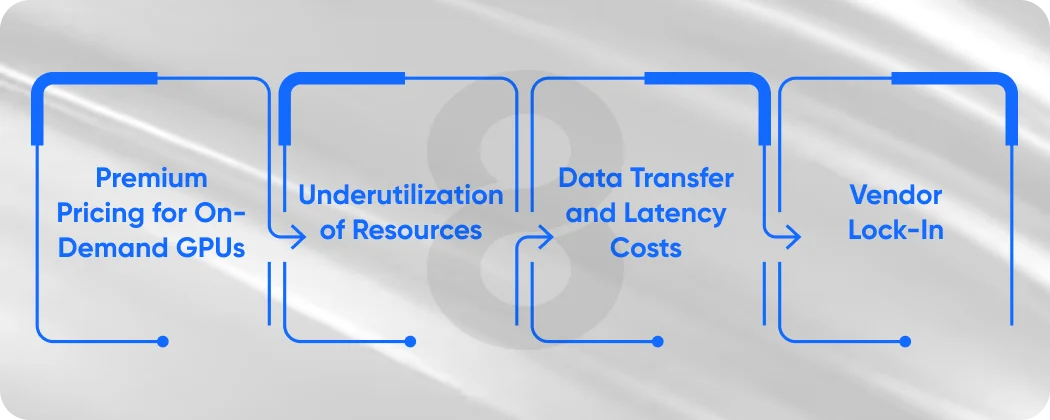
Public GPU clouds are flexible and can be implemented quickly, although costs and inefficiencies remain undisclosed, and this can play a critical role in the economics of the GPU units, compelling CTOs to rethink long-term infrastructure policies.
1. Premium Pricing for On-Demand GPUs
There are premium pricing models associated with cloud GPU instances, particularly those of the high-demand hardware such as A100s and H100s. The expenses may be high during high seasons, making the cost-effectiveness very low.
2. Underutilization of Resources
Most AI workloads do not end up utilizing the assigned capacity of the GPUs, but organizations still pay the full price of an instance. This creates inefficiencies, high costs, and low overall infrastructural utilization efficiency.
3. Data Transfer and Latency Costs
Moving big data across the storage and the compute tiers in the cloud systems creates latency and extra costs. Such miscellaneous expenses can be gathered within a short period and affect performance, responsiveness, and the overall efficiency of operations.
4. Vendor Lock-In
Migration is typically challenging due to the common dependencies created by cloud providers using proprietary services and settings. This constrains flexibility and optimization opportunities and makes long-term CTO infrastructure decisions about scaling AI systems hard.
Read More: AI FinOps 2026 – How to Predict and Manage the “Token Tax” in High-Scale Generative AI Applications
Understanding HBM and Its Role in AI Performance
High Bandwidth Memory, or HBM, is a special form of memory that is created to provide much higher data throughput than a normal memory system.
HBM is especially significant when doing AI workloads since
- Massive memory bandwidth is needed by large language models.
- Increased speed of access to data decreases bottlenecks.
- It allows parallel processing to be made efficient.
Indicatively, GPUs with HBM are capable of supporting larger batch sizes and shortening training time. This feature has direct effects on performance as well as cost efficiency.
In straightforward terms, HBM enables GPUs to be smarter and not harder.
Read More: Leveraging Model Context Protocol to Connect AI Agents Across Salesforce, Slack, and SAP
Why Private HBM Architectures Are Gaining Momentum
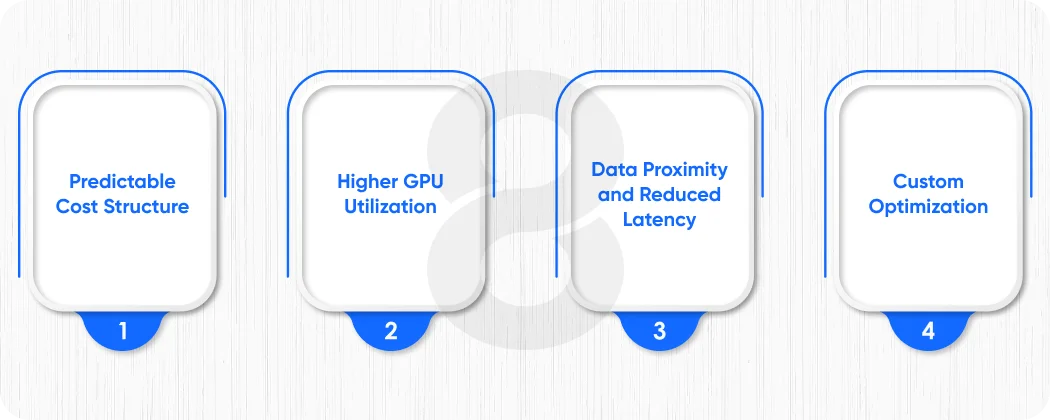
With increasing AI workloads, CTOs are considering moving to private HBM architecture to have enhanced cost control, performance, and long-term efficiency and scalability of infrastructure.
1. Predictable Cost Structure
Private HBM infrastructure substitutes the variable cloud pricing with certain, amortized expenses. This enables CTOs to make proper budgets, minimize financial risk, and match infrastructure costs to long-term business objectives.
2. Higher GPU Utilization
In the case of workloads, the organizations can adjust workloads in a private environment to optimize the usage of the GPUs. This reduces resource wastage and maximizes efficiency and greatly improving GPU unit economics during training and inference processes.
3. Data Proximity and Reduced Latency
Holding data nearer to the compute resources of a GPU means that constant data movements are not necessary. This reduces latency, reduces costs, and improves real-time processing of high-performance AI applications and systems.
4. Custom Optimization
Privacy settings allow workload-specific (hardware and software) optimizations. This facilitates software design that is performance-oriented, enabling organizations to attain greater efficiency, increased processing speed, and enhanced system reliability.
Read More: The ‘Decision Trace’ Protocol – Building Audit-Ready AI Agents for Regulated Industries
GPU Cloud Cost Optimization vs Private Infrastructure
The initial cost optimization strategies that many organizations pay attention to include the following:
- Reserved instances
- Spot pricing
- Workload scheduling
Although these techniques are effective, they are not usually transformational but incremental.
The private HBM architectures, however, provide the following:
- Long-term cost reduction
- Complete resource allocation control
- Greater conformity to AI workload requirements
This is the reason why firms that have outgrown pilot stages are investing more in personal arrangements.
Read More: How to Build a “Digital Workforce” of Specialized AI Agents for Supply Chain Automation
The Role of Custom AI Development Services in Infrastructure Decisions
Moving to private HBM designs is not a lift-and-shift operation. It involves experience in AI and infrastructure architecture.
It is at this point that bespoke AI development services become important. Such services assist organizations in:
- Optimize model pipelines through design
- Match workload with infrastructure
- Minimise training and inference inefficiencies
Through infrastructure strategy and AI expertise, companies will be able to open the doors to improved performance at a manageable cost.
Integrating Custom Software Solutions for Scalable Systems
There is no single operation of the private GPU infrastructure. It should be able to blend into the existing systems.
Custom software solutions are important in:
- Arranging workloads on GPUs
- Managing data pipelines
- Ensuring system reliability
This results in scalable cross-platform systems when properly done and able to sustain growing demand without cost growing exponentially.
Read More: Agentic SOC – Transitioning from Human-Led Detection to Autonomous AI Threat Response
Private HBM Architectures in Digital Transformation Strategy
One of the core layers of any current digital transformation strategy is now AI infrastructure. Companies that invest in effective computing systems reap great benefits.
The following architectures are made possible by private HBM architectures:
- Faster innovation cycles
- Lower operational costs
- Increased manageability of sensitive data
This causes them to be strategic and not simply a technical upgrade.
Read More: AGI vs AI – Which Technology Drives Better Business Automation?
Real-World Impact on Emerging Technology Solutions
Firms that develop emerging technology solutions that include the following:
- Generative AI platforms
- Autonomous systems
- Real-time analytics tools
They are especially sensitive to the costs of GPUs.
In these applications, a lack of scalability can be significantly improved by even a minor enhancement of efficiency in GPUs. This is the reason why infrastructure decisions are increasingly being linked closely with product strategy.
Read More: How to Hire AI Developers in USA
Performance Gains That Drive Business Value
Architectures of HBMs in the private environment are not only cost-cutting. They also enhance performance in quantifiable measures:
- Reduced time in model training
- Lower inference latency
- Improved throughput
These returns are directly converted to:
- Better user experience
- Shorter time to market
- Increased revenue potential
That is, optimization of the GPU unit economics extends beyond cost savings. It has something to do with unlocking expansion.
Read More: 10 AI Hallucination Examples and Their Root Causes
Key Considerations Before Moving to Private HBM
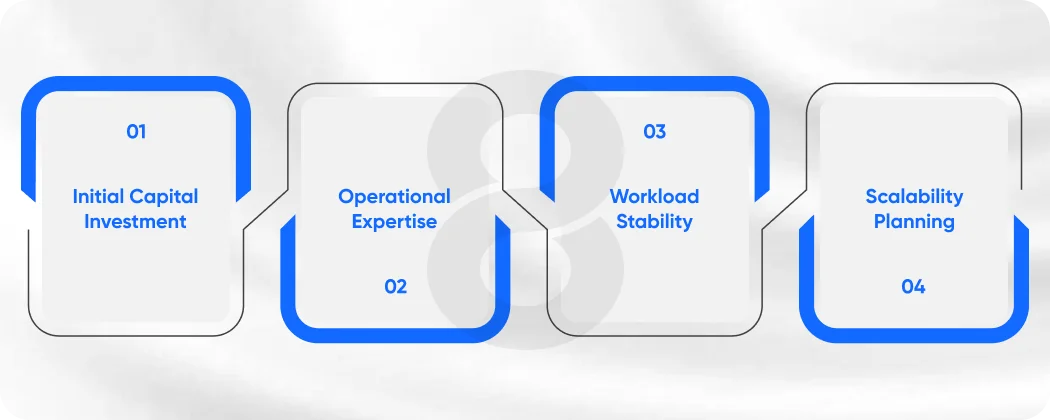
CTOs should take their time to consider cost, expertise, workload patterns, and scalability before moving to the private HBM architectures to guarantee optimal performance, efficiency and success in the long-run infrastructure.
1. Initial Capital Investment
Privatized infrastructure involves a large initial capital outlay of network equipment, hardware, and installation. Nevertheless, these expenses can be paid back by the savings in the long run, the better use of GPUs, and the predictability of performance results.
2. Operational Expertise
The operation of the personal clusters of graphics cards and HBM systems needs profound technical knowledge. Competent engineers will be needed to maximize the workloads and retain the performance and stability of the system in the complex AI-driven settings.
3. Workload Stability
Organizations that have a predictable and regular workload make the most out of private setups. The predictable demand is good in that it enables proper planning of resources, minimizes inefficiencies, and puts the capacity of the GPUs to good use without waste.
4. Scalability Planning
When implementing the use of private infrastructure, a clear scalability plan is needed. CTOs should make sure that systems are optimized to support future growth so that growth can be smoothly achieved without interfering with the performance, reliability and efficiency of the system.
The Future of GPU Infrastructure
The trend towards HBMs being privately designed is an extension of a larger movement in AI infrastructure:
- Convenience to control
- From experimentation to optimization
- Short-term benefits to long-term effectiveness
With the further development of AI, the companies that will be more successful in terms of efficient infrastructure will be clearly advantaged.
Statista reports that the count of data centers in the world is ever-increasing at a rapid rate, and this is facilitating the ever-growing demand for computing resources.
This increase underscores the need to make strategic infrastructure decisions nowadays.
Read More: 10 Open-Source Small Language Models for Your Next Project
Our Approach to Optimizing GPU Unit Economics

In our company, we assist organizations in gaining control of GPU unit economics by developing smart, cost-effective AI infrastructures that are driven by our own HBM architectures. We are concentrating on the development of high-performance systems that minimize compute waste, enhance the use of GPUs, and expand easily with the demand.
Our expertise in the custom AI development service allows CTOs to make wiser infrastructure choices, spend less on operations, and access quicker innovation. We are committed to providing usability solutions that are future-ready and are in tandem with long-term business expansion.
Final Thoughts!
The discussion of AI infrastructure is evolving. Access to GPUs is no longer a matter of concern. It concerns the efficiency of the use of those GPUs.
GPU unit economics has turned into a key indicator of contemporary organizations. It affects everything, all the way up to the cost structures and the scalability of products. With the limitations of public clouds becoming more evident, CTOs are considering more and more private HBM architectures as a way to gain more control, efficiency, and performance.
This change is not just a technical upgrade. It is a strategic action of sustainable AI development. The companies that adopt this strategy will not just save money but also set themselves up in the long run to succeed in a competitive environment that is growing progressively.