


You have a VR Game Idea. Perhaps it’s a shooter game played by more than one player, a puzzle game that is in immersive mode, or a training simulation. At some point, as you are planning, you stumble upon the same problem everyone stumbles upon when planning: how much is this going to cost?
The issue is that there is no number for VR game development cost. It’s a range. A wide one. You can invest $20,000 into a focused casual experience for Meta Quest, or you can lose $1 million on a not-completed AAA open-world VR experience. They are both actual results. Both happen regularly.
What factors influence the placement of your project in that continuum? This guide is how it breaks down. We’ll dive into each cost, each variable that shifts the number, what it actually costs to target each platform and genre and how to make strategic decisions before putting pen to paper.
How Much Does It Cost to Develop a VR Game?
The answer is it depends. The better answer: it could be as little as $15,000 or as much as $1 million, with most commercial VR game development projects between $50,000 and $200,000.
Average VR Game Development Cost
For a well done VR game with solid 3D environments, with basic interactions and interactions, the average VR game development cost in 2026 is about $50,000 to $100,000. That is the money for pre-production, design, programming, asset creation and QA. Under $30k, typically you are building a PoC or a limited scope demo. Once you move past $200,000, you’re into the world of multiplayer games, open worlds, and photorealistic graphics.
Another factor is global pricing. The rates at the North America or Western Europe development teams are usually $80-$150 an hour and experienced studios from Eastern Europe or South Asia can offer $30-$70 per hour with little degradation in most types of projects. This hourly difference can make or break 40% of your overall budget or more.
Cost by Project Size
| Complexity | Estimated Cost | Team Size | What It Includes |
|---|---|---|---|
| Small (Prototype/Casual) | $15,000–$50,000 | 3–6 people | Basic environments, simple mechanics, 1–2 levels |
| Medium (Mid-Core) | $50,000–$200,000 | 6–12 people | Multiple levels, custom assets, decent AI, single-platform |
| Large (Multiplayer/Open World) | $200,000–$500,000 | 12–20 people | Multiplayer backend, rich worlds, advanced AI, cross-platform |
| Enterprise (AAA) | $500,000–$1M+ | 20+ people | AAA visuals, live ops, multiple platforms, ongoing updates |
Read More: VR App Development: Costs, Features & Factors
VR Game Development Cost Breakdown
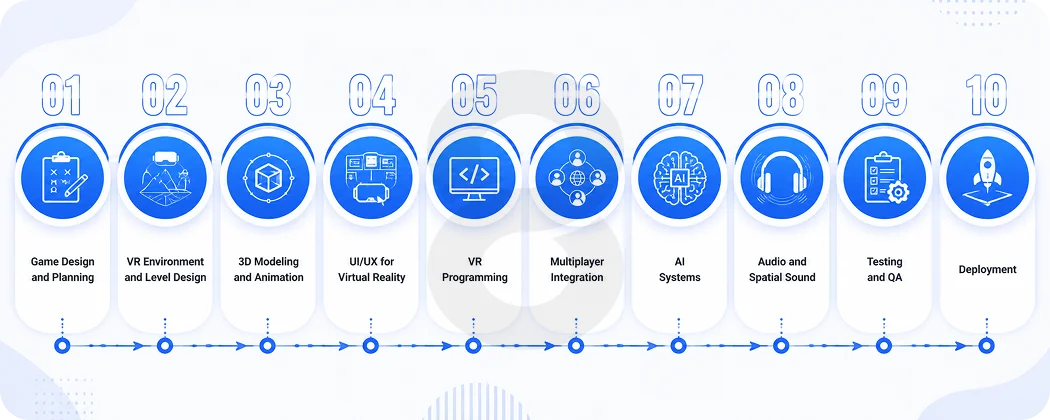
This is where most developers get caught off-guard. The line item budget seems affordable until you see where the money goes. Development costs are spread across multiple game development stages, each with its own cost factors.
Game Design and Planning
When it comes to saving money later, good planning is the key. This stage involves game mechanics design, story and narrative structure, Game Design Document (GDD), wireframes, and technical architecture. Allow 10-15% of the total project for this. One of the most frequently made and costly errors teams can make is skipping or rushing this stage.
VR Environment and Level Design
VR environments are not just 3D spaces! They are worlds that users can experience interactively, walking through. Player scale, interaction zones, comfort (avoiding motion sickness triggers) and spatial storytelling are to be considered by designers. An individual VR level designed from the ground up costs $5,000-$20,000, depending on the complexity of the visuals.
3D Modeling and Animation
This can be the biggest line item in a VR budget, accounting for 30-40 percent of the total cost. All objects, characters and environment elements must be modeled, rigged, textured and animated. VR is more challenging than regular games when it comes to character animation, because everything is closer to the player’s eyes. For a mid-range game, the price range for high quality 3D assets can easily be $20k to $60k.
UI/UX for Virtual Reality
Standard UI rules don’t apply in VR. Flat menus feel jarring and break immersion. Abdul Wahab, Senior UI/UX Designer at 8ration, puts it well: “VR UI design isn’t about putting a screen inside a headset. It’s about designing for a body in space; every interaction point has to feel physically natural, or the whole experience unravels.”
Diegetic interfaces (UI elements that exist inside the game world itself), gaze-based interactions, and hand-tracking UI all require specialized design thinking and add to cost.
VR Programming
For most VR budgets, 25–35% is dedicated to the core development, physics, player locomotion, interaction systems, and game logic. VR-specific programming issues such as maintaining the frame rate (to avoid motion sickness or more than 72fps), integrating spatial audio, and mapping controller inputs are more complicated than game development.
Multiplayer Integration
Implementing multiplayer in a VR game isn’t just twice the expense; it can be three or four times the subsystems. You have to deal with the server side, real-time synchronisation, latency, voice chat and anti-cheat. Multiplayer alone can add $30,000–$100,000 to a project.
Read More: How to Make a Multiplayer Game: A Complete Guide (2026)
AI Systems
Spatial AI is a must-have in VR for NPCs and enemy behaviors, which have to be aware of where the player is physically in the 3D environment, not just on a screen. In a VR environment, there are also significant levels of pathfinding, reaction systems, and adaptive difficulty. Basic AI game systems typically cost $5,000–$15,000, while advanced adaptive AI can cost $30,000 or more.
Audio and Spatial Sound
VR is real because of spatial audio. Sounds should originate from the right location in 3D space and should sound right when the player is moving. This takes special audio engineering apart from the typical game sound design. Budget $5,000–$20,000 for audio on a mid-range project.
Read More: 2D vs 3D Animation Pricing: Full Breakdown for Game Studios
Testing and QA
VR QA is physically challenging and time consuming. Testers should go through all scenarios with a headset on, looking for any potential motion sickness issues, interaction glitches, performance degradation and platform-specific issues. Plan to spend 10–15% of the total development budget on QA.
Deployment
Platform fees at the end line, certification requirements and store optimization are additional costs. Each platform (Steam, Meta, PlayStation, and Apple Vision Pro) has their own submission process and technical certification requirements.
| Development Stage | % of Budget |
|---|---|
| Planning & Design | 10–15% |
| 3D Art & Animation | 30–40% |
| Core Development | 25–35% |
| Audio | 5–8% |
| QA & Testing | 10–15% |
| Deployment & Launch | 3–5% |
Key Factors That Affect VR Game Development Cost
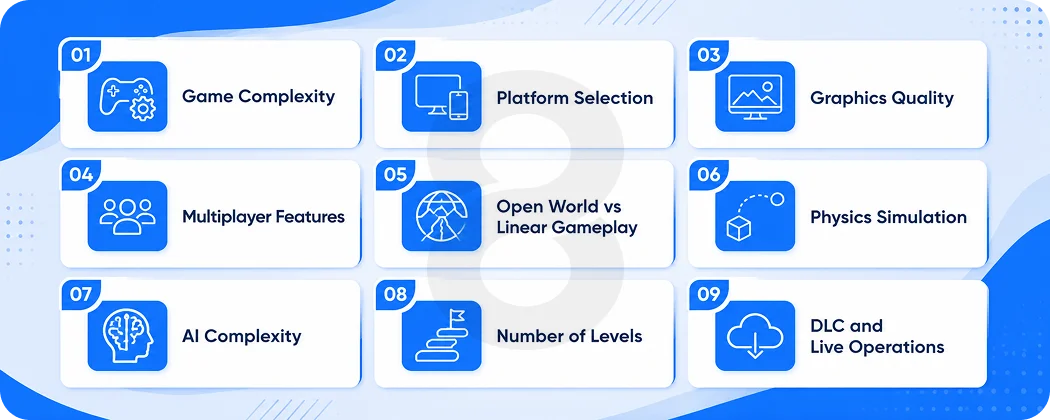
Two VR games can look similar on paper and cost wildly different amounts. Here’s why.
Game Complexity
The more interactive systems, game mechanics, story branches, and hours of content – the more expensive. A linear VR experience with fixed interactions to run for 30 minutes is a lot less expensive than a free running open-ended VR sandbox type experience.
Platform Selection
Each VR platform has its own technical requirements, performance constraints, and SDK. Building for multiple platforms multiplies both development and QA time significantly.
| Platform | Development Cost Range | Notes |
|---|---|---|
| Meta Quest (Standalone) | $20,000–$100,000 | Largest VR user base; performance constraints require optimization |
| SteamVR (PC VR) | $25,000–$150,000 | More powerful hardware; broader graphics scope |
| HTC Vive | $25,000–$120,000 | Premium PC VR; enterprise and enthusiast audience |
| Pico | $20,000–$80,000 | Growing market in Asia; similar workflow to Meta Quest |
| PlayStation VR2 | $40,000–$200,000 | Console certification adds cost; strong gaming audience |
| Apple Vision Pro | $60,000–$250,000+ | Most expensive platform; entirely new interaction paradigms |
Graphics Quality
Your game’s appearance has a huge impact on budget. Stylized, cartoon-like images are much cheaper than photorealistic images. With dynamic lighting and realistic materials, high polygon characters can push art costs alone over $100,000 to attain AAA quality.
| Graphics Tier | Additional Cost vs. Baseline |
|---|---|
| Stylized / Cartoon | Baseline |
| Semi-Realistic | +30–50% |
| Photorealistic | +80–150% |
| AAA Cinematic | +200%+ |
Multiplayer Features
Real-time multiplayer is the single biggest cost amplifier in VR development. Server infrastructure, synchronization logic, latency management, and ongoing hosting costs all stack up fast.
Open World vs Linear Gameplay
Open-world VR games require massive environment libraries, dynamic AI, complex navigation systems, and significantly more content creation time than linear experiences.
Physics Simulation
Advanced physics, destruction, soft-body dynamics, and fluid simulation add meaningful development complexity. Many VR games use simplified physics to keep performance stable.
Read More: Simulation Game Development: From Concept to Launch
AI Complexity
Basic enemy AI is manageable. Adaptive AI that learns from player behavior, or complex NPC social systems, can become major budget items in their own right.
Number of Levels
More levels mean more environment art, more testing, and more QA time. It’s a straightforward multiplier on both art and development budget.
DLC and Live Operations
If you plan to launch with live content updates, seasonal events, or DLC, you need to architect those systems from the start. Adding them post-launch is significantly more expensive.
| Feature | Cost Impact |
|---|---|
| Multiplayer | Very High |
| AI NPCs | Medium–High |
| Open World | Very High |
| Voice Chat | Medium |
| Cross-platform | High |
| Physics Simulation | Medium |
| Live Ops / DLC | High |
VR Game Development Cost by Game Genre
Genre is one of the most reliable predictors of VR development cost. Here’s how different types of VR games typically land:
| Genre | Estimated Cost Range | Why |
|---|---|---|
| Puzzle | $20,000–$60,000 | Limited environments, minimal AI, focused mechanics |
| Casual / Social | $30,000–$80,000 | Avatar systems, basic multiplayer, simple assets |
| Horror | $40,000–$120,000 | Atmospheric audio, AI behavior, environmental storytelling |
| Fitness | $30,000–$80,000 | Motion tracking precision, content depth, ongoing updates |
| Educational | $25,000–$100,000 | Content breadth, accessibility features, enterprise QA |
| Simulation | $80,000–$300,000 | Physics accuracy, detailed environments, realistic AI |
| Shooter | $80,000–$250,000 | Multiplayer, weapon systems, AI combat, large environments |
| Racing | $60,000–$200,000 | Vehicle physics, track environments, multiplayer |
| RPG | $150,000–$500,000 | Character progression, story depth, world-building, NPC systems |
| Social VR | $100,000–$400,000 | Avatar customization, persistent worlds, content moderation |
| MMORPG | $500,000–$2M+ | Persistent world, economy systems, live ops, massive scale |
The biggest cost differences come from content volume and systems complexity. A puzzle game is bounded by design. An MMORPG is theoretically infinite.
Read More: How to Build an RPG: Solo Indie Project vs. Full Studio Team
VR Game Development Cost by Platform
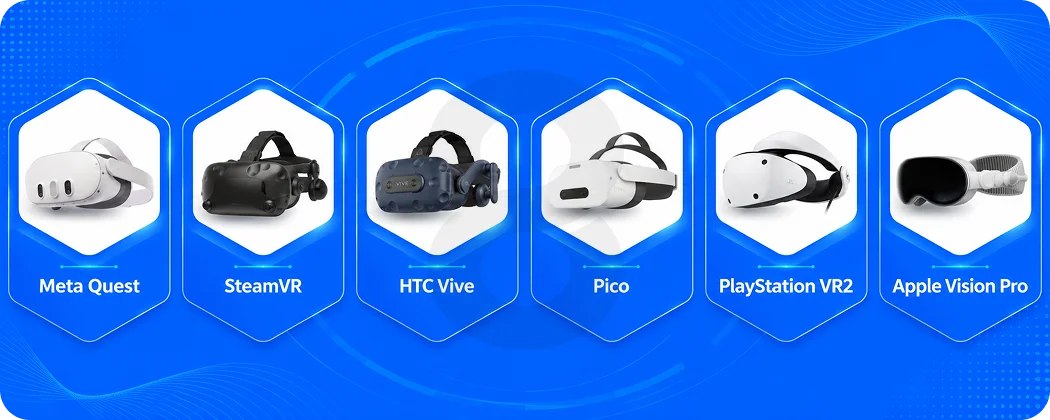
Meta Quest
Meta Quest (2, 3, and Pro) is the most popular standalone VR headset. It’s mobile, which means the developers have to work hard to optimize. This equals QA and optimization time and the platform has the biggest potential VR customer base. A polished Meta Quest game will cost $25k to $150k to develop.
SteamVR
SteamVR is geared towards PC-powered headsets such as the Valve Index, HTC Vive and others. Higher fidelity visuals are possible with the more powerful hardware, although the audience is smaller, and less optimization is needed. You should expect to spend $30,000 to $200,000 on a competitive SteamVR release.
HTC Vive
HTC Vive is well established in the high-end segment of the VR market and has seen significant penetration in enterprise and professional markets. Development costs are akin to SteamVR and typically range from $25,000 to $150,000; enterprise simulation projects can be higher.
Pico
Pico’s standalone headsets have grown significantly in Asia-Pacific markets. The development workflow is similar to Meta Quest, and costs are comparable: $20,000–$100,000 for most consumer titles.
PlayStation VR2
PlayStation VR2 introduces eye tracking, adaptive triggers, and haptic feedback that can be incorporated into gameplay. The console certification process adds 2–4 weeks and $5,000–$15,000 in testing costs. Total budgets for PSVR2 titles run $50,000–$250,000.
Apple Vision Pro
Apple Vision Pro is the most expensive VR/spatial computing platform to develop for. It uses entirely different interaction paradigms (eye tracking, hand tracking, and voice) and requires visionOS-specific development. Expect $80,000–$300,000+ for a polished Vision Pro experience.
Build an In-House Team vs Outsource VR Game Development
Choosing between building an internal team and outsourcing is one of the decisions that most directly affects both your total budget and your delivery timeline. Neither is universally right. It depends on your organization’s long-term plans.
Building in-house gives you direct control, accumulated institutional knowledge, and the ability to iterate quickly over time. But the upfront cost is steep. Hiring a VR developer in North America costs $90,000–$150,000 per year in salary alone, before benefits, equipment, licenses, and management overhead. Recruiting a full team takes 3–6 months on average.
Outsourcing to an experienced VR development studio costs less upfront, gives you immediate access to specialists, and reduces the risk of misallocated hiring. The tradeoff is less direct control and more structured communication requirements.
| Factor | In-House Team | Outsourcing |
|---|---|---|
| Initial Cost | High | Lower |
| Hiring Time | 3–6 months | 2–4 weeks |
| Development Speed | Moderate | Faster (established workflows) |
| Scalability | Limited | High |
| Expertise Access | Depends on hiring | Immediate |
| Management | Direct | Shared / coordinated |
| Long-Term Cost | Higher | Flexible |
| Best For | Large studios with ongoing VR pipelines | Startups, single titles, first VR projects |
For most first-time VR projects or companies entering VR without an existing games team, outsourcing to a studio with proven VR experience delivers better ROI at lower risk.
Unity vs Unreal Engine Development Cost
Your engine choice affects both budget and final output. The two dominant options are Unity and Unreal Engine, and the right choice depends on what you’re building.
Unity is more widely used across indie and mid-tier VR development. It has a larger asset marketplace, a lower learning curve, and strong cross-platform VR support. Developer hourly rates for Unity tend to be slightly lower because the talent pool is larger.
Unreal Engine delivers superior visual fidelity, particularly for photorealistic environments. It’s the engine behind most AAA VR experiences. Developer rates are often 10–20% higher than Unity specialists, but the output quality for high-fidelity projects is typically better. 8ration’s Unreal game development team uses Unreal specifically for cinematic-quality VR and AAA projects.
| Factor | Unity | Unreal Engine |
|---|---|---|
| Development Cost | Lower | Moderate–Higher |
| Graphics Quality | Good (stylized–realistic) | Exceptional (photorealistic) |
| Performance on Standalone VR | Better | Requires more optimization |
| Developer Availability | Very High | High |
| Asset Marketplace | Extensive | Good |
| Best For | Casual–mid-range, cross-platform | High-fidelity, AAA, cinematic VR |
| Licensing | Free up to revenue threshold | Free + 5% royalty over $1M revenue |
Read More: What Are AAA Games? Breaking Down the Biggest Titles in Gaming
Hidden Costs of VR Game Development
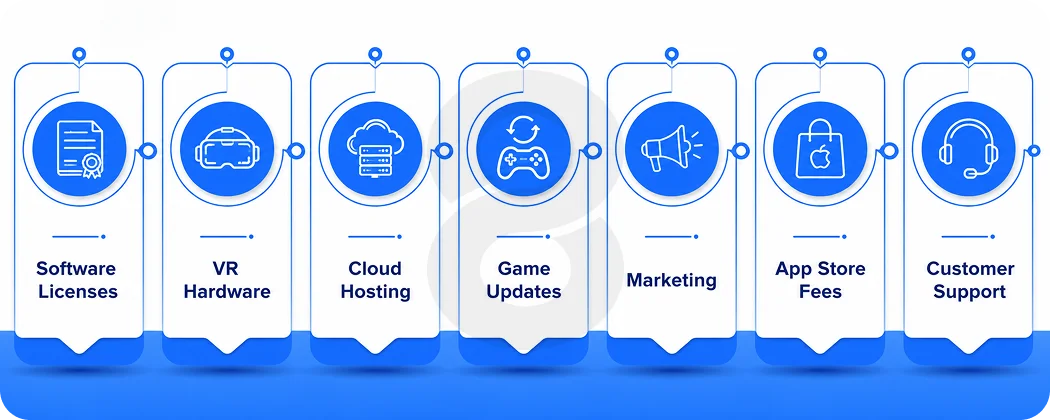
The line-item development budget is rarely the final number. These costs catch studios off-guard:
Software Licenses
Unity Pro, Unreal, Substance Painter, Maya, ZBrush, and other tools carry license fees ranging from $500 to $10,000+ annually per seat.
VR Hardware
Your team needs headsets to test on. A proper testing setup covering Meta Quest, PSVR2, and a PC VR headset can run $3,000–$8,000.
Cloud Hosting
Multiplayer games require dedicated servers or cloud infrastructure. Ongoing hosting for a multiplayer VR game runs $500–$5,000 per month depending on player count.
Game Updates
Post-launch patches, performance updates, and content additions are ongoing costs. Budget 15–20% of initial development cost per year for maintenance.
Marketing
VR is a crowded space. A basic launch marketing campaign (trailer, store page assets, PR outreach) costs $5,000–$30,000. Paid acquisition campaigns add significantly more.
App Store Fees
Steam takes 30% of revenue. Meta Quest Store takes 30%. PlayStation takes 30%. Apple takes 30% from the Vision Pro App Store. These aren’t development costs but they’re significant revenue considerations.
Customer Support
Players file bug reports, encounter issues, and need help. If you don’t plan for support infrastructure, you’ll improvise at the worst possible time.
| Hidden Cost Category | Estimated Range |
|---|---|
| Software Licenses | $2,000–$15,000/year |
| VR Hardware for Testing | $3,000–$8,000 |
| Cloud Hosting (Multiplayer) | $6,000–$60,000/year |
| Annual Maintenance | 15–20% of dev budget |
| Marketing (Launch) | $5,000–$50,000 |
| App Store Fees | 30% of revenue |
Read More: How Much Does It Cost to Make a Mobile Game?
How Long Does It Take to Build a VR Game?
Timeline depends on scope, team size, and how clearly defined the project is at the start. Projects with a detailed GDD and experienced teams move significantly faster than those figuring things out mid-development.
The following table breaks down the VR game development timeline into key development stages and their estimated durations.
| Development Stage | Duration |
|---|---|
| Pre-production & Planning | 2–6 weeks |
| Prototype / Proof of Concept | 4–8 weeks |
| Core Development | 3–12 months |
| Art & Asset Production | Parallel to development |
| QA & Testing | 4–8 weeks |
| Certification & Submission | 2–4 weeks |
| Post-Launch Stabilization | 4–8 weeks |
The following table provides the estimated total development timeline for different types of VR games.
| VR Game Type | Total Timeline |
|---|---|
| Simple Prototype | 1–2 months |
| Casual VR Game | 2–4 months |
| Mid-Range VR Game | 4–8 months |
| Multiplayer VR Game | 6–10 months |
| AAA VR Game | 12–24 months |
The most common timeline killer isn’t technical difficulty. It’s scope creep: the tendency to keep adding features after development has started without adjusting the budget or timeline.
Read More: How Long Does it Take to Make a Video Game
How to Reduce VR Game Development Costs Without Sacrificing Quality
There’s a real difference between cutting costs and cutting corners. Here’s how to do the former without the latter.
Start with an MVP
Build the smallest version of your game that proves the core mechanic works and is fun. An MVP VR experience can be built for $20,000–$50,000 and gives you real user feedback before you spend $200,000 on features players may not want.
Use Cross-Platform Development
Building on a cross-platform engine like Unity and targeting multiple VR platforms from a shared codebase dramatically reduces per-platform cost compared to building separate versions.
Reuse Existing Assets
The Unity Asset Store and Unreal Marketplace offer thousands of high-quality 3D assets, animations, and audio files. Strategic asset reuse can cut art budget by 20–30% without visible quality loss.
Choose the Right Engine
Don’t use Unreal Engine for a stylized casual puzzle game. Don’t use Unity for a cinematic AAA VR experience. Matching the engine to the project scope prevents overbuilding.
Read More: Casual Game Development: A Complete Guide for Business Owners
Outsource to Experienced Teams
A studio that’s built 10 VR games will avoid the mistakes your first in-house team won’t. Experienced VR studios also have reusable code libraries, established pipelines, and optimized workflows that reduce hours on every project.
Prioritize Core Gameplay
The mechanics need to work before the world needs to look beautiful. Spending $40,000 on environment art for a game with broken locomotion is money spent in the wrong order.
Plan for Scalability Early
Building multiplayer, live ops, or cross-platform support retroactively costs 2–3x what building it properly from the start would have. Architect for where the game is going, not just where it starts.
Is Investing in VR Game Development Worth It?
The market numbers make a strong case. The VR gaming market was valued at $41.18 billion in 2026 and is projected to reach $88.74 billion by 2031, growing at a CAGR of 16.6%. Grand View Research projects the broader VR gaming market will reach $109.6 billion by 2030 at a CAGR of 21.6%.
This isn’t growth driven by hype. It’s being driven by hardware finally catching up with the promise. Standalone headsets like Meta Quest 3 brought VR to a mainstream audience without requiring a $2,000 PC setup. Apple Vision Pro opened spatial computing to enterprise and creative markets. In 2025, over 8,000 VR-compatible gaming titles were available across major platforms, and consumer expectations have risen accordingly.
From a monetization standpoint, VR offers multiple revenue models: premium one-time purchase, freemium with in-app purchases, enterprise licensing, subscription, and location-based entertainment. Studios that launched strong titles in the mid-2020s have seen healthy returns, particularly in genres where VR adds genuine value (fitness, horror, simulation, social).
| ROI Factor | VR Consideration |
|---|---|
| Market Growth | 16–21% CAGR through 2030 |
| Audience Size | 171M VR users worldwide (2026) |
| Platform Distribution | Steam, Meta, PlayStation, Apple Vision Pro |
| Monetization Models | Premium, IAP, subscription, enterprise licensing |
| Early Mover Advantage | Most VR genres still have headroom |
| Enterprise Demand | Training, simulation, and visualization use cases growing fast |
The short version: yes, investing in VR game development makes sense in 2026, especially if you’re entering a genre where VR provides a differentiated experience. The caveat is the same as any software investment, execution matters more than the market.
Read More: Hire VR Developers: Complete Guide to Hiring Skilled Virtual Reality Developers
Why Choose 8ration for VR Game Development?
8ration is a full-service software and game development company with over a decade of experience building mobile, web, AI, and immersive technology products. On the VR and gaming side specifically, the team covers everything from concept and GDD through to post-launch support.
The company’s VR and game development capabilities span Unity and Unreal Engine development, AR/VR experience design, multiplayer infrastructure, 3D modeling and animation, and cross-platform deployment. 8ration has built VR experiences for enterprise training, gaming studios, and product visualization clients, working across Meta Quest, SteamVR, HTC Vive, PlayStation VR2, and Apple Vision Pro.
A few things that set the team apart in practice. The Unreal game development team specifically handles AAA-grade and cinematic VR work, while the broader game development team covers Unity-based cross-platform titles, Web3 game development, and metaverse development services for clients who need persistent virtual worlds built on blockchain infrastructure. The fact that the team spans AI, blockchain, and traditional development under one roof matters for VR projects that need those systems integrated rather than bolted on.
For studios or companies that don’t have an in-house VR team but need experienced hands quickly, 8ration’s model of working as a development partner rather than a vendor keeps projects moving without the 3–6 month hiring delays that building internal teams requires.
Read More: Virtual Reality vs Augmented Reality: Choosing the Right Tech for Your MVP
Final Thoughts!
VR game development cost is ultimately a function of choices: platform, complexity, team structure, graphics fidelity, and feature scope. A casual Meta Quest puzzle game and a cross-platform AAA VR shooter both require skilled teams, but the scale, risk, and investment are entirely different.
The clearest advice for anyone planning a VR game in 2026: start with an MVP, define your core mechanic before you spend money on visuals, and work with a team that has shipped VR products before. The market is real, the demand is there, and the technology is finally mature enough to deliver on what VR promised a decade ago. But none of that matters if the development plan is poorly scoped or the budget runs out before launch.
If you’re figuring out where your project fits on the cost spectrum, the best next step is a scoping conversation with an experienced VR development team.